


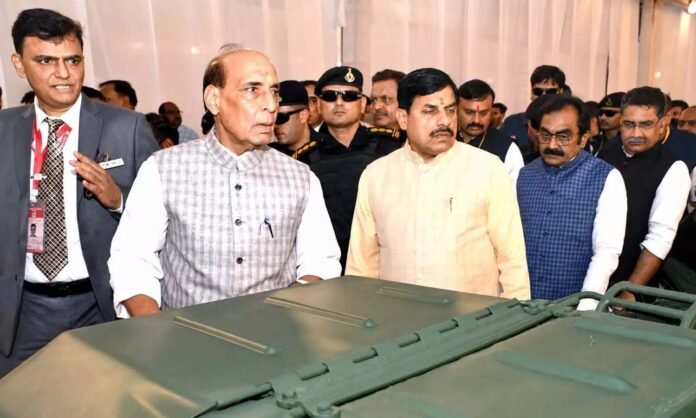
Jabalpur. Speaking at the foundation stone ceremony for a ₹ 472-crore T-series tank overhaul facility in Jabalpur, Madhya Pradesh, the defence minister addressed ongoing global debates regarding the future of armoured ground warfare. He noted that while modern conflict has evolved rapidly with the integration of unmanned aerial systems, precision missiles, artificial intelligence and electronic warfare, tanks continue to be indispensable to ground defence operations.
Singh emphasised that the true strength of armoured units lies in their unmatched mobility and heavy firepower, acting as a formidable deterrent against aggressive actions along sensitive border areas while boosting the confidence of frontline infantry troops.

Rebuffing arguments that armour has become obsolete in an era dominated by cheap attack drones, Singh clarified that modern military doctrine does not pit one individual platform against another. Instead, winning future wars requires an integrated combat ecosystem where tanks, artillery, air defence missiles and loitering munitions operate in seamless coordination.
Rather than phasing out armoured units, the national focus remains squarely on modernising existing platforms with advanced sensors, digital communication arrays and enhanced situational awareness systems.
The new facility at the 57-year-old Vehicle Factory Jabalpur, a public sector unit under Armoured Vehicles Nigam Limited, will play a direct role in maintaining the operational readiness of the Indian Army’s armoured corps.
The facility is set to overhaul 80 T-72 and T-90 main battle tanks each year.Added to the current capacity of the Heavy Vehicles Factory in Avadi, Tamil Nadu, which handles approximately 150 overhauls annually, this new line bridges the target requirement of overhauling 230 armoured vehicles per year locally.

The establishment of this infrastructure reinforces broader strategic goals under the Aatmanirbhar Bharat initiative. Beyond extending the operational lifespan of heavy armour, the overhaul programme creates vital supply chain opportunities for local micro, small and medium enterprises providing hydraulic, electronic and mechanical components.
By retaining complex maintenance, repair and upgrade capabilities within domestic borders, India ensures its armoured fleet remains combat-ready without reliance on external supply lines.

India’s Future Ready Combat Vehicle (FRCV) programme – officially designated Project Ranjeet – is moving forward as the Indian Army’s main initiative to replace its aging fleet of over 1,700 T-72 Ajeya Main Battle Tanks (MBTs) continues.
Procurement Status and Procurement Path
- Formal Greenlight: The Defence Acquisition Council (DAC), chaired by Defence Minister Rajnath Singh, accorded the mandatory Acceptance of Necessity (AoN) for the FRCV programme.
- Project Value & Volume: The project carries an estimated capital cost of ₹57,000 crore (approx. $6.8 billion) to procure 1,770 next-generation MBTs in three phased batches.
- Procurement Route: It is being processed under the Make-I (Government-Funded) category of defence acquisition. Under this route, the Ministry of Defence will fund up to 70% of the research, development and prototyping costs, with shortlisted domestic industry partners funding the remainder.
- Execution Strategy: The programme involves collaboration between the Defence Research and Development Organisation (DRDO), state defence firms (like Armoured Vehicles Nigam Limited) and private defence majors.
Key Capabilities and Specifications
The Future Ready Combat Vehicle (FRCV) represents a multi-generational leap beyond legacy Russian-designed armour, prioritising dynamic situational awareness, network-centric operations and low weight.
To meet these operational requirements, the platform is designed with a weight limit under 55-60 tonnes, making it optimised for Indian border terrain and rail transport. It is powered by a minimum 1,500 hp engine to ensure a high power-to-weight ratio.
For offensive firepower, the main armament features a 120mm or 125mm smoothbore main gun capable of firing smart munitions, APFSDS and anti-tank or anti-helicopter guided missiles. Defence is handled through a multi-layered protection suite incorporating soft-kill and hard-kill Active Protection Systems (APS) against drones and anti-tank guided missiles (ATGMs).
Furthermore, the platform features next-generation integration, including embedded Artificial Intelligence (AI) decision support, real-time drone integration, battlefield management systems and tethered UAV scouting capabilities.
To bridge the gap while full-scale production and induction of all 1,770 FRCVs span from 2030 through 2040-2045, the Indian Army is executing an interim dual-track strategy to prevent operational deficits.
Phase 1 deliveries will introduce the first batch of 590 FRCVs, focusing primarily on replacing the oldest T-72 variants. In parallel, the Army is pursuing a T-72 upgrade programme, overhauling and upgrading approximately 1,200 T-72 tanks with new 1,000-horsepower engines, modern Thermal Imaging Fire Control Systems (TIFCS) and life-extension programmes.
Facilities such as the Vehicle Factory Jabalpur and HVF Avadi are managing these overhauls to keep the legacy fleet combat-ready alongside the incoming new platforms.






