


On August 24, 2026, Washington launched Operation Economic Outcast, an aggressive campaign to sever Iran from its remaining economic lifelines. The United States is once again demonstrating something extraordinary: its ability to turn financial architecture into geopolitical power. But perhaps the more important question is not what America can do to Iran. It is what repeated demonstrations of such power are doing to the world.
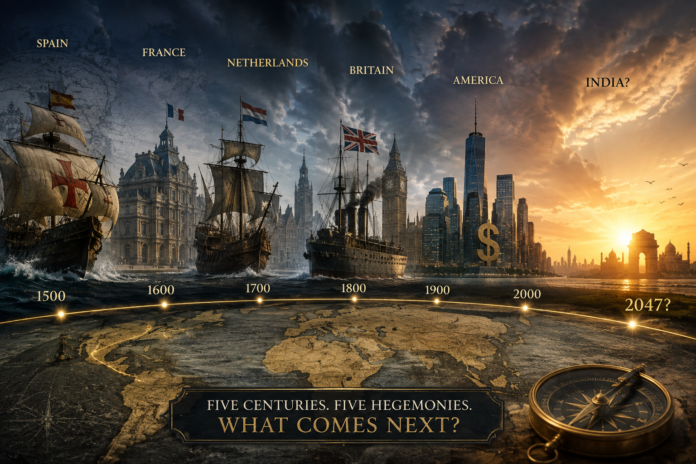
For roughly five centuries, the centre of global economic power has moved through Spain, France, the Netherlands, Britain and finally the United States. Their periods of dominance were neither identical nor precisely one hundred years. History does not operate like a clock.

Yet there is a striking rhythm. A power rises. It builds an economic order. Its currency and institutions become global. Its power becomes self-reinforcing. Then, gradually, overextension, debt, demographic pressures, institutional rigidity, technological change, or the rise of competitors begin to erode its relative advantage. The empire does not necessarily disappear. It simply ceases to be the centre.
If America is the fifth great economic hegemon, who — or what — is the sixth? That is the question this essay attempts to explore through what I would call scientific crystal gazing: not prophecy, but extrapolation from visible historical and economic trends.
Five Hegemonies, One Recurring Pattern
- Spain — Wealth without Sustainability: Spain’s extraordinary power was built on empire, trade routes and the enormous silver flows from the Americas. But abundance became expenditure. Expenditure became debt. Imperial ambition gradually outran productive capacity. Spain did not suddenly become insignificant. It simply lost the ability to determine the direction of the world economy.
- France — Power consumed by Rivalry: France inherited enormous continental influence. It possessed military strength, population, territory and cultural power. Yet prolonged rivalry, expensive wars, fiscal pressures and political upheaval weakened its ability to sustain primacy. Power became increasingly expensive to maintain.
- The Netherlands — Commerce before Conquest: The Dutch created perhaps the world’s first sophisticated commercial-financial model of global power. Amsterdam became a centre of shipping, trade, insurance and capital. The Dutch demonstrated that a relatively small country could exert influence far beyond its physical size. But competitors learned. Britain possessed greater territory, resources, industrial potential and eventually naval supremacy. The Dutch model was not destroyed. It was surpassed.
- Britain — the Empire of Industry and the Sea: Then came Britain’s extraordinary century. The Industrial Revolution gave it productive superiority. The Royal Navy protected its trade routes. London became the world’s financial centre. Sterling became the currency of international commerce. But two world wars changed the equation. Britain emerged victorious but financially weakened. Across the Atlantic stood a continental-scale America with enormous industrial capacity, capital and an increasingly powerful financial system. The baton moved again.
A hegemon begins to weaken not necessarily when it becomes weak, but when maintaining dominance becomes progressively more expensive than the dominance itself is worth
- America — the Empire without Colonies: America perfected something different. Its empire did not require conventional colonies. Its influence travelled through the dollar, Wall Street, Treasury markets, technology, corporations, trade, alliances and the world’s largest consumer economy. The American system became so deeply embedded in global commerce that access to it itself became a weapon. That is the extraordinary power now being demonstrated against Iran. But it also carries the first warning.
A hegemon begins to weaken not necessarily when it becomes weak, but when maintaining dominance becomes progressively more expensive than the dominance itself is worth.
America’s Strategic Karma
- The Accumulated Ledger: Vietnam. Iraq. Afghanistan. Venezuela. Iran. Each belongs to a different historical and strategic context. They cannot honestly be reduced to one simplistic narrative. But together they demonstrate the enormous geographic reach of American power and its willingness, at different times and for different reasons, to employ military, political and economic instruments far beyond its borders. Then there is Cuba. There are the increasingly extraordinary confrontations involving Canada and Greenland. There are tariffs, sanctions, secondary sanctions and restrictions that increasingly extend American economic jurisdiction beyond America’s physical territory. The issue is no longer one particular policy. It is the cumulative perception of power.
- When Power becomes Coercion: Every hegemon eventually faces a temptation. When others depend upon your system, why merely persuade them? Why not compel them? That is where strength can slowly turn into overreach. The dollar gives Washington an extraordinary capacity to punish without firing a shot. Banks can be sanctioned. Companies can lose market access. Transactions can become risky. Countries can be warned that doing business with an adversary may carry consequences. It is an extraordinarily effective weapon. But every weapon teaches its target something.
- Strategic Karma: I call this strategic karma. Not divine punishment. Not morality disguised as economics. A simple behavioural consequence: Every act of coercion teaches the coerced to prepare before the next act of coercion. Iran learns to circumvent sanctions. Russia learns to build alternatives. China learns to reduce vulnerabilities. Other countries watch. They ask a simple question: If this can happen to them today, could it happen to us tomorrow? And once countries start asking that question, diversification becomes rational.
- The Unintended Consequence: Alternative payment systems. Local currencies. Gold. Bilateral settlements. Regional financial institutions. Non-dollar trade. Parallel supply chains. None of these individually threatens America. Together, they create something more important: optionality. The world does not need to overthrow the dollar. It only needs to become less dependent upon it.
Every act of coercion teaches the coerced to prepare before the next act of coercion. And, other countries watch. They ask a simple question: If this can happen to one today, could it happen to them tomorrow? Consequently, diversification becomes rational
The Dollar: From Crown Jewel to Achilles’ Heel?
- The Dollar is not Dying: Let us be clear. The dollar is not about to collapse. America possesses advantages that are extraordinarily difficult to replicate: deep capital markets, Treasury liquidity, technological leadership, institutional networks and the enormous network effects surrounding the dollar. There is no obvious replacement waiting in the wings. That is precisely why the real danger is subtler.
- Dilution, not Dethronement: The dollar does not have to be replaced. It only has to become less indispensable. The dollar became dominant because the world wanted to use it. The danger begins when countries continue using it while simultaneously spending money creating alternatives because they fear being denied access to it. That is a profound strategic paradox.
- The Weapon Creates the Counter-weapon: The more Washington demonstrates the power of the dollar as a geopolitical weapon, the more valuable it becomes for others to develop financial protection against that weapon. This does not produce a sudden post-dollar world. It produces a post-dependence world. The distinction is crucial. America can remain the world’s richest and most powerful economy while gradually losing some of its ability to tell the rest of the world: Do this — or lose access to our system.
- The Real American Decline: The American decline, if it comes, may therefore be almost invisible initially. The dollar remains number one. Wall Street remains dominant. American technology remains formidable. The Treasury market remains indispensable. But the consequences of exclusion become progressively less frightening because alternatives exist. That is how hegemonic power can erode without the hegemon becoming poor.
The dollar does not have to be replaced. It only has to become less indispensable. The dollar became dominant because the world wanted to use it. The danger begins when countries continue using it while simultaneously creating alternatives
- The Most Dangerous Sentence for Washington: The most dangerous sentence for American power may not be: “We no longer need the dollar.” It may be: “We need the dollar — but we don’t need only the dollar.” That is a much more realistic future.
China: The Obvious Successor That May Not Be
- The Chinese Proposition: If America weakens, conventional strategic thinking immediately points towards China. And understandably so. China possesses continental scale, extraordinary manufacturing capacity, technological ambition, infrastructure, a huge market, financial resources and an increasingly sophisticated geopolitical strategy. It is playing the long game. And it is playing it intelligently.
- But China has its own Structural Constraints. An ageing population. High debt. Property-sector weakness. Subdued household consumption. Dependence on investment and exports. The difficult transition from an investment-led economy to a consumption- and innovation-driven economy. These are not minor problems. They are the structural tests of China’s next phase.
- The Successor may not be China. China may become America’s principal strategic competitor without becoming America’s successor. That distinction matters. The world may not be waiting for another hegemon. It may be moving towards a system of several powerful centres. America may remain one. China may become another. Europe may retain substantial economic and technological influence. The Gulf may become an increasingly important financial and energy centre. And India may emerge as something different altogether.
- The Sixth Power: Perhaps the sixth power will not be the country that defeats America. Perhaps it will be the country that grows while America overreaches, integrates while others divide, and builds relationships across competing power centres. That brings us to India.
India has become one of the world’s largest economies and is integrated into global supply chains, digital systems, infrastructure networks and strategic partnerships. The World Bank estimates that India would need sustained growth of around 7.8% for the next two decades to achieve high-income status by 2047. That is difficult, but not impossible
India: The Sixth Power in the Making
- The Unusual Indian Proposition: India possesses a combination that is historically unusual. Continental scale. A huge domestic market. Favourable demographics. Technological capability. Expanding infrastructure. Strategic geography. Democratic institutions. And a civilisation accustomed to interacting with multiple cultures without necessarily demanding their submission. India’s opportunity is, therefore, larger than becoming another great power. It is to become a different kind of great power.
- Geo-Moral Power: India’s greatest strategic asset may ultimately not be military. It may be what I would call geo-moral power. India can engage America without becoming American. Engage Russia without becoming Russian. Compete with China without becoming anti-Chinese. Lead the Global South without becoming anti-Western. It can speak to multiple camps because it does not have to belong completely to any one of them. That gives India a rare strategic advantage.
- The Economic Foundation: The opportunity is backed by scale. India has become one of the world’s largest economies and is increasingly integrated into global supply chains, digital systems, infrastructure networks and strategic partnerships. The World Bank estimates that India would need sustained growth of around 7.8% for the next two decades to achieve high-income status by 2047. That is difficult. But it is not impossible.
- The Unfinished Transformation: The opportunity will mean little without execution. India must create productive employment at enormous scale. It must improve human capital. Accelerate manufacturing. Increase productivity. Raise female labour-force participation. Build better cities. Strengthen institutions. Deepen innovation. And sustain infrastructure investment. India cannot inherit leadership. It has to earn it.
- The One Temptation India Must Resist: India must also resist the oldest temptation of every rising power: mistaking power for entitlement. It must not imitate the imperial behaviour of its predecessors. It must not confuse military capability with leadership. It must not believe that the world needs another hegemon. Its greatest strength may lie precisely in doing things differently.
For India, the opportunity will mean little without execution. It must create productive employment at enormous scale, improve human capital, accelerate manufacturing, increase productivity, raise female labour-force participation, build better cities, strengthen institutions, and sustain investment. India cannot inherit leadership. It has to earn it
The Next Empire?
- The Historical Warning: Five centuries have given us five dominant powers. Spain. France. The Netherlands. Britain. America. Each, in its own time, appeared too powerful to be displaced. Yet each eventually discovered the same truth: No economic order is permanent. The causes are different every time. Debt. Demography. War. Technology. Overextension. Institutional sclerosis. New competitors. But the outcome rhymes. Relative power shifts.
- America’s Future: America may remain extraordinarily powerful for decades. There is no reason to predict an overnight collapse, a sudden disappearance of the dollar or a retreat of the United States to its mainland. That would be sensationalism, not strategy. The more credible possibility is gradual relative decline. A smaller share of global output. A more contested financial architecture. A less indispensable dollar. More alternative payment systems. More powerful competitors. And a world increasingly unwilling to accept that one country should define the economic choices of everyone else.
- The Sixth Century: The most interesting possibility, therefore, is that the sixth great power will not necessarily be China. Nor will it necessarily be India. It may be multi-polarity itself. A world where several major powers coexist, compete, cooperate and balance one another. But within that world, one country could emerge as the principal bridge between civilisations, economies and strategic camps. India has that possibility. If it sustains its growth, strengthens its institutions, deepens its technological and manufacturing capabilities and continues building diplomatic partnerships based on confidence rather than dependence, 2047 could mark much more than a demographic or economic milestone. It could mark India’s arrival as a principal architect of the global order.
- Not the Next Empire: And here lies the final paradox. India’s greatest opportunity may not be to become the sixth empire. It may be to become the first great power that does not need an empire to lead. Perhaps that is what the next century will demand. Not a new ruler. Not another imperial centre. But a power capable of combining economic scale with restraint, technological capability with responsibility, national interest with global responsibility, and civilisational confidence with strategic humility. Five empires have dominated the last five centuries. Perhaps the sixth century will belong to no empire at all.
And perhaps the country best prepared for that world will not be the one that learns how to command it. It will be the one that learns how to lead it without owning it.


Lt Gen Rajeev Chaudhry (Retd) writes on contemporary national and international issues, strategic implications of infrastructure development towards national power, geo-moral dimension of international relations, and leadership nuances in a changing social construct. The views expressed are of the author and do not necessarily reflect the views of Raksha Anirveda





