


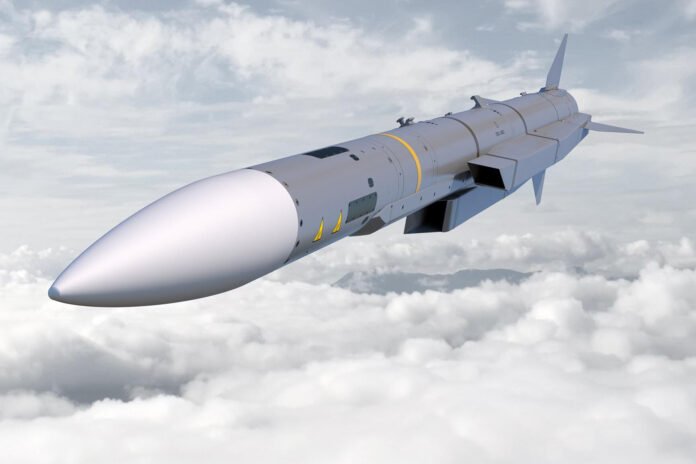
Tel Aviv: France has agreed to supply the Meteor air-to-air missile to be carried by the French Rafale fighter aircraft operated by the Egyptian Air Force. So far, the US has denied Egyptian requests to get long–range advanced air–to–air missiles.
The acquisition of the Rafale and the supply of the advanced missiles is part of the Egyptian policy to diversify the sources of its defence systems and not rely only on American made ones.

Egypt’s newer batches of Rafale jets are built to the advanced F3 R standard, which inherently supports integration with the Meteor – the long-range beyond-visual-range air-to-air missile (BVRAAM).
The Egyptian Air Force widely operates MBDA’s Mica air-to-air missile alongside its Rafales, but the acquisition of the longer-range Meteor provides a strategic capability as standard Egyptian F-16s lack modern active-radar BVR missiles.
Egypt’s F-16 fighter jets are not equipped with modern long-range active air-to-air missiles.
Beyond-visual-range (BVR) means a missile can hit targets far away without the pilot seeing them. Egypt’s F-16s lack modern active-radar BVR missiles like the US AIM-120 AMRAAM.

The F-16 jets rely on the older AIM-7 Sparrow. This older missile requires the pilot to keep their radar aimed at the target the entire time until impact.
The United States kept these limits for decades. While the US approved AIM-120 missiles for Egypt’s ground-based NASAMS air defence systems, they are still not cleared or integrated for use on the F-16 jets.


-The writer is an Israel-based freelance journalist. The views expressed are of the writer and do not necessarily reflect the views of Raksha Anirveda





