


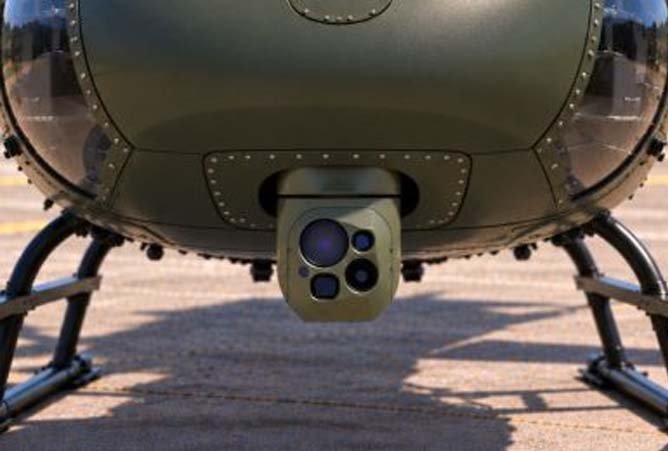
TEL AVIV. Elbit Systems is positioning airborne laser weapons as a new growth area, saying the technology has begun moving beyond research and development into production programmes. The company is developing two versions: Sting, designed for helicopters, and XCalibur, a pod-based system intended for fixed-wing aircraft.
Chief Executive Bezhalel Machlis said Elbit is targeting an earlier readiness milestone for a Sting prototype than for XCalibur, but did not provide a timetable for either system to enter service. Chief Financial Officer Kobi Kagan told analysts on the company’s third-quarter earnings call that high-power lasers could contribute to growth in 2027, alongside PULS rocket artillery and other defence products.

The shift marks a commercial milestone for a technology that Elbit and Israel’s Ministry of Defence have developed over several years. In June 2021, the ministry announced that an airborne laser system had intercepted several unmanned aerial vehicles in tests over the Mediterranean. The system was mounted on a Cessna Grand Caravan; an Israeli defence official said some targets were engaged at distances exceeding one kilometre. The ministry described the trials as an early phase, with further development needed before operational use.
Elbit’s current systems are intended to take that concept onto operational aircraft. A laser carried by an aircraft could potentially detect and engage aerial threats from a mobile platform, extending the reach of ground-based air defence. The company has not publicly disclosed detailed performance specifications for Sting or XCalibur, nor has it announced when either version will be fielded.
Turning a successful demonstration into a deployable weapon presents substantial engineering challenges. An aircraft-mounted system must fit within strict limits on size, weight and power, generate and direct sufficient energy, and manage heat. It must also hold a beam accurately on a target while the platform is moving. The earlier tests demonstrated interception capability under trial conditions; they do not by themselves establish performance across operational environments or against all classes of threat.
The airborne effort sits alongside Israel’s broader development of directed-energy defences. Elbit is also involved in the Iron Beam ground-based laser programme with Rafael, which is designed as an additional layer in the country’s air-defence network.

Airborne and ground-based systems face distinct operating conditions, and lasers are generally affected by atmospheric factors such as clouds and visibility. An aircraft operating above some weather may mitigate certain constraints, but does not eliminate the technical and environmental challenges.
The commercial opportunity comes as militaries confront the spread of relatively inexpensive unmanned aircraft. Laser weapons are often promoted as potentially less costly per engagement than conventional interceptors, but actual operating costs and effectiveness depend on the system, target and conditions. Elbit has not published a separate revenue figure for its laser products.

Its latest results nonetheless suggest the technology is beginning to enter the company’s business pipeline. Elbit said revenue in its intelligence, surveillance, target acquisition, reconnaissance and electronic warfare division rose 32% in the third quarter from a year earlier, with higher sales of airborne and land-based high-power lasers among the contributing factors. The division also benefited from electronic warfare and maritime systems in Asia-Pacific and electro-optical systems in Israel.
Overall, third-quarter revenue rose 17.2% to $2.25 billion, operating profit increased 35.6% to $232.5 million, and the order backlog reached a record $33 billion at the end of September. Management expects revenue growth in 2027, with further margin expansion. Those figures cover Elbit’s broader business, rather than laser sales alone.
Kagan said high-power lasers had moved from long-running research efforts into programmes of record, a transition he described as offering attractive profitability. The next test will be whether development programmes can deliver aircraft-ready systems that satisfy military requirements and generate sustained orders. For now, Elbit’s statements signal a nearer-term commercial push, not a declared operational deployment date.







