


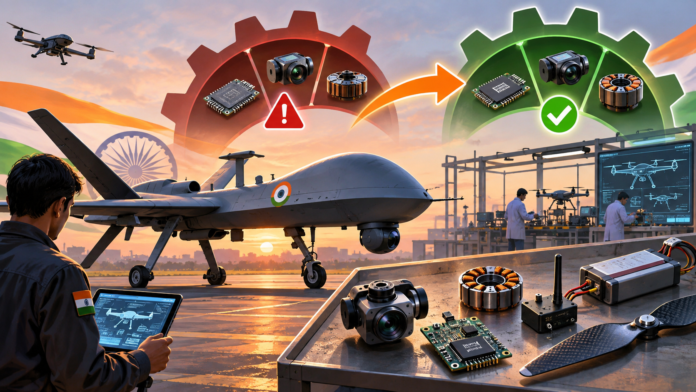
BENGALURU. Drone Federation India (DFI) has unveiled a 22-point roadmap to strengthen domestic production of drone components, placing supply-chain resilience at the centre of India’s push for a self-reliant industry.
The recommendations were released at the Bharat Drone Stack Conference 2026, held in Bengaluru on November 12 and 13. DFI said the event brought together more than 80 Indian component exhibitors and about 3,000 delegates, including representatives from the armed forces, government, research institutions and industry. The programme included 10 thematic sessions.

The accompanying white paper, Making the Swadeshi Switch, proposes measures including Indian-content norms for civil and defence drones, targeted support for component manufacturers, and domestic testing and certification. DFI plans to present the recommendations to relevant ministries and agencies and review progress at the next conference in 2027.
The agenda addresses a gap between assembling drones in India and making the parts that determine their performance and reliability. DFI President Smit Shah said more than 160 drone models have type certificates and over 200 manufacturers are building defence drones, but warned that dependence on a single source for a flight-critical component could expose users to sudden supply disruptions.
The challenge extends across batteries, magnets, chips, flight controllers and other specialised systems. DFI’s conference account cited Chinese export controls on drone-related parts, rare-earth magnets and autopilots since September 2024 as a reason to diversify and localise supply. Domestic production would not automatically remove all foreign exposure, but could broaden sourcing options and strengthen control over critical technologies.
DFI estimates that India’s drone industry could grow from Rs 5,720 crore in 2025-26 to around Rs 97,300 crore by 2030-31. It separately targets a component market worth USD 3.08 billion. These are industry projections, not confirmed outcomes. The Bharat Drone Stack initiative’s published 2030 goals also include reducing component imports by 75%, mapping more than 500 suppliers and supporting 50,000 or more direct and indirect jobs.

Launched in August 2025, Bharat Drone Stack is both an industry initiative and an online supplier directory. Its website lists 208 Indian component manufacturers and suppliers, including 83 startups, and allows buyers to search listings and contact suppliers directly. The platform maps the sector across 11 categories, 62 subsystems, 243 parts and 52 raw materials, providing a picture of where local capabilities exist and where gaps remain.
That mapping could help buyers identify Indian suppliers, but a directory alone cannot ensure that components meet demanding performance, safety and security requirements. Certification, dependable production volumes, competitive pricing and sustained research and development will be essential if domestic parts are to win adoption from drone manufacturers and government customers.

India has previously used policy incentives to encourage domestic drone production. The government’s drone production-linked incentive scheme covered manufacturers of drones and components, with a tenure running from financial year 2021-22 to 2023-24, according to the scheme’s administrator. The conference roadmap now points to the next set of questions: whether support can reach specialised component makers, whether standards can be developed and applied consistently, and how testing capacity can keep pace with new products.
Conference discussions also linked localisation to defence procurement and security evaluation. A session on a proposed “Trusted Indian Component” mark involved the Defence Research and Development Organisation and the Directorate General of Aeronautical Quality Assurance. An Army workshop introduced manufacturers to AASHVAST, a lab that screens drones and electronic systems for hardware and firmware vulnerabilities.
The roadmap’s impact will depend on implementation: which recommendations agencies adopt, how funding and certification are structured, and whether local suppliers can meet buyers’ needs at scale. Its central test is practical-whether Indian-made components become reliable, qualified alternatives, rather than simply appearing on policy lists.







