


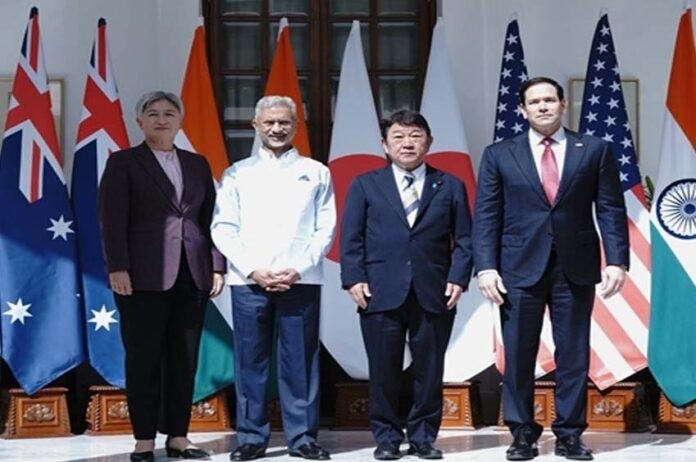
Australian Foreign Minister Penny Wong, External Affairs Minister S Jaishankar, Japanese Foreign Minister Toshimitsu Motegi, and US Secretary of State Marco Rubio attended the Quad Foreign Ministers’ Meet in New Delhi on May 26, 2026. Before the meeting, the Ministry of External Affairs (MEA) said the Indo-Pacific grouping was expected to discuss US President Trump’s visit to China, the Iran war, and the Hormuz blockade.
Rubio arrived in India three days earlier, on May 23. Having held discussions with Prime Minister Narendra Modi (with Jaishankar and NSA Ajit Doval in attendance) and subsequent delegation-level talks with Jaishankar, Rubio would have worked out the proceedings of the Quad FM meet in advance. Australia and Japan being US allies, he would have been in regular touch with his counterparts in those countries. The fact that the Quad FM Meet lasted just over one hour and the 2,278-word joint statement was released immediately thereafter suggests this was already worked out.

Discussing Trump’s visit to China at the Quad meet would have embarrassed Rubio, especially with Pete Hegseth, Secretary of War, now saying America wants good relations with China because America needs three years to rebuild its war reserves
Highlights of the Joint Statement are as follows:
- Uphold international law, peacefully resolving disputes, sovereignty, and territorial integrity.
- Recognise the potential of innovation and emerging technologies for economic prosperity.
- Oppose using force/coercion to change the status quo.
- Support a free and open Indo-Pacific.
- Support diplomacy to resolve the West Asia crisis.
- Condemn attacks on commercial shipping and measures inconsistent with UNCLOS, including imposition of tolls.
- Oppose unilateral actions in the East and South China Seas.
- Committed to the denuclearisation of North Korea.
- Support ASEAN centrality, ASEAN-led regional architecture, Pacific Islands Forum, Pacific-led regional groupings, and the Indian Ocean Rim Association (IORA).
- Address challenges through: maritime and transnational security; economic prosperity and security; critical and emerging technologies; humanitarian assistance response.
- India to host next edition of Quad-at-Sea Ship Observer Mission.
- Condemn terrorism and transnational crimes; cooperate in preventing, detecting, and responding.
- The Quad Critical Minerals Framework was launched to leverage economic policy tools and coordination.
- The Quad Initiative on Indo-Pacific Energy Security was launched for cooperation on energy security and resilience.
- Quad to work, in coordination with Fiji, to advance port infrastructure in the country.
- Cooperation in the Quad Partnership for Cable Connectivity and Resilience.
- Build secure, resilient digital ecosystems and support next-generation technologies.
- Cooperation in Humanitarian Assistance and Disaster Relief (HADR) in the Indo-Pacific.
- Strengthen Quad health security cooperation.
- Committed to the Indo-Pacific Logistics Network (IPLN).
- Look forward to the Quad Leaders’ Summit and the next Quad Foreign Ministers’ Meeting.
This was the 11th Quad Foreign Ministers Meet, which was unique on multiple counts, like: the meeting lasted just over an hour because Rubio had set the scheme in advance; no date was announced for the Leaders’ Summit; the four FMs did not address the press directly after the meeting as has been the convention, although Penny Wong and Toshimitsu Motegi spoke to the media separately.
The FMs did not discuss Trump’s visit to China, as the MEA had outlined before the meeting. The reason obviously was the subtle snub that Trump received in China, with President Xi Jinping refusing to meet the plane load of billionaire CEOs accompanying Trump. The US requested this meeting, and if Trump hoped for assurance about China not invading Taiwan, Xi was explicit that he would brook no interference over Taiwan, which he considers integral to China. Trump later said Taiwan should not call for independence. Discussing Trump’s visit to China at the Quad meet would have embarrassed Rubio, more so with Pete Hegseth, Secretary of War, now saying America wants good relations with China, because America needs three years to rebuild war reserves.
About the situation in West Asia and the Straits of Hormuz, the deliberate US-Israel attacks on Iran initiated the crisis. Iran was not developing nukes, as was stated by Tulsi Gabbard, Director of the US National Intelligence, who has since resigned. According to US strategic analyst Alan McGregor, if any country was to be attacked on account of terrorism, it should have been Pakistan and Syria, not Iran.

At the Quad FM Meet, India has committed to the Quad Port Project in Fiji, but the project is part of the US plan to convert small Pacific nations into Western outposts against China. What strategic advantage does it give India?
Iran’s government officially estimates the damages inflicted by the joint US-Israeli strikes at nearly $270 billion till now. In addition, Iran’s total frozen assets globally range from $100 billion to $123 billion. The US-Israel war on Iran has forced Tehran to levy tolls on vessels transiting the Straits of Hormuz, which was open to all earlier. The Quad FMs are opposed to tolls on waterways. So why have they not objected to tolls on commercial vessels?
Calls for diplomacy to resolve the West Asia crisis are good, but does Trump’s rogue-based World Order and Israel support this? The US continues to bomb Iran and target Iranian vessels/commercial vessels bound for Iranian ports. Despite ceasefires, Israel continues to bomb Gaza and Lebanon. Aren’t the US and Israel the topmost offenders in using force and coercion to change the status quo?

As regards opposing unilateral actions in the East China Sea and the South China Sea, the US sat tight all these years to let China have its way, and even now does little other than occasional Freedom of Navigation Operations (FONOPs). The aim apparently is to use Japan, the Philippines, or South Korea as the front. At best, it indulges in ‘poking’ China, like calling South Korea a Dagger in Asia’s Heart.
With President Trump focusing on bilateral rather than multilateral forums, the Quad has been downgraded. It is unlikely he would attend the Quad Leaders’ Summit in India, if it is held at all
In terms of economic terrorism and terrorism per se, the US tops the list, having raised, armed and trained the Mujahideen (predecessor of Al Qaeda), Islamic State in Turkey (inducted into Iraq-Syria and later into Afghanistan), Jabhat al-Nusra, installed former Al-Qaeda leader Ahmed al-Sharaa as President of Syria (who is assisting Israel’s ground offensive into Lebanon), reviving Al Qaeda with Syrian fighters being trained in Turkey, planning to induct Al Qaeda/ISIS fighter in Iran, and the like.
India used to laugh at Pakistan offering rare earth minerals of Balochistan to the US. Who will control the Quad Critical Minerals Framework other than the US? In addition, has Rubio signed a major agreement with India to secure supplies of critical minerals and rare earths, including their mining and processing? As for energy security, we are importing Russian oil only with American approval and oil from Venezuela through US channels. We plan to import oil from Norway and Oman, which must transit the Straits of Hormuz. Any plans for Oman to lay a pipeline to India will be sabotaged by the US rogue-based order. The aim is to make India import maximum American oil at Trump’s prices. Also, India committed to purchasing $500 billion in US goods over the next five years.
In the Quad FM Meet, India has committed to the Quad Port Project in Fiji. Fiji’s military coup in 1987 and subsequent coups (2000 and 2006) triggered a mass exodus of an estimated 100,000+ Indo-Fijians, who relocated to countries like Australia, New Zealand, Canada, and the US. Today, Indians/Indo-Fijians number about 316,000 (38% of Fiji’s population). Chinese number approximately 6,000-7,000 – mix of long-established families and recent expatriates. But the fact is that the Quad Port Project in Fiji is part of the US plan to convert small Pacific nations into Western outposts against China. What strategic advantage does it give India?
India needs to recognise its strengths to stand up to the US and China. Also, the US delinking from China is a long way off, and it will be naïve for India to celebrate on that count
As to the potential of innovation and sharing emerging technologies, compare what is happening in Quad to the US, UK, and Australia developing underwater drone technology. But for sharing critical/emerging technologies with India, the US would seek to extract a strategic price. With Trump focusing on bilateral rather than multilateral forums, the Quad has been downgraded. It is unlikely he would attend the Quad Leaders’ Summit in India, if it is held at all.
Finally, India needs to recognise its strengths to stand up to the US and China, which it very well can. Also, the US delinking from China is a long way off, and it will be naïve for India to celebrate on that count.

The author is an Indian Army veteran. The views expressed are of the author and do not necessarily reflect the views of Raksha Anirveda





