


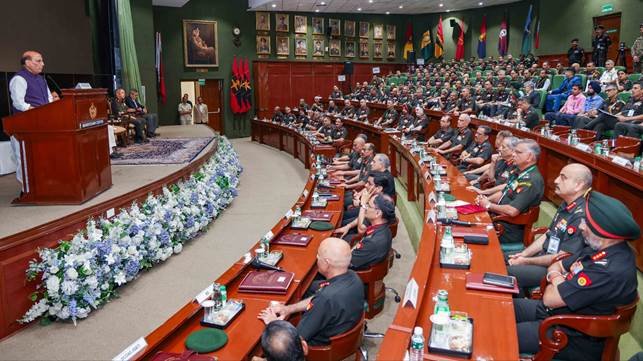
Addressing the Army Commanders’ Conference in New Delhi on October 23, Singh called for a strategic vision spanning 20 to 30 years. He also urged senior officers to monitor geopolitical and regional developments closely and ensure the Army could respond to emerging challenges. The two priorities, he said, must go together: long-range planning should not come at the cost of immediate operational readiness.
Singh said military strategies must remain “dynamic and flexible”, so they can be adjusted as circumstances change. The remarks framed preparedness as an ongoing process, requiring commanders to assess capabilities and update plans as security conditions and technology evolve.

The minister released the Land Warfare Doctrine, described by the Defence Ministry as an overarching framework to prepare the Army for the changing character of warfare and future conflicts. The doctrine’s release was a key part of the three-day conference, held from October 21 to 23. The forum brings together the Army’s senior leadership to review operational preparedness, capability development and future transformation.
Singh said ground forces would remain indispensable even as threats increasingly span air, maritime, space and cyber domains. He called for an integrated approach and argued that success in modern warfare would depend on multi-domain capabilities and seamless coordination in joint operations.
The address also highlighted the need to speed up work in artificial intelligence, autonomous systems, data analytics, cybersecurity and secure communications. Singh linked these technologies to stronger military capabilities, while urging the Army to continually assess performance and make improvements in response to changing circumstances. He also welcomed restructuring efforts focused on drones and modern technology.
The minister cited Operation Sindoor as an example of adaptation, saying innovative thinking, enhanced synergy and superior coordination, supported by advanced weaponry, contributed to its success. He said the operation sent a message that India would take necessary measures to safeguard its national interests.

The doctrine arrives as the Army considers how to prepare for conflicts that may combine conventional ground operations with cyber activity, drones, space-based capabilities and electronic warfare. The government’s announcement ahead of the conference described the document as a framework for addressing the evolving nature of warfare, rather than a replacement for the Army’s broader planning and capability development.
The conference also provided a setting for senior commanders to review ongoing initiatives and identify future priorities. The Defence Ministry said the wider aim was to build a force that is progressive, adaptive, technologically enabled and prepared for future challenges.

Singh’s emphasis on long-term planning alongside short-term readiness reflects a difficult balancing act for military leadership: preparing for uncertain future threats while maintaining the ability to respond to those that emerge now. His call for flexible strategies suggests that the planning horizon should be ambitious, but not fixed; capabilities and operational approaches must be adjusted as circumstances shift.
He also stressed that new technology must be matched by coordination across services and domains. AI, autonomous systems and secure networks may strengthen military operations, but the minister’s remarks underscored that integration and timely decision-making remain central to applying those tools effectively.
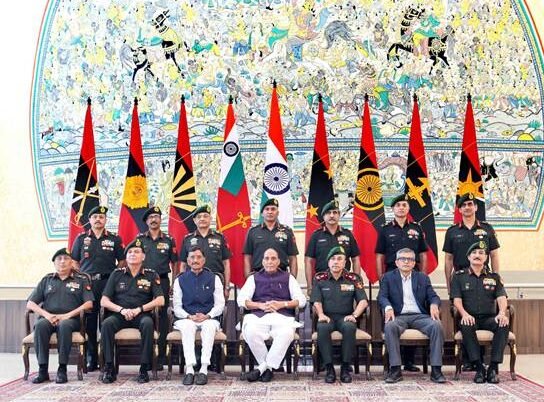
Alongside the doctrine’s release, Singh unveiled the annual United Nations Journal and recognised Army personnel for their contributions as UN peacekeepers. Senior officials present included Chief of Defence Staff General NS Raja Subramani, Army Chief General Dhiraj Seth and Defence Secretary Rajesh Kumar Singh.
The conference closed on October 23, after three days of deliberations on the changing security environment and the Army’s future readiness. The doctrine now sets out an overarching framework for the force as it adapts its planning and capabilities to evolving forms of conflict.







