


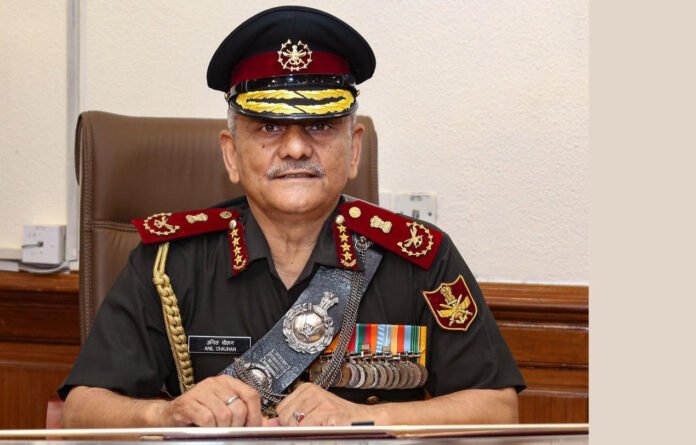
New Delhi: Chief of Defence Staff General Anil Chauhan has issued a comprehensive warning about a rapidly evolving security environment for India, emphasising the emergence of a “fourth evolving military threat” that challenges the nation’s traditional defence paradigms.
He highlighted the increasing alignment of interests among China, Pakistan, and Bangladesh, noting that this convergence poses significant risks to India’s internal stability and security. This warning comes in the context of deteriorating ties with Bangladesh following the ouster of former Prime Minister Sheikh Hasina, who sought refuge in India.

General Chauhan underscored that the Indian Ocean Region (IOR) is becoming a theatre for external influence through debt diplomacy, allowing outside powers to exploit economic vulnerabilities and deepen their strategic presence. He warned that frequent changes in government and shifting geopolitical allegiances in South Asia further complicate India’s security landscape, increasing the risk of instability.
A central focus of his remarks was the urgent need for India to expand its conventional military capabilities into new and emerging domains. He identified the “fourth evolving military challenge” as the growing vulnerability to long-range vectors and precision strikes—including ballistic missiles, hypersonic weapons, cruise missiles, and mass drone or loitering munition attacks.
General Chauhan stressed that there is currently no fool proof air defence system capable of countering these threats, and called for India to prepare for operations across land, air, sea, cyber, and space domains.
Reflecting on Operation Sindoor, the recent military engagement with Pakistan from May 7–10, General Chauhan described it as a unique conflict between two nuclear-armed states. He explained that India’s no-first-use nuclear doctrine provided strategic space for a robust conventional response, allowing India to destroy terrorist camps following a major terror attack without escalating to nuclear conflict.

He emphasised that the escalation threshold remained in Pakistan’s hands, thereby limiting their options for nuclear brinkmanship.
Operation Sindoor also showcased the complexities of modern multi-domain warfare. The operation was characterised not only by airstrikes on terror camps but also by significant efforts in cyber operations, intelligence, and countering disinformation—with up to 15% of the armed forces’ efforts devoted to managing fake news and misleading narratives. This reflects a shift from traditional, platform-based warfare to flexible, deceptive, and technologically integrated strategies, where the “story war” and perception management are as critical as kinetic operations.

General Chauhan also drew attention to the deepening military and defence ties between China and Pakistan, noting that 70–80% of Pakistan’s military hardware in recent years has been sourced from China, further entrenching Chinese influence in the region.






