


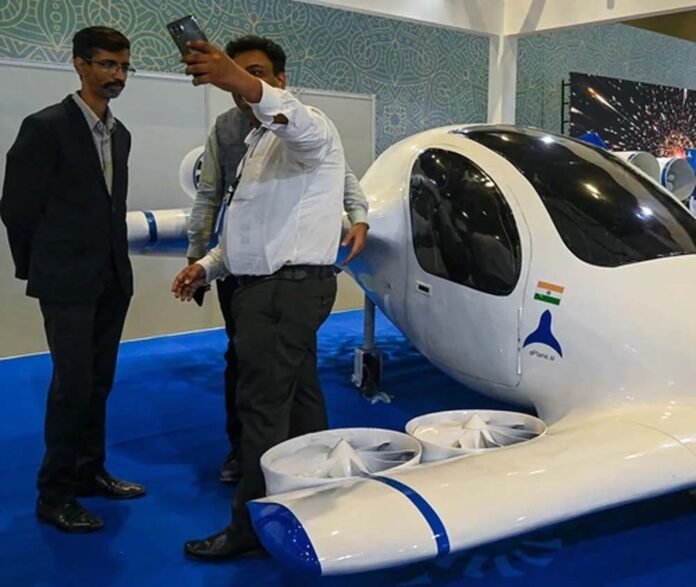
In a major milestone for Indian aerospace technology, deep-tech startup The ePlane Company officially assembled and unveiled its full-scale electric vertical take-off and landing (eVTOL) prototype. Designated as the e200X (PT-01), the aircraft was revealed at the startup’s newly operational 60,000-square-foot facility located on the IIT Madras Discovery Campus in Thaiyur, near Chennai.
A Giant Leap for Urban Air Mobility
While electric “flying taxis” are frequently envisioned as futuristic commuters whisking daily office goers above gridlocked city highways, ePlane is taking a far more pragmatic and high-impact approach. The company is directing its initial commercial rollout toward emergency medical transportation, critical organ transport and high-priority urban cargo before expanding into general passenger transit.

By targeting emergency medical services first, ePlane addresses a critical healthcare bottleneck across India’s densely populated urban centres, where traditional ground ambulances regularly struggle against severe traffic delays.
The e200X (PT-01) eVTOL aircraft features a distinct technical specification and architecture designed for urban air mobility and medical transport.
It is constructed with an 8m x 11m footprint and has a maximum gross weight of 2.2 tonnes. The cabin is configured to accommodate a payload capacity of one pilot plus two passengers, or alternatively, up to 200 kg of medical or cargo payload.
For performance, the aircraft achieves an operational range of up to 110 km on a single electric charge and can reach cruising speeds of up to 160 km/h. Its power and propulsion setup is driven by an 800V system utilising proprietary “Synergistic Lift” architecture.

Technical Specifications & Architecture
Unlike conventional aircraft that require expansive runways, the e200X relies on multi-rotor electric propulsion to take off and land vertically, transitioning into winged forward flight mid-air. Its compact footprint enables it to utilise existing hospital helipads, open parking lots and urban rooftops without requiring massive infrastructure overhauls.
Moreover, the e200X utilises ePlane’s patented Synergistic Lift architecture. Instead of complex tilt-rotor mechanisms that tilt propellers between vertical and horizontal axes, the aircraft employs separate, fixed propeller systems for vertical lift and forward cruise. This design choice reduces mechanical complexity, enhances structural safety and drastically lowers manufacturing and maintenance overheads.

Regulatory Roadmap and Testing Ahead
Founded in 2019 by IIT Madras aerospace engineering professor Satya Chakravarthy and entrepreneur Pranjal Mehta, The ePlane Company has already logged over 10,000 kilometres of flight testing using smaller sub-scale technology demonstrators (such as the ATVA and e50 models).
In May 2023, the startup secured Design Organisation Approval (DOA) from India’s Directorate General of Civil Aviation (DGCA), establishing its engineering credentials. The newly unveiled full-scale PT-01 prototype shifts the enterprise from design simulation into physical validation.
Ground integration tests are currently underway, with certified flight testing targetted to begin around mid-2027. In line with DGCA airworthiness protocols, early test flights will be completely uncrewed to rigorously demonstrate safety and fail-safe redundancy across all weather conditions.
Paving the Way for Commercial Operations
Commercial deployment is scheduled for 2028, starting with air ambulances and medical freight. The startup reports already securing advance commitments for over 800 aircraft units, reflecting massive interest from healthcare providers, logistics firms and regional operators.
As battery densities improve and regulatory frameworks for Advanced Air Mobility (AAM) mature in India, the e200X platform will eventually expand to offer intra-city passenger shuttle services – turning hour-long highway commutes into swift 10-minute aerial trips.






