


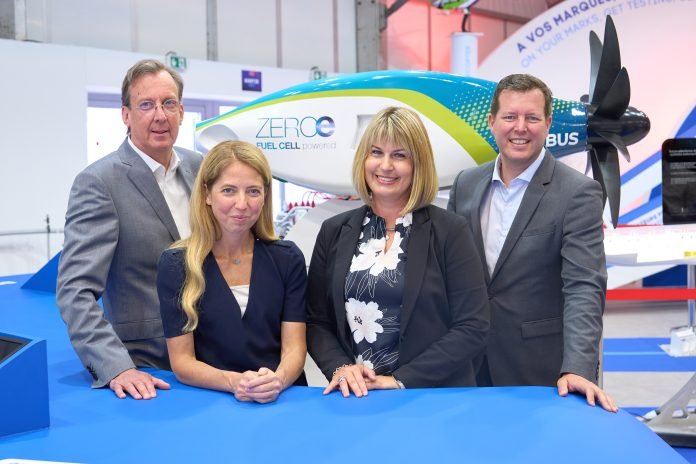
Paris, France. Airbus and MTU Aero Engines have signed a Memorandum of Understanding (MoU) to progress together on hydrogen fuel cell propulsion, a promising and critical technology to decarbonise aviation.
This MoU was signed today during the 55th Paris Airshow by Bruno Fichefeux, Airbus’ Head of Future Programmes and Dr. Stefan Weber, MTU’s SVP Engineering and Technology.

The partnership draws on the combined expertise of Airbus, a leading aircraft manufacturer and pioneer in hydrogen-powered aviation through its ZEROe project, and MTU Aero Engines, a globally recognised engine expert for commercial and military aircraft. It follows Airbus’ decision to focus its research effort on a fully electric, hydrogen-powered aircraft with a fuel cell engine, a field in which MTU has developed recognised expertise through its Flying Fuel Cell concept.
The agreement sets out a three-step roadmap for the development of a hydrogen-powered fuel cell engine suitable for the commercial aviation market. The first step is to mature the technological building blocks essential for the engine through joint research projects, such as Clean Aviation. The second step will involve aligning the two partners’ R&T roadmaps on hydrogen technologies. The result of these joint explorations then would allow us to consider a third step towards the development of a fuel-cell engine for a hydrogen powered aircraft.
“Our focus on fully electric fuel cell propulsion technology for future hydrogen-powered aircraft underscores our confidence and progress in this domain,” said Bruno Fichefeux, Head of future programmes at Airbus. “Collaborating with MTU, a leader in engine manufacturing and innovation, is a perfect complement to our own advancements. This partnership will allow us to pool our collective knowledge, accelerate the maturation of critical technologies, and ultimately deliver a revolutionary hydrogen-powered propulsion system for future commercial aircraft. Together, we are not just imagining a sustainable future of flight, we are actively pioneering it.”
“As a globally recognised engine expert, we are driven by the vision of a revolutionary propulsion concept that allows virtually emissions-free flight,” said Dr. Stefan Weber, SVP Engineering and Technology at MTU Aero Engines. “Today, we are at the centre of a wide-ranging eco-system of partners aiming to achieve the complete electrification of the powertrain by using fuel cell technology. Partnering with Airbus opens up the possibility to jointly address both technology maturity and platform integration aspects. Our joint efforts in the years to come are the first step in paving the way for a potential product development in the future.”







