


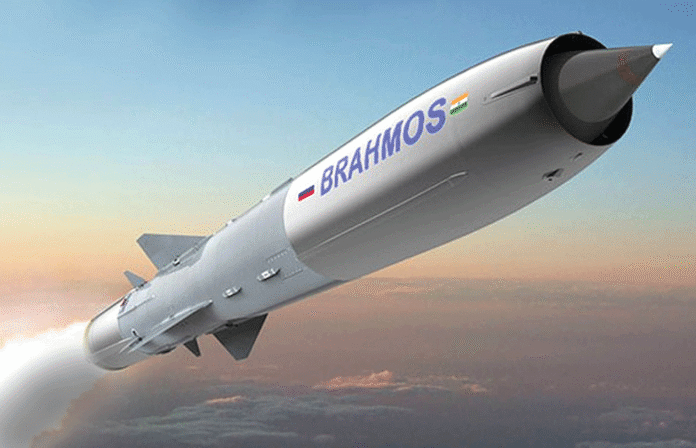
Nagpur. India’s defence indigenisation has achieved a historic milestone as Solar Industries delivered the first completely domestic BRAHMOS warhead alongside the 100th booster, drastically reducing reliance on foreign supply chains.
India’s missile indigenisation programme notched a landmark achievement on Thursday, June 18, 2026 with the delivery of the country’s first fully indigenous warhead for the BRAHMOS supersonic cruise missile, manufactured at a private-sector facility in Nagpur, Maharashtra. The warhead, produced by Nagpur-based Solar Defence and Aerospace Limited (SDAL), was flagged off alongside the company’s 100th BRAHMOS booster, a dual milestone that underscores the deepening role of private industry in one of India’s most sensitive strategic weapons programmes.

The booster was formally flagged off by BrahMos Aerospace Chief Dr Jaiteerth Joshi and Satyanarayan Nuwal, Chairman of Solar Industries India Ltd, in the presence of senior officials and technical experts associated with the programme. Joshi noted that the booster was previously imported from Russia before a technology transfer agreement enabled domestic production, and credited Solar Industries with being the first company to take on that technology transfer and push ahead with indigenisation of both boosters and warheads.
The warhead has been produced under a technology transfer arrangement with the Defence Research and Development Organisation (DRDO), marking a decisive step in reducing reliance on foreign suppliers for one of the most critical components of the BrahMos system. Until now, India had depended on Russia for BRAHMOS warheads despite having developed extensive missile manufacturing capabilities domestically. The technology transfer initiative behind the warhead began between 2017 and 2018, aiming to build domestic expertise in warhead design and production so India could eventually manufacture these critical subsystems independently.
The newly delivered warhead will not be inducted immediately. It will first be sent to the Terminal Ballistics Research Laboratory for a series of tests and evaluations assessing its performance, reliability, and operational readiness before it becomes part of India’s military inventory. Joshi confirmed that warhead trials have already been conducted, and that once fully successful, imported warheads will be replaced with indigenous ones.
Highlighting the missile’s operational record, Joshi said BRAHMOS has earned global recognition for its reliability and performance over the past quarter century, with its operational use further reinforcing confidence in the system and enhancing its global reputation. The supersonic cruise missile gained further prominence during Operation Sindoor in 2025, when it was reportedly used operationally for the first time during military action following the Pahalgam terror attack.

The Nagpur rollout also points to expanding export prospects for the missile system. Joshi indicated that Vietnam will soon become the next overseas customer for the supersonic cruise missile after the Philippines, noting that clearances for Vietnam are almost complete and that India is in advanced discussions with several countries in the eastern and western regions. He further disclosed that Russia itself has expressed interest in acquiring additional BRAHMOS missiles, despite being an industrial partner in the joint Indo-Russian programme.
The development reflects the government’s emphasis on integrating private industry into the defence supply chain under the Aatmanirbhar Bharat initiative, with facilities such as SDAL’s expected to play a pivotal role in scaling up production to meet both domestic and export demands. The rollout comes amid a broader government push to deepen private-sector involvement in strategic defence production and strengthen indigenous supply chains for advanced weapon systems.

Nuwal called the achievement a proud moment for both the company and the nation, stating that the booster and warhead are two of the most critical components of the BRAHMOS missile, and that the company is fully prepared to meet future requirements. With both the propulsion and warhead segments of the missile now within indigenous reach, the BRAHMOS programme – jointly developed by India and Russia and counted among the world’s fastest operational supersonic cruise missiles – moves a decisive step closer to complete self-reliance, reinforcing India’s standing as a serious player in the global missile-export market.






