


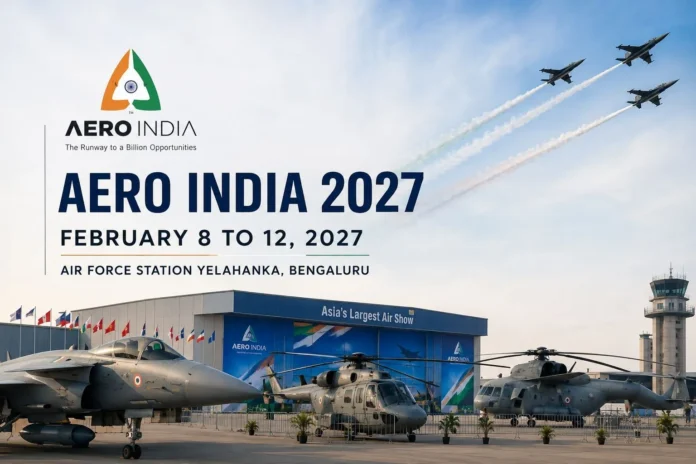
Aero India’s challenge is not a lack of ambition. It is the distance between the show’s strategic promise and the experience of people expected to deliver its business, report its achievements and make its brand meaningful. The 16th edition, scheduled for February 8-12, 2027 at Yelahanka, Bengaluru offers aerospace and defence planners and organisers an opportunity to close that gap. The event should be treated as a national showcase – facilitating at the core, a professional international marketplace aligned to country’s brand identity and equity.
The distinction matters. Aero India is India’s flagship biennial aerospace and defence exhibition, organised by the Department of Defence Production. In 2025, it had three business days followed by two public days. Yet, according to observations from attendees, families associated with the organising public-sector undertakings crowded the venue from the opening day, leaving limited room for business and media to work effectively. This highlights the point that the show’s operating priorities need sharper definition.

The problem is not that families or the public should be excluded. Their enthusiasm is part of an air show’s appeal, and public engagement can inspire future engineers and aviation professionals. The problem is unmanaged access and inadequate separation of functions. A trade exhibition must give exhibitors room to demonstrate products, hold meetings and develop leads in a conducive atmosphere. Journalists need working space, reliable access and facilities to produce accurate coverage. Public visitors need safe routes, clear information and a compelling viewing experience. When these needs compete for space without effective crowd planning, everyone loses, and the event’s commercial value is diminished.
The Paris and Dubai air shows offer useful, though different, models. Paris separates its trade days from its public days, reserving the opening part of the event for business and industry before opening to public visitors over the weekend. Dubai makes the distinction more explicit: its main air show is a business trade event for industry professionals, while members of the public can attend a separate SkyView experience to watch flying displays.
Following 2025 complaints of early crowding by PSU families, organisers must adopt the discipline of the Paris and Dubai air shows, strictly separating trade days from public viewing to preserve commercial deal-making
Dubai also advertises a dedicated media centre with facilities and privileged access to announcements. These approaches do not mean public engagement is unimportant; they show that it can be organised without allowing public access to overwhelm the professional purpose of the exhibition.
Aero India’s own schedule already provides a foundation for such a system. The task is to make the distinction work on the ground. Business and media access should be controlled and enforced during trade days, with clear accreditation, visitor screening and crowd limits in high-demand areas. Public-sector employees and their families should not be allowed to overwhelm the professional environment before public days begin. Organisers can recognise their contribution through designated access, staff events or reserved visiting periods. The principle is simple: access should be planned around the purpose of each day.

The physical layout also needs reconsideration. At Yelahanka in 2025, attendees reported that the static and logistical display areas were spread across a vast expanse of tarmac, requiring business visitors and media to walk long distances without accompanying mobility services. At an airfield, safety and aircraft movement constrain where vehicles can travel. But that makes careful design more important, not less.
To eliminate exhausting walks across vast tarmac expanses, planners need to build frequent shuttle loops, clear pedestrian corridors, rest zones and live wayfinding directly into the site design
A published site map should show distances, entrances, meeting points and accessible routes. Frequent shuttle loops, clearly marked pedestrian corridors, resting areas, water points and live wayfinding should connect halls, media facilities and static displays. Transport and visitor circulation belong in the original layout plan, not as afterthoughts.

Media facilities deserve the same attention as exhibition stands. Attendees described the 2025 media area as inadequate and the catering for journalists as below standard. These may sound like secondary complaints beside defence deals and aircraft displays. But they are not.
A poorly equipped press centre makes it harder to file stories, conduct interviews and transmit images on deadline. A professional media centre should provide dependable connectivity, power, seating, quiet interview areas, briefing rooms, clear access to aircraft and officials, and adequate catering for long working days. Accreditation should be straightforward, information prompt, and press transport linked to key venues.
Dubai’s approach underscores that media operations are part of the event’s design: organisers promote a dedicated media centre, press information and access to announcements, rather than treating journalists as ordinary spectators. Its main show is also clearly identified as a professional trade event, while the public-facing viewing experience is distinct. Aero India need not copy Dubai’s format exactly. It should adopt the underlying discipline: define each audience, provide for its needs, and protect the work the event is meant to enable.
Rather than treating journalists as spectators with subpar catering and cramped spaces, the 2027 show must deliver a world-class press centre with reliable connectivity, briefing rooms, and dedicated transport
The business case for fixing these shortcomings is clear. Aero India is not merely a spectacle; it is a platform for procurement, partnerships, industrial investment and export promotion. But attendance figures and announcements alone do not establish global leadership. Exhibitors return when they can meet the right customers, navigate the venue and trust that the event is professionally run. Media coverage follows when journalists can report efficiently. A brand becomes credible through repeated delivery, not slogans.
That is also how Aero India should brand India. The country’s identity at the show should be more than military hardware and national symbolism. It should communicate a credible proposition: India is a serious buyer, a growing manufacturing partner, a source of engineering talent and a place where international firms can build long-term industrial relationships.
The brand must be backed by evidence – clear pathways to partnerships, strong support for smaller suppliers, technical forums, well-run business meetings and reliable logistics. A global air show should make it easy to see not only what India wants to buy, but what it can design, manufacture, maintain and export with partners.
The lesson from multinational aircraft programmes is that global industrial capacity is built through organised cooperation. Airbus grew from European aerospace companies joining forces to develop commercial aircraft and compete with established manufacturers. The Franco-German Transall C-160 and the multinational Panavia Tornado offer other examples of pooled technical capability and resources.
To shed its merely “aspirational” tag, Aero India 2027 must track success not by raw footfall, but by repeat exhibitors, export leads and tangible multinational partnerships
These programmes are not templates to copy wholesale: they required sustained political commitment, agreed roles, shared technical work and the ability to manage differences among partners. The takeaway for India is practical. Aero India should be a place where such partnerships are negotiated and made visible, not merely advertised through pavilion displays.
Aero India 2027 should set measurable goals: professional days protected for business; media facilities benchmarked against leading international shows; shuttle services across the site; clear crowd-management plans; and feedback gathered from exhibitors, journalists and visitors. It should also track outcomes beyond attendance, repeat participation, business meetings, supplier partnerships, technology collaboration and export opportunities.
Being ambitious is not enough. India’s defence-export objectives, Aatmanirbhar Bharat and Viksit Bharat require practical choices as well as confidence. Aero India has earned international attention; now it must convert attention into trust, access and opportunity.
The question for planners is not whether India can aspire to join the world’s leading air shows. It is whether they will organise the event so businesses can do business, journalists can report and the public can enjoy it, without one audience crowding out the others.
Overall, the moot question is how long Aero India will remain aspirational to position itself as the world’s leading air show. To become one, its planners should plan the event keeping this as a priority, and 2027’s show should prove it.

-The writer is a New Delhi-based senior commentator on international and strategic affairs, environmental issues, an interfaith practitioner, and a media consultant. The views expressed are personal and do not necessarily carry the views of Raksha Anirveda






