


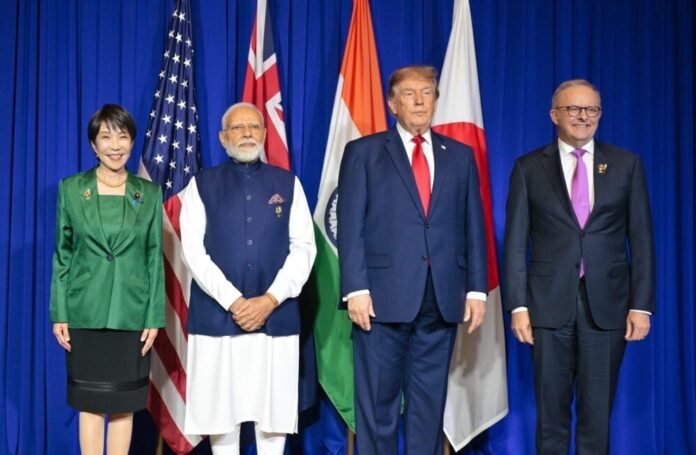
When Prime Minister Narendra Modi, President Donald Trump, Prime Minister Sanae Takaichi and Prime Minister Anthony Albanese met in Manila on November 17, it was the 7th Quad Leaders’ Summit and the first since Joe Biden chaired the grouping in Delaware on September 21, 2024. The gap was not accidental. The summit India was due to host in 2025 never happened, as the grouping lost momentum amid tensions between Washington and New Delhi over tariffs. For two years the Quad survived largely at the level of foreign ministers, who met three times in 2026 alone, in New Delhi, Manila and Atlanta.
A Summit After a Long Silence
The joint press release that followed Manila is short on rhetoric and long on mechanisms. It launches an Indo-Pacific Maritime Surveillance Collaboration, affirms a Super Intelligence Accelerator for trusted AI, expands the Quad Partnership for Cable Connectivity and Resilience, and steps-up cyber cooperation. It also announces an inaugural Quad Business Leaders’ Forum, to be hosted in Mumbai in early 2027. The leaders condemned terrorism in all its forms, including cross-border terrorism, language that carries weight in the Quad’s first summit since the Pahalgam attack.

Sceptics were quick to dismiss the meeting as “photo diplomacy”. That verdict is premature, but it is not baseless. The real test of Manila lies in two areas where the Quad’s ambitions meet hard material limits: critical minerals and the security of sea lanes. On both, India has more at stake than any other member.
Coming after a two-year hiatus strained by tariff tensions, the Quad leaders reconvened in Manila to pivot from broad rhetoric to concrete mechanisms in AI, undersea cables and maritime security
Minerals: The Deal Announced But Not Written Down
Critical minerals were the subject Trump stressed most. He said the four countries were increasing critical minerals and rare earths production to reduce dependence on concentrated sources of supply, and that new agreements had been signed. Yet, the joint press release speaks only of “securing critical supply chains” and voices “grave concerns about economic coercion, including through arbitrary export restrictions”. No counterparty, mineral or amount was named.
The omission matters because the groundwork already exists. Quad foreign ministers launched the Quad Critical Minerals Initiative in Washington in July 2025. In New Delhi on May 26, 2026, they formally launched a Critical Minerals Initiative Framework and pledged to mobilise US$20 billion in government and private money for mineral supply chains. What Manila needed to show was progress against that pledge. It did not.
The urgency is not abstract. China controls about 90 per cent of the world’s production of rare-earth magnets. When Beijing placed medium and heavy rare earths under export controls on April 4, 2025, Indian automakers were among the first to feel it, having sourced nearly 90 per cent of their rare-earth permanent magnets from China in 2023-24 and 2024-25. A further round announced on October 9, 2025 extended curbs to batteries and industrial diamonds.

The Quad has a natural place to start. Its four members share 20 critical minerals on their national lists; India lists 30 and the United States 50. That overlap is a ready-made agenda for joint stockpiles, offtake agreements and processing ventures.
New Delhi has made this argument consistently. At the BRICS summit in Rio de Janeiro in July 2025, PM Modi said that no country should weaponise critical minerals, technology or supply chains for selfish gain. The Quad gives India a smaller, more like-minded forum in which to turn that principle into practice, through projects rather than declarations.

Sea Lanes: From Awareness to Assurance
The maritime track produced the summit’s most concrete deliverable. The Indo-Pacific Maritime Surveillance Collaboration is designed to improve information sharing and maritime domain awareness. The four countries’ P-8 and P-3C patrol aircraft will fly a joint maritime exercise in 2027, the first in a Quad context. This builds on the Common Operating Picture in the maritime domain agreed by foreign ministers in May, and on the Partnership for Maritime Domain Awareness that PM Modi singled out in his remarks.
While Donald Trump touted new critical mineral agreements to counter Beijing’s rare-earth dominance, the joint statement lacked specifics, leaving the Quad’s $20 billion pledge awaiting real, bankable projects
For India, the timing could not have been sharper. On November 16, a day before the Quad summit, the Panama-flagged LPG tanker Tara Gas, carrying 24 Indian seafarers, was hit by a missile in the Strait of Hormuz. A second strike on November 17, caused another fire, and one Indian seafarer was then reported missing. This was no isolated incident. More than 20 ships came under attack in October alone, and in July an Indian crew member was killed when Iranian missiles struck two UAE tankers, prompting New Delhi to summon Iran’s deputy ambassador.
Hormuz lies outside the Quad’s Indo-Pacific remit, and none of the four would welcome a Quad role in the Iran war. The strait was the route for around a fifth of global energy supplies before the conflict began. The lesson still travels east. Surveillance tells a navy where a threat is; it does not protect a crew. With Indian seafarers repeatedly caught in the crossfire, their safety is becoming a core foreign-policy interest. The Quad’s maritime agenda should therefore cover crew safety, search and rescue and evacuation protocols, not only the tracking of grey hulls.
The China Question Nobody Names
Like most Quad documents, the Manila text names no country. The leaders strongly oppose destabilising or unilateral actions that seek to change the status quo by force or coercion, and they criticise arbitrary export restrictions. Everyone reads this as aimed at Beijing. But the summit fell in an unusual diplomatic week. From Manila, Trump headed to the APEC summit in Shenzhen, where he was expected to hold his third face-to-face meeting with Xi Jinping this year. That followed his visit to Beijing in May and Xi’s visit to Washington in September, when Trump took the rare step of greeting him on the tarmac. Trump has also revived the term “G2” to describe the two powers.
Beijing, for its part, has long criticised the Quad as a Cold War-style grouping aimed at containing its development. The irony is that the Quad’s most powerful member now talks to Beijing more often than the four leaders talk to one another.
The summit launched a joint maritime surveillance collaboration, but recent missile strikes on Indian-crewed vessels highlight an urgent need to expand the agenda from tracking ships to rescuing crews
This is the Quad’s structural dilemma. A partnership built on shared concern about Chinese coercion is now led, in Washington, by an administration that is also seeking a broader understanding with Beijing on trade, technology and rare earths. If such an understanding eased export controls for American firms but not for Indian, Japanese or Australian ones, the Quad’s minerals agenda would be hollowed out from within. Partners would then be left managing their vulnerability alone.
India cannot resolve this tension, but it can hedge against it. The sensible course is to treat the Quad as one layer of a wider minerals’ strategy rather than its foundation. That strategy should combine bilateral partnerships with Australia and Japan, wider ties with producers in Africa and Latin America, and India’s own domestic effort. Strategic autonomy, in this domain, means having more than one door to knock on.
What India Brings, And What it Needs
India comes to this agenda with real assets. The National Critical Mineral Mission, approved by the Union Cabinet on January 29, 2025, commits ₹16,300 crore of government expenditure and an expected ₹18,000 crore from public sector undertakings over seven years to 2030-31. It covers the whole value chain, from exploration and mining to beneficiation, processing and recovery from end-of-life products. A ₹1,500 crore recycling incentive scheme targets the recovery of 400 kilo-tonnes of material. Industry has adapted under pressure too: imports of permanent magnets more than halved in the first six months of 2025-26 as automakers began shifting away from heavy rare earths.
What India lacks is processing capacity and patient capital at scale. This is where the Quad can genuinely help. Australian ore, Japanese processing technology, American finance and Indian demand and engineering together form a natural value chain. None of the four can build it alone at competitive cost.
As Trump pursues “G2” diplomacy with Xi Jinping, India must treat the Quad as just one layer of its supply-chain strategy, hedging against a US-China deal that could leave other members vulnerable
Modi framed the business forum in precisely these terms. “To turn our strategic cooperation into commercial partnerships, India has announced the QUAD Business Leaders Forum,” he said. The Mumbai forum should therefore not become a networking event. It should be where the US$20 billion pledge turns into a list of bankable projects, with Indian firms as co-owners rather than mere buyers.
Five Tasks Before Mumbai
First, put the minerals deals on paper: Agreements announced orally but absent from the joint text invite doubt. A public annex listing minerals, projects and financing would reassure markets and give partners something to hold one another to.
Second, start with shared vulnerabilities: The 20 minerals common to all four national lists offer a ready agenda. Priority should go to the heavy rare earths hit by the April 2025 controls, through coordinated stockpiles and joint processing ventures.
Third, link minerals to maritime security: Ore, concentrates and magnets move by sea. Surveillance should cover the corridors that carry them, and connect to the Quad’s first joint infrastructure project, a port in Fiji, and the undersea cable projects planned in the Indian Ocean.
Fourth, put seafarers on the agenda: India should press for Quad cooperation on crew safety, medical evacuation and consular coordination in contested waters. The repeated attacks on Indian-crewed ships show that this is no longer a niche concern.
Combining Australian ore, Japanese tech, US capital and Indian engineering offers a natural value chain, making the upcoming Mumbai Business Leaders’ Forum the ultimate test of whether the Quad can deliver
Fifth, never again let two years pass between summits: Momentum in the Quad has always depended on leaders. An annual leaders’ meeting, whatever the state of bilateral ties, is the minimum discipline the grouping needs.
Beyond the Photograph
Manila showed that the Quad still matters to all four capitals. Its agenda has widened from vaccines and climate to minerals, cables, AI and patrol aircraft. Breadth, however, is not the same as delivery. The credibility of this revival will rest on whether the minerals deals become projects and the surveillance collaboration becomes real protection for ships and crews.
For India, the Quad is not an alliance and should not try to become one. It is a platform for building the industrial and maritime capacity that strategic autonomy requires. Mumbai, in 2027, is where that claim will be tested.
If the forum produces signed projects, Manila will be remembered as the moment the Quad moved from vision to supply chains. If it does not, the sceptics will have been proved right.

The writer is an independent researcher. The views expressed are of the writer and do not necessarily reflect the views of Raksha Anirveda






