


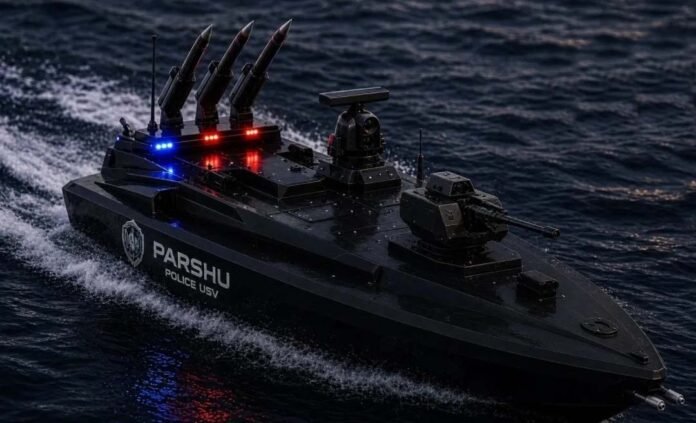
The programme focused on the practical application of artificial intelligence in the maritime domain, bringing officers from across India to INS Valsura, the Indian Navy’s Centre of Excellence for Artificial Intelligence. Participants explored large language model (LLM) fine-tuning through a hands-on format, as the Navy continues to build expertise in emerging technologies.
The collaboration between Parshu Tactical Defence and INS Valsura placed technical learning in a defence setting, where AI systems may need to work with specialised information and meet operational requirements. The three-day course gave officers an opportunity to engage directly with the process of adapting LLMs, rather than limiting instruction to a broad overview of the technology.

The programme’s maritime focus is significant because naval organisations work with large volumes of information spanning operations, maintenance, logistics and other functions. AI tools can help users search, organise and interpret such information, but their usefulness depends on the quality of data, careful evaluation and appropriate controls. Training officers to understand model adaptation can help them assess where the technology may be useful and where human judgement remains essential.
LLM fine-tuning involves adapting a pre-trained language model using selected examples or domain-specific material, with the aim of improving its performance on particular tasks. It differs from simply entering a prompt: fine-tuning changes model behaviour through additional training. In a maritime context, such work requires attention to the relevance and quality of source material, as well as testing for incorrect or unsupported outputs. The programme’s hands-on approach offered officers a chance to engage with these practical considerations.
The training also reflects a wider effort within the Indian Navy to incorporate artificial intelligence and machine learning into mission-critical areas. A Ministry of Defence account of the Navy’s AI work at INS Valsura notes that the institution has been involved in AI and big-data initiatives, including pilot projects in maintenance, human resources and perception assessment. The Navy has also described training in AI and machine learning as part of its development of personnel across different specialities.
Such initiatives highlight the role of institutions like INS Valsura in connecting technical developments with naval requirements. AI tools are not a substitute for professional expertise; their performance depends on sound data practices, clear use cases and oversight by trained personnel. Courses that combine technical instruction with domain-specific discussion can help officers develop a more grounded understanding of both the potential and limitations of the technology.

For Parshu Tactical Defence, the collaboration provided an opportunity to contribute to AI capacity-building in a naval environment. The programme brought an industry participant into a training setting led by the Navy’s AI centre, creating a forum for practical engagement between defence personnel and technology practitioners. The details provided for the event did not identify individual instructors, specific software platforms or the exercises undertaken, so the programme’s outcomes should be understood in terms of its stated focus and participation.
The gathering of 60 senior officers from across the country also offered a way to broaden familiarity with LLMs among naval personnel. As generative AI tools become more widely discussed, domain-specific training can help organisations move beyond general demonstrations and consider how models might be assessed for real tasks. For maritime users, that includes weighing accuracy, reliability and information handling alongside potential efficiency gains.

The three-day programme at INS Valsura marks a step in that learning process. By centering the course on hands-on LLM fine-tuning for maritime applications, Parshu Tactical Defence and the Navy’s AI centre aimed to give officers practical exposure to a fast-developing technology and its possible uses in naval work.
(Except for the headline, this story has not been edited by the RA staff and is published from a syndicated feed.)







