


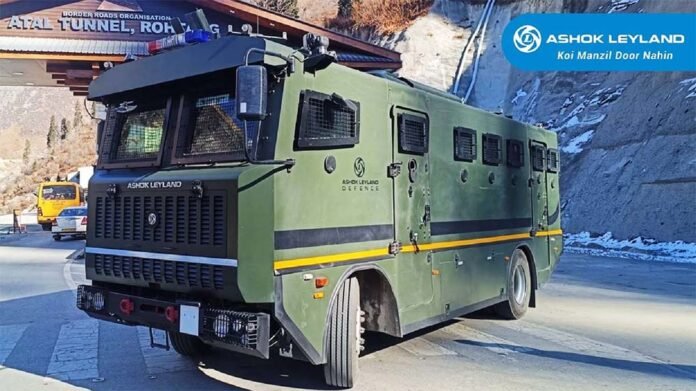
The new armoured troop transporter was flagged off on November 18, described as India’s first indigenously designed, developed and manufactured bullet- and blast-protected 28-seater armoured troop transporter. The company’s website lists an Armoured Troop Transporter (ATT) 4×4 among its defence vehicles. The rollout marks a step in a procurement programme intended to strengthen protected troop mobility in counter-terrorism and other high-risk operational settings.
The report says 124 vehicles are being produced under a Ministry of Home Affairs contract worth ₹187.24 crore. It identifies 109 vehicles for the Central Reserve Police Force (CRPF) and 15 for the Border Security Force (BSF). Those allocations point to the intended users, but the vehicle’s public rollout does not, by itself, confirm the delivery schedule or the date each force will begin operating its units.

The transporter is intended to carry troops in a protected vehicle rather than in soft-skinned buses that offer less resistance to ballistic or blast threats. The report says the project was envisaged in collaboration with security forces after the February 2019 Pulwama convoy attack. That context underscores the risks of moving personnel along vulnerable routes, though the vehicle represents one component of a wider security and convoy-protection effort.
Ashok Leyland’s product information for its ATT 4×4 identifies ballistic, mine-blast and underbelly protection, along with a 360-degree turret with a gun mount. Additional equipment on the 28-seater includes: a run-flat tyre system, pan-tilt-zoom surveillance cameras, an integrated command-and-control suite and climate control. The manufacturer’s website confirms core protection and turret features.
Run-flat tyres are intended to help a vehicle retain mobility after tyre damage, while surveillance cameras and command-and-control equipment can support situational awareness and coordination. The vehicle is also reported to have a modular design that can be adapted as a mobile command-and-control post, and to be capable of integration with unmanned ground vehicles and surveillance drones. These functions are described in the report; the public material does not provide detailed technical specifications or test results for those configurations.
The transporter is described as Central Motor Vehicles Rules-certified and designed to operate in harsh terrain and extreme weather. Certification and manufacturer claims offer useful indicators, but do not substitute for independently published details about ballistic or blast protection levels, testing protocols, or the exact threats against which the vehicle is rated. Such specifications were not included in the available reporting and company product page.

Ashok Leyland has experience in producing vehicles for defence applications. In 2021, it delivered a light bulletproof vehicle to the Indian Air Force, a separate platform that was reported as indigenised and developed in India. That earlier delivery provides context for the company’s defence-vehicle work, but it should not be confused with the larger 28-seater transporter now being rolled out.
For CRPF and BSF personnel, protected transport can reduce exposure during movement through areas assessed as dangerous, while vehicle-mounted cameras and communications equipment may assist coordination. The vehicles are expected to support operations in Jammu and Kashmir and other high-risk zones, according to the report. Their operational value will depend on deployment, crew training, maintenance and how they are incorporated into existing convoy procedures.

The immediate milestone is the flag-off, not the completion of all 124 deliveries. The programme’s impact will become clearer as vehicles reach their assigned forces and are put into service. The reported contract and allocations outline the scale of the rollout; further official information on delivery progress, protection specifications and deployment would clarify how the fleet will be used.







