


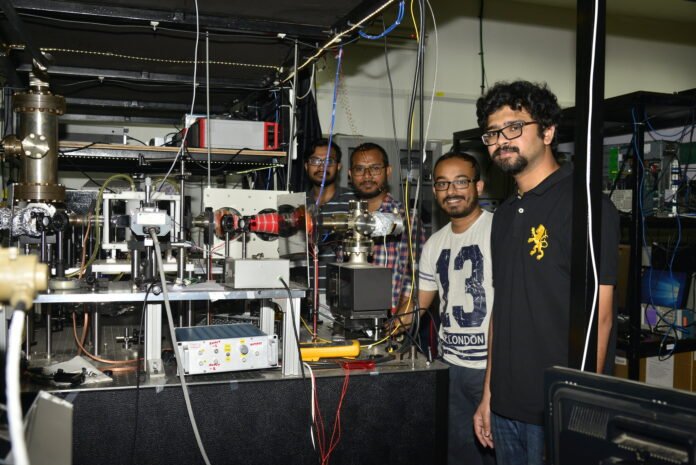
The prototype, developed by the deep-tech startup incubated at IISER Pune’s I-HUB Quantum Technology Foundation, is intended to support India’s efforts to build domestic precision-timing technology. The company completed it in seven months and is targeting a miniature version by August 2027.
Atomic clocks keep time by using the stable behaviour of atoms as a reference. That precision is vital to satellite navigation: a receiver estimates its distance from a satellite by measuring how long a signal takes to arrive. Errors in satellite timing can therefore translate into errors in positioning.

QuPrayog’s prototype uses rubidium-87 atoms and a technique called Coherent Population Trapping (CPT). In this approach, laser light interacts with atoms to produce a stable frequency reference. The company says the method could help make the clock smaller and less power-hungry than designs that rely on microwave cavities.
Laboratory tests recorded frequency stability of approximately 3 × 10⁻¹⁰ over one second, improving to around 2×10⁻¹¹ over 100 to 1,000 seconds, the company reported. It also said the system improved an ordinary crystal oscillator’s stability by about 50 times over 1,000 seconds. These are prototype test results; the report did not describe an in-orbit demonstration or deployment on a satellite.
The next phase will focus on improving performance and reliability, as well as packaging the system in a smaller form. The company’s longer-term plans include compact, rugged clocks for satellite navigation, telecommunications and scientific instruments, along with work on optical atomic-clock technology. Whether the prototype can meet the strict size, power, reliability and environmental requirements of spaceflight will need to be established through further development and testing.
The work has potential relevance to India’s navigation infrastructure. The country operates NavIC, its regional satellite navigation system, and satellite-based positioning depends on accurate timing. ISRO’s NVS-01, launched in 2023, carried an indigenous rubidium atomic clock developed by the Space Applications Centre in Ahmedabad, marking an existing national effort to develop clock technology for navigation satellites.

That progress does not mean QuPrayog’s device is ready for NavIC or any other satellite programme. The startup’s prototype remains at laboratory scale, and the report does not say it has been selected by ISRO or qualified for space. Its stated ambition is to reduce reliance on imported atomic clocks and build an Indian supply chain for high-performance timing systems.
The importance of the technology extends beyond navigation. Mobile and telecommunications networks rely on precise synchronisation, while defence and other strategic systems may need dependable timing when satellite-navigation signals are weak or unavailable. The startup says its clock could serve applications including GPS-denied navigation, but the prototype’s reported results do not establish performance in those operational settings.

QuPrayog was founded in 2024 by Jay Mangaonkar and Rahul Sawant and is also incubated at the IIT Madras Incubation Cell, the report said. Its development receives support from India’s wider deep-tech ecosystem, including the National Quantum Mission. Approved in 2023, the mission has an outlay of ₹6,003.65 crore over eight years and includes quantum sensing and precision measurement among its focus areas.
The prototype is an early step toward a difficult engineering goal: converting laboratory precision into a compact instrument able to operate reliably in demanding settings. If further testing and miniaturisation succeed, the technology could broaden India’s options for home-grown timing systems. For now, the August 2027 miniature-version target is the next milestone, not a guarantee of satellite deployment.







