


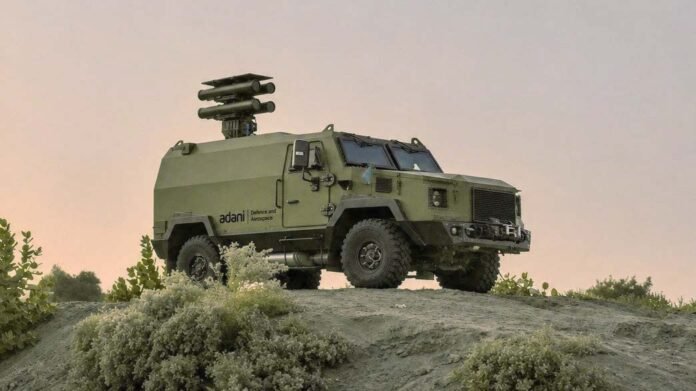
Adani Defence & Aerospace has demonstrated its Bagheera AT1 vehicle-mounted anti-tank guided missile system at the Pokhran Field Firing Ranges in Rajasthan, reporting successful trials involving four missiles. The No Cost No Commitment (NCNC) demonstration took place on November 20 and was witnessed by senior representatives of the Indian Army, the Department of Military Affairs and the Ministry of Defence, the company said.
The programme tested day and night engagements, a two-missile tandem firing along a single beam against a target representing an armoured vehicle, and an engagement against an aerial target at extended range. A static display of the complete system followed. The company described the event as an opportunity for the armed forces to assess the platform; it does not, by itself, indicate that the Army has ordered or inducted the system.

Bagheera AT1 combines a missile, an automated launcher and day-and-night sights mounted on an Adani Defence-designed 4×4 high-mobility armoured vehicle. The company says the system was developed over 18 months and customised for Indian terrain, climate and operational requirements. It is intended to offer a mobile, vehicle-based option alongside man-portable and helicopter-launched anti-tank systems.
The company puts the system’s anti-armour engagement range at up to 8 kilometres. Its release also says the wider missile architecture can support guided engagements of up to 10 kilometres, a distinct claim that should not be confused with the stated anti-armour range. The missile uses laser beam-riding guidance rather than a radio link, which Adani says makes it highly resistant to electronic jamming.
A central feature demonstrated was tandem firing: two missiles launched in quick succession along the same beam toward one target. Adani says the first is intended to engage a tank’s active protection system, while the second is designed to penetrate its defences. The launcher carries four ready-to-fire missiles, with eight reloads onboard, for a stated total capacity of 12 per vehicle. The system also incorporates television and thermal-imaging sights with automated target tracking.
The test comes as India continues to modernise its anti-tank missile inventory. The company’s release describes Milan-2T and Konkurs-M as part of the in-service backbone, notes the induction of Spike missiles, and says India is progressing with the acquisition of Javelin systems. These references provide context for the demonstration, but do not establish how Bagheera AT1 would fit into any future procurement or deployment plan.

The trial also reflects the growing role of private firms in India’s defence manufacturing sector. The company cited defence production of ₹1.78 lakh crore in FY 2025-26, with private-sector production accounting for 24 per cent, or about ₹42,000 crore. It also reported defence exports of ₹38,424 crore for the year. The figures are presented in Adani’s release and describe the wider sector, rather than the company’s own output.
For now, the Pokhran event marks a demonstration and evaluation milestone, not a confirmed acquisition. Any decision on procurement would depend on the armed forces’ assessment and the government’s process. Adani says it has developed, integrated and tested the complete system for evaluation. The trials showcased its claimed range, mobility and day-and-night capability; further official information would be needed to establish test results beyond the company’s account or the system’s eventual service status.








