


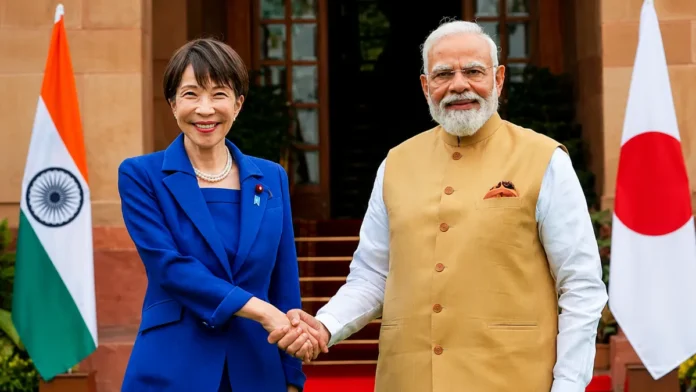
Defence Minister Rajnath Singh and External Affairs Minister S Jaishankar are in Tokyo for the fourth India-Japan Foreign and Defence Ministers’ Dialogue, known as the 2+2. The meeting brings together the two countries’ foreign and defence ministers to review security cooperation and discuss regional and global developments. Singh is also holding bilateral discussions with Japan’s Defence Minister Shinjiro Koizumi, while Jaishankar is due to participate in a separate strategic dialogue with Japanese Foreign Minister Toshimitsu Motegi.
The talks follow a series of engagements this year, including Koizumi’s visit to New Delhi in August and meetings on the sidelines of the ASEAN Defence Ministers’ Meeting-Plus in Cebu in October. The ministers are expected to build on those discussions by looking at defence technology and equipment, maritime security, defence-industry links and more complex joint exercises across the three services.

A central task is to turn the two governments’ broad strategic alignment into practical cooperation. The agenda includes strengthening maritime security coordination and expanding the scale and sophistication of joint military exercises. Both sides are also expected to consider closer industrial collaboration, including ways to connect Japanese technology with India’s manufacturing capacity.
The focus on the sea reflects the countries’ strategic geography: Japan depends on secure maritime routes across the Indo-Pacific, while India’s security and trade interests extend across the Indian Ocean. A maritime security arrangement signed during Koizumi’s August visit provides a framework for deeper cooperation. Areas identified include warship-building, mine-countermeasure capabilities and ship repair, according to reporting on the talks.
The relationship has developed through repeated dialogues, defence agreements and military exercises, but officials and analysts have pointed to the need for tangible outcomes. A 2024 joint statement from the previous 2+2 meeting welcomed progress on the transfer of Japan’s UNICORN integrated communications antenna and related technology, and called for faster cooperation on defence equipment. It also noted that the two navies were exploring ship-maintenance cooperation in India.
The UNICORN project is one example of the challenge of moving from agreements to delivery. A cooperation memorandum involving Bharat Electronics Limited was signed in November 2024, while further steps toward implementation were discussed in 2026. The antenna system has become a visible test of whether the countries can translate a long-standing defence-technology partnership into concrete joint work.

Exercises are another route to greater interoperability. India and Japan conduct a range of service-to-service drills, and both governments have signalled interest in making them more demanding. In 2026, Japanese fighter aircraft joined the Veer Guardian exercise in India for the first time, while discussions have included integrating unmanned systems and expanding training opportunities.
The ministers are also expected to exchange views on developments in the Indo-Pacific and reaffirm their commitment to a free, open, inclusive and rules-based regional order. Their 2024 joint statement underscored support for ASEAN’s central role and peaceful resolution of disputes, while condemning attempts to change the status quo by force.

The fourth 2+2 meeting thus comes at a point when both sides are seeking a more operational and industrial dimension to their partnership. Its impact will depend not only on the commitments made in Tokyo, but also on whether the two governments can advance projects, sustain military exchanges and deepen cooperation between their defence industries.







