


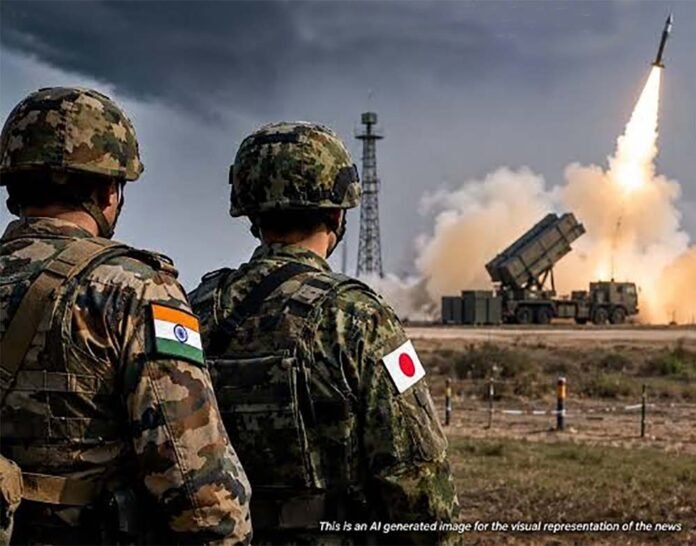
India and Japan signed a Letter of Intent (LoI) on the use of Indian firing ranges by Japan’s Self-Defence Forces (JSDF) at the fourth India-Japan Foreign and Defence Ministers’ Dialogue, known as the 2+2 meeting, in Tokyo. The ministers agreed to accelerate coordination between their defence authorities to put the arrangement into effect. The LoI establishes a framework for cooperation; it is not, by itself, a detailed schedule of exercises.
The plan marks a first: Japanese forces are to conduct live-fire training at facilities in India, including exercises involving surface-to-ship missiles, according to reporting on the announcement. The specific range, dates, participating units and operational details were not disclosed. Nor was a timetable given for the first training activity.

The agreement was among a broader set of outcomes from the Tokyo meeting, attended by India’s Defence Minister Rajnath Singh and External Affairs Minister S Jaishankar, and their Japanese counterparts, Defence Minister Shinjiro Koizumi and Foreign Minister Toshimitsu Motegi. The ministers discussed widening military exercises, maritime security, defence technology and industrial cooperation.
The sides also agreed to make future military exercises more complex and include unmanned systems, while pursuing bilateral and multilateral drills at short notice. The announcement builds on recent activity: Japanese Air Self-Defence Force fighter aircraft took part for the first time in the India-Japan air exercise Veer Guardian 26, held in India, according to the meeting’s coverage. The two countries also conducted a trilateral naval Passage Exercise with Indonesia in February 2026.
The proposed firing-range access adds a practical training element to the partnership. A live-fire exercise can allow forces to train with real weapons under controlled conditions, while exchanges of this kind may help armed forces become more familiar with each other’s procedures. However, the announcement does not specify whether the missile-related training would involve a particular weapon system, or whether the exercise would be bilateral or part of a wider drill.
Maritime security featured prominently in the talks. The two governments agreed to strengthen cooperation between the Indian Navy and Japan Maritime Self-Defence Force, including maritime and air domain awareness, search and rescue, information sharing and humanitarian assistance and disaster relief. They also discussed mine-countermeasure capabilities and possible cooperation in naval shipbuilding and design.

Defence industry cooperation is another strand. The ministers reaffirmed work under the “Design with Japan, Make in India” framework and looked forward to progress on the UNICORN project, which involves co-development of integrated antenna masts for Indian Navy warships. They also discussed a Maritime Ship Repair Arrangement that would enable both countries to use each other’s ship-repair facilities.
The agreements reflect a steady expansion of India-Japan defence engagement, from exercises and maritime coordination towards more operational and industrial links. They also come amid increasing attention to security in the Indo-Pacific, where both countries have interests in maintaining safe sea lanes and regional stability. The officials’ statements frame the cooperation as part of a strategic partnership, not as a military alliance.

For now, the firing-range initiative remains at the coordination stage. Its practical significance will depend on how the two governments settle access, safety procedures, scheduling and the scope of training. The LoI signals political intent and provides a basis for that work; further implementation details are needed before the first live-fire session can be confirmed.
(Except for the headline and intro para, this story has not been edited by the RA staff and is published from a syndicated feed.)







