


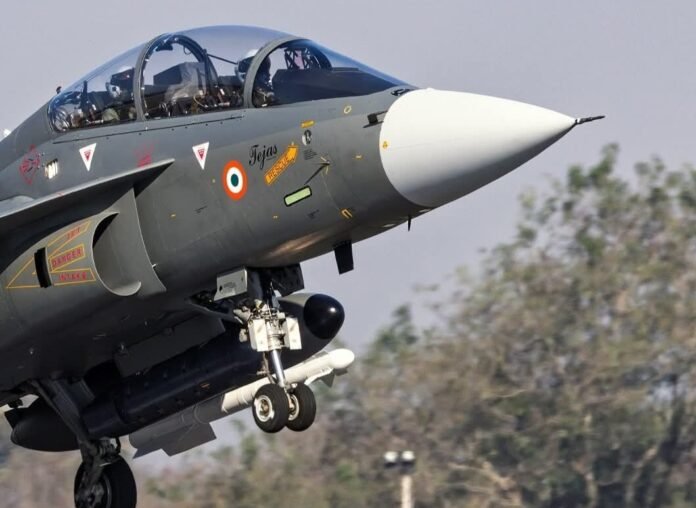
Somewhere on a factory floor in Bengaluru, a robotic arm may soon help decide how quickly India rebuilds its fighter strength. The Indian Air Force (IAF) has only 29 fighter squadrons against a sanctioned 42, a shortfall of about 13 just as older jets are being retired. Every new aircraft counts, and none is awaited more keenly than the Tejas Mark 1A.
The programme now has a firm date. Air Chief Marshal Ashutosh Dixit has indicated that induction will begin within the current financial year, and the first one or two jets could arrive as early as January 2027. The goal is a full squadron, normally 18 aircraft, by March 31, 2027. With 180 fighters on order, that squadron would be only the opening chapter.

Why is this jet worth the wait? Its AESA radar works like thousands of tiny electronic eyes looking in many directions at once, spotting threats sooner. Beyond-visual-range missiles let a pilot strike an enemy long before it can be seen. Its electronic warfare suite acts as a shield of noise and deception that confuses hostile radars. Together they mean earlier warning, longer reach and better survival.
Deliveries were first promised for February 2024, and the reasons for the slip are spread across many doors. The largest single hurdle lay outside India. GE Aerospace of the United States fell behind on the F404-IN20 engine, and the first unit arrived only in March 2025. HAL kept building regardless. In February 2026 it reported five jets fully ready and nine more already built and flown, awaiting engines. Its then chairman, Dr DK Sunil, had long maintained that the engine was the central obstacle, and the parked airframes largely support that view.
The engine, though, was not the whole story. Modern fighters are essentially flying computers. On the Mark 1A, the mission computer is Indian, the radar Israeli, the electronic warfare kit from another source and the weapons Indian. Making them talk to one another depends on software, which is why “source code issues” kept surfacing. Picture an orchestra where every musician reads a different notation; someone must translate before the music can play. Foreign partners, DRDO and HAL all shared that translation work, and it took longer than anyone had planned.
The IAF, for its part, chose not to accept jets without their key weapons, and that decision deserves understanding. Recent conflicts, including Operation Sindoor, showed that air combat rewards whoever sees first and shoots first. A jet meant for air defence and ground attack, lacking long-range weapons, would have to fly dangerously close to enemy defences. That firm stand brought the IAF, Israeli partners, DRDO and HAL to one table.

Speaking to CNN-News18, Air Marshal RGK Kapoor said responsibility is widely shared, though he felt HAL must do better on transparency, accountability and communication. He also pointed to a structural knot: DRDO designs the aircraft, HAL builds it and the IAF flies it. With three agencies in the chain, finding exactly where a fault lies becomes the hardest task.
HAL, meanwhile, is visibly changing gear. Its present chairman, Ravi Kota, has placed sharp emphasis on automation. A recent order brings robotic drilling to Tejas wing assembly through a consortium led by Bengaluru-based ADD Engineering Components (India), with True Position Robotics of the United Kingdom supplying systems proven on Boeing and BAE programmes. Each wing needs about 8,000 holes, and a technician with a hand drill spends 25 to 35 minutes on every one. The robotic cell must finish a hole, countersink included, in under 60 seconds. Work that once swallowed weeks per wing set would shrink to days. It is a classic example of a leadership determined to match manufacturing pace with national need.

The path forward is clear. Timelines must be realistic, coordination quicker, and integration risk planned for from day one. A central record of everything learnt on the Mark 1A, much like the reviews the IAF conducts after operations, would spare future projects the same pain. The next 97 aircraft and the Mark 2 should move faster, with the Indian Uttam radar and a maturing Astra Mark 2 missile.
One worry lingers. Because every component is linked, any delay in signing for the F414 engine could see the Mark 2 repeat the same story, while the indigenous Kaveri engine remains a debate of its own. For the pilots and technicians who have waited years, March 2027 is far more than a date on a calendar. It is a promise the nation cannot afford to break.

-The writer is an award-winning science communicator and a Defence, Aerospace & Geopolitical Analyst. He is the Managing Director of ADD Engineering Components India Pvt. Ltd., a subsidiary of ADD Engineering GmbH, Germany. You can reach him at: girishlinganna@gmail.com. The views expressed are personal and do not necessarily carry the views of Raksha Anirveda






