


MBDA Deutschland and ATMOS Space Cargo signed a cooperation agreement on November 18 to examine whether orbital transport and atmospheric re-entry technologies could support a future precision-strike system. The initiative, named Precision Orbital Deep Strike (PODS), is at an early stage: the companies say initial work will cover system architecture, technical feasibility, military-payload integration and possible technology demonstrations. No development budget, operational schedule or procurement commitment has been announced.
The concept pairs ATMOS’s experience developing spacecraft and re-entry systems with MBDA’s defence-systems and military-payload expertise. ATMOS WORKS, the company’s unit serving European government and defence customers, will lead its part of the effort. MBDA Deutschland Managing Director Thomas Gottschild described the collaboration as part of the group’s broader space strategy and its goal of developing a sovereign European capability.

In broad terms, an orbital vehicle would carry a conventional payload into space and later return it through Earth’s atmosphere. The companies have not publicly specified the system design, the payload type, how it would be launched, or how a strike mission would be controlled. The partnership’s immediate purpose is to assess the architecture and integration challenges, not to announce a tested weapon or an operational system.
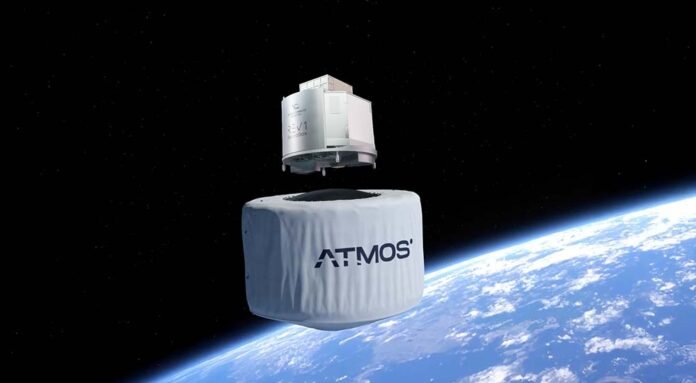
ATMOS’s civilian PHOENIX spacecraft provide some background to its role, but the company has explicitly separated that programme from PODS. PHOENIX is intended for orbital logistics and returning research or industrial cargo to Earth; PODS is described as a dedicated defence system. The experience and technologies may be relevant to the study, but the announcement does not say that a PHOENIX vehicle will be converted into a weapon or used for the project.
ATMOS has demonstrated part of its reentry technology in flight. Its PHOENIX 1 capsule launched aboard a SpaceX Falcon 9 on the Bandwagon-3 rideshare mission in April 2025. The company reported that the capsule transmitted data and deployed its inflatable heat shield during re-entry. Recovery was not conducted after a change to the re-entry trajectory, according to launch-services provider Exolaunch. That test was a technology demonstration, not a precision military strike test.
Turning orbital transport and re-entry into a military capability would involve challenges beyond bringing a payload back through the atmosphere. A system would need to meet requirements for reliable navigation, predictable timing, payload survival, communications and accuracy, while also accounting for the cost and complexity of launching and maintaining orbital hardware. Defence analysts have stressed that the agreement is a feasibility effort; neither company has disclosed evidence that these demanding operational requirements have been achieved.

The proposal also raises questions about strategic stability and international law. The 1967 Outer Space Treaty prohibits placing nuclear weapons and other weapons of mass destruction in orbit, but does not impose a general ban on conventional weapons in Earth orbit. That does not mean any particular deployment or use would automatically be lawful: international law still applies, and governments would have to assess the system and its use under relevant legal obligations. The companies say any future deployment would be subject to applicable law and decisions by responsible authorities.
The agreement reflects Europe’s push to develop more defence and space capabilities through its own industrial base, and the growing overlap between commercial space technology and military planning. ATMOS chief executive Sebastian Klaus has framed orbital transport and return as strategic infrastructure, while MBDA says the work supports its vision for defence in space. Those ambitions remain aspirational: the companies have not set out a programme timetable or disclosed a path from study to deployment.

For now, PODS is best understood as a joint investigation into a technically ambitious concept, not a weapon ready for service. The next milestones will be whether the companies define a feasible system architecture, identify the required technologies and agree on any funded demonstration. Until then, claims of rapid global reach or precision should be treated as possibilities associated with the concept, not demonstrated performance.







