


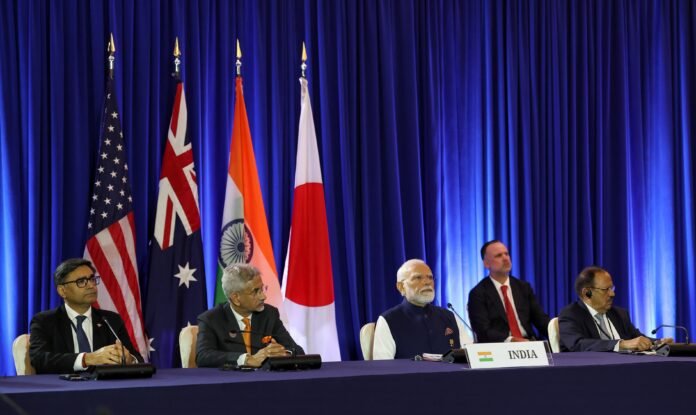
The leaders of India, the United States, Australia and Japan agreed to deepen practical cooperation across the Indo-Pacific at their first summit in more than two years. The November 17 meeting, held in Manila on the sidelines of regional gatherings, produced commitments on maritime monitoring, cyber threats, artificial intelligence, business ties and connectivity.
A key announcement was the Indo-Pacific Maritime Surveillance Collaboration, intended to improve information-sharing and maritime-domain awareness. The four countries said their patrol aircraft would conduct a maritime exercise in a Quad setting for the first time in 2027. The planned flights are to involve P-8 and P-3C aircraft, according to the summit’s joint press release.

The initiative builds on existing efforts to track activity across a vast region where shipping lanes, fishing grounds and strategic waterways are vital to national economies. Better coordination could help partners build a more complete picture of maritime activity and respond to shared challenges. The statement also pledged work with regional partners to keep maritime transit corridors open, safe and resilient.
Cybersecurity was another central focus. The leaders pointed to a rapid rise in the number and scale of cyber incidents across the region and announced enhanced Quad cybersecurity cooperation. The countries plan to work together toward an open and secure cyberspace, though the public announcement did not detail specific new joint operations, funding or implementation timelines.
The summit also endorsed continued work on trusted artificial intelligence. Leaders reaffirmed the AI Accelerator, announced earlier by their foreign ministers, which is intended to coordinate and fund efforts to support access to trusted AI, its deployment and technical assistance across the Indo-Pacific. The focus reflects growing concern that AI can be misused in cyberattacks and other harmful activity, while also presenting opportunities for public services and economic development.
Economic cooperation also, featured in the package. The leaders announced an inaugural Quad Business Leaders’ Forum for early 2027, bringing together business representatives, officials and policy experts. The forum is intended to strengthen commercial ties and encourage partnerships across the four countries, including deals considered important to regional prosperity.

The joint statement also highlighted cable connectivity and resilience. The Quad said its partnership had expanded access to secure communications infrastructure and welcomed an expanded Australian contribution focused on electricity cables. It also pointed to forthcoming undersea cable projects in the Indian Ocean, which are intended to improve regional connectivity. The announcement links digital infrastructure with energy security, both increasingly important to economies reliant on cross-border networks.
The leaders reaffirmed support for a free, open and stable Indo-Pacific and opposed unilateral attempts to change the status quo through force or coercion. They also voiced concern about economic coercion, including arbitrary export restrictions, and backed ASEAN’s central role in regional affairs. Their statement condemned terrorism and violent extremism, including cross-border terrorism, and committed to strengthening cooperation against such threats.

The Manila summit came amid heightened strategic competition in the Indo-Pacific and questions about the durability of multilateral partnerships. The Quad, an informal grouping rather than a treaty-based alliance, has broadened its agenda over time, adding practical cooperation in areas such as health, infrastructure, disaster response and technology alongside security issues. Its leaders described the partnership as focused on delivering tangible benefits to the region.
The new announcements establish a forward programme, but their impact will depend on follow-through: whether information-sharing improves, the planned patrol-aircraft exercise takes place, and cyber and AI cooperation translates into concrete support for regional partners. The 2027 business forum and maritime exercise will offer early tests of the group’s ability to turn summit commitments into sustained activity.







