


Latin America has historically been viewed as a ‘distant frontier’ in India’s foreign policy calculus because of the vast physical distance, limited direct maritime and aviation connectivity, language barriers, and competing geopolitical priorities. However, over the last few decades, this has changed through high-level diplomatic and economic push, and Latin America has transitioned from a neglected periphery to an active component of India’s strategic imagination.
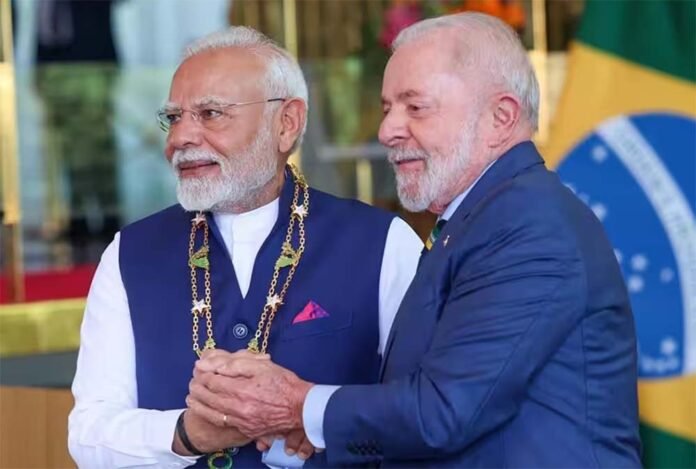
Prime Minister Modi’s recent visits to Brazil, Argentina, and Trinidad and Tobago mark a turning point in New Delhi’s outreach towards Latin America and the Caribbean
India’s engagement with Latin America is gaining momentum, marked by Prime Minister Narendra Modi’s recent visits to Brazil, Argentina, and Trinidad and Tobago. Amid rising Chinese influence, sustained political engagement and targeted investments are key to unlocking Latin America’s potential for India’s benefit. India needs a multifaceted strategy that blends economic engagement with public diplomacy and more official visits at higher political levels.

India must elevate Latin America from a peripheral trade partner to a central pillar of its foreign policy to secure critical resources, diversify supply chains, and strengthen Global South leadership. Historically constrained by the ‘tyranny of geography’, New Delhi’s strategic imagination is now shifting as Latin America undergoes major political, economic, and green-energy transformation.
India’s transformation from a peripheral actor to a crucial partner in Latin America was highlighted by Modi’s personalised diplomacy, which included diaspora engagements and joint declarations detailing ten-year roadmaps. Modi’s recent visits to Brazil, Argentina and Trinidad and Tobago mark a turning point in New Delhi’s outreach towards Latin America and the Caribbean.
India’s Strategic Scenario with Latin America
The past few decades have seen a revitalisation of the political relationship between India and Latin America, in line with the gradual but steady expansion of trade and investment ties in the 21st century. This is more evident in certain sectors like automobiles. Latin America is one of India’s most important markets for car, motorcycle, and auto parts exports. Nearly half of India’s motorcycle exports in 2024 and one-fourth of the country’s car exports were destined for the Latin American region.
The Latin American region accounts for roughly 15% to 20% of India’s petroleum imports and supplies copious amounts of vegetable oils and agricultural products to India
In fact, over the past four years, India has exported more cars to Chile than to the United States, with Peru next in line. After a gap of 38 years, Peru’s foreign minister, Elmer Schialer Salcedo, made a bilateral visit to India in March 2025, accompanied by the Foreign Trade and Tourism Minister and a large business delegation. India and Peru are expected to sign a Free Trade Agreement (FTA) this year, after multiple rounds of negotiations that began in 2017.

Modi’s Argentina trip was equally significant, the first bilateral visit by an Indian Prime Minister to Argentina in 57 years. The two countries called for enhancing cooperation in critical minerals. Argentina is part of the ‘lithium triangle’, which runs along the Andes Mountains with Bolivia and Chile, one of the world’s richest reserves, with 75% of global supply. This is particularly useful for India’s auto and tech industries, as well as oil, gas, defence, nuclear energy, and agriculture.
Why Latin America Matters Now
India is rightly positioned to diversify its economic partners. This presents a new window of opportunity to reassess regions that previously received less attention, such as Latin America. The Latin American region accounts for roughly 15% to 20% of India’s petroleum imports and supplies copious amounts of vegetable oils and agricultural products to India.

India’s immediate interest in Latin America is in critical minerals and Clean Energy. The region has abundant reserves of critical minerals such as copper, lithium, nickel, cobalt, and rare earths
No doubt Latin America can serve as an economic hedge for India. However, in this context, the following trends should be followed:
- India’s immediate interest in Latin America is in critical minerals and Clean Energy. The region has abundant reserves of critical minerals such as copper, lithium, nickel, cobalt, and rare earths. Indian companies have so far only managed to secure large supplies of copper from Latin America. Now India is trying to secure duty-free, long-term access to Chilean lithium and copper for its EV and green energy industries.
- The region’s ‘Lithium Triangle’ (Argentina, Bolivia, and Chile) holds over 75% of the world’s lithium reserves, alongside massive copper deposits. Securing these assets, such as India’s state-backed KABIL mining agreement in Argentina, is vital for India’s electric vehicle and clean energy transitions.
- The next important trend is Market Diversification and Export Growth. Argentina and Brazil are indispensable suppliers of edible oils and pulses, shielding India from domestic agricultural inflation. With bilateral trade hovering around $35 billion to $50 billion, the region is a high-growth market for Indian pharmaceuticals, automobiles, and IT services.
- Latin America already absorbs roughly one-third of India’s total automobile exports, entering the region’s value chains to shield Indian companies from uncertainties emanating from other countries or regions. Indian companies in the automobile, pharmaceuticals, agribusiness, and information technology sectors are already part of regional value chains in Latin America.
- Multilateral and Global South Alignment is another point for engaging major regional economies, including G20 members Brazil, Argentina, and Mexico. It amplifies India’s voice in multilateral forums like BRICS and the United Nations. India’s posture of strategic autonomy makes it an attractive, non-threatening partner for Latin American nations seeking to balance ties between the United States and China.
Key Bilateral Anchors
- Brazil: India’s largest regional partner and strategic anchor, featuring deep cooperation in biofuels, defence and oil, underlined by comprehensive multi-pillar roadmaps.
- Mexico: India’s second-largest trading partner in the region and the largest Latin American investor in India, focusing on automotive and pharmaceutical collaboration.
- Argentina and Chile: Crucial hubs for lithium, copper, and agricultural supply, with ongoing efforts to deepen preferential trade and comprehensive economic partnership agreements (CEPA).
Brazil is India’s largest regional partner and strategic anchor, featuring deep cooperation in biofuels, defence and oil, underlined by comprehensive multi-pillar roadmaps
Key Structural Challenges
Despite the rising momentum, structural bottlenecks continue to limit the full realisation of this partnership:
- Scale of Competition: China’s deeply entrenched economic footprint across South America heavily overshadows Indian trade volumes and capital deployment. China’s trade with Latin America exceeds $400 billion, backed by massive Belt and Road infrastructure projects like Peru’s Chancay port. India cannot match Beijing’s financial scale and must instead compete on value, technology, and equitable partnerships.
- Connectivity Deficits and Logistics Bottlenecks: The lack of direct maritime shipping lanes and commercial flights significantly inflates freight costs and transit times. Most trade currently relies on costly transshipment hubs in Europe, North America, or East Asia. Absence of direct flights and limited direct maritime shipping routes.
- Geopolitical and Domestic Fragmentation: Amid limited institutional bandwidth and political and economic shifts within Latin American states, a fruitful partnership requires constant diplomatic calibration. Despite recent openings of new embassies, India’s diplomatic footprint and institutional mechanisms such as the stalled India-CELAC dialogue remain under-resourced compared to its outreach in Africa or Southeast Asia.
India should offer its low-cost, open-source digital stack, such as UPI for payments and Aadhaar-style identity systems, to help Latin American nations to modernise financial inclusion and digital health platforms
Strategic Roadmap for Enhanced Engagement
To move from episodic outreach to sustained strategic partnership and to turn diplomatic momentum into lasting influence, India can prioritize four actionable shifts:
- Accelerate Trade Agreements: India should expand existing Preferential Trade Agreements (PTAs) with MERCOSUR and Chile while concluding ongoing fast-track Comprehensive Economic Partnership Agreements (CEPAs) with key economies like Chile and Peru to reduce tariff barriers. In September 2026, Commerce Minister Piyush Goyal and MERCOSUR’s Pro Tempore Presidency (Uruguay) formally launched negotiations to expand the PTA.
- Export Digital Public Infrastructure (DPI): India should offer its low-cost, open-source digital stack, such as UPI for payments and Aadhaar-style identity systems, to help Latin American nations to modernise financial inclusion and digital health platforms. Recently, both sides signed the First Additional Protocol to introduce electronic Certificates of Origin. This will reduce customs clearance delays and lower the compliance costs for Indian exporters.
- Expand Diplomatic and Institutional Bandwidth: Operationalise new resident missions across Central America and the Caribbean, institutionalise regular India-CELAC summits, and strengthen technical exchanges under the ITEC programme. The government should upgrade the India-CELAC dialogue to regular ministerial summits and establish dedicated regional desks to ensure sustained political attention beyond episodic state visits.
- Boost ties across Maritime, Aviation, Space, Defence and Pharma Cooperation: The Indian government should subsidise and incentivise direct shipping routes and air cargo links to reduce logistics costs for Indian exporters and Latin American commodity suppliers. India should also build on ISRO’s existing collaborations with regional space agencies, promote joint defense manufacturing, and establish local pharmaceutical hubs to position India as a reliable, non-hegemonic development partner.
The Indian government should subsidise and incentivise direct shipping routes and air cargo links to reduce logistics costs for Indian exporters and Latin American commodity suppliers
Conclusion
Latin America is rapidly transitioning from the ‘last frontier’ of Indian foreign policy to a vital pillar of its Global South leadership, resource security and multipolar diplomacy. India has expanded commercial exchange with Latin America, but strategic investment still needs to grow with a multifaceted strategy that blends economic engagement with public diplomacy and increasing official visits at higher political levels.
Accelerating trade architecture in Latin America involves upgrading India’s shallow Preferential Trade Agreements (PTAs) into deep, comprehensive pacts that lower tariff walls, secure critical mineral supply chains, and remove non-tariff barriers. Indian companies are now looking at Latin America as the next investment destination in sectors such as IT, pharmaceuticals, energy, mining, manufacturing, and agrochemicals.
Ultimately, bringing Latin America into the center of India’s strategic imagination marks a shift from distant diplomacy to a proactive, multipolar partnership. By bridging the geographical divide through critical mineral security, upgraded trade frameworks and digital cooperation, India can transform the region into a cornerstone of its Global South leadership and long-term economic resilience.

The author retired as a Senior Technical Officer at the Central Salt and Marine Chemicals Research Institute, Bhavnagar (Gujarat), and currently contributes articles to research journals and magazines. The views expressed are personal and do not necessarily carry the views of Raksha Anirveda.






