


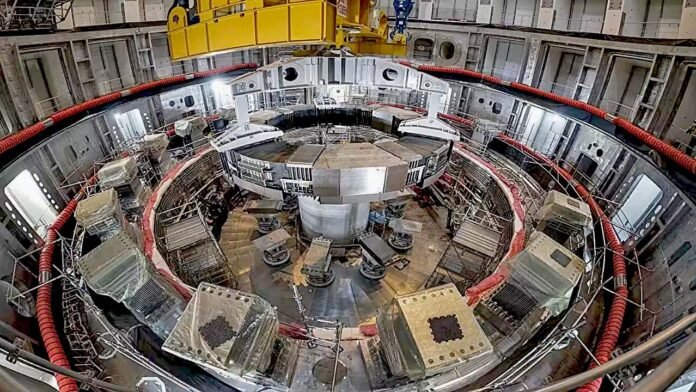
Mumbai: India and Russia, along with five other international partners, mark the 20th anniversary of the International Thermonuclear Experimental Reactor (ITER) agreement, signed on November 21, 2006. The milestone marks two decades of international cooperation towards developing fusion energy, a potential source of low-carbon electricity.
ITER, currently under construction in southern France, brings together India, Russia, the European Union, China, Japan, South Korea and the United States. The project aims to demonstrate the scientific and technological feasibility of fusion energy, with the experimental reactor designed to produce 500 MW of fusion power from 50 MW of external heating power supplied to the plasma.

India plays an important role in the project through ITER-India, operating under the Institute for Plasma Research (IPR), Gandhinagar. The country is responsible for nine major procurement packages, including the cryostat, cooling water systems, cryogenic systems, plasma heating equipment and diagnostic technologies. These contributions involve Indian research institutions and engineering companies in the development and manufacturing of specialised reactor components.
Rosatom coordinates Russia’s participation through its ITER Project Centre, which has served as the country’s Domestic Agency since 2011. Russian specialists are responsible for 25 systems at the facility, with more than 50 research organisations and industrial enterprises involved in their development and manufacturing. These include superconducting systems, electrical equipment, vacuum vessel components and plasma heating and diagnostic technologies.
Anatoly Krasilnikov, Director of the ITER Project Centre of Rosatom, said, “Russia stood at the origins of the ITER project. It was in our country that the tokamak concept was created, which became the basis for modern research into controlled thermonuclear fusion, and the initiative to unite international efforts to create an experimental reactor was developed at the initiative of our country. Today, Russia not only maintains leading scientific competencies in this field but also makes a significant practical contribution to the implementation of the project by developing and supplying highly complex high-tech systems. For us, ITER is an opportunity to confirm the potential of domestic science and industry and to take a direct part in the decisive experiment on the path towards thermonuclear energy.”
Participation in ITER has supported advancements in superconductors, magnetic systems, advanced materials and precision engineering, with applications extending to scientific equipment, nuclear technologies and medical devices.

For India, the collaboration provides opportunities to strengthen domestic expertise in plasma physics, cryogenics, advanced manufacturing and nuclear engineering. The project also supports the exchange of scientific knowledge and the development of specialised engineering capabilities among participating nations.
As ITER completes two decades since the signing of its founding agreement, the international collaboration continues to advance research and technology development aimed at making fusion energy commercially viable in the future.

ITER is an international fusion energy research project involving seven members: the European Union, China, India, Japan, South Korea, Russia and the United States. Located in southern France, the experimental facility aims to demonstrate the scientific and technological feasibility of fusion energy.







