


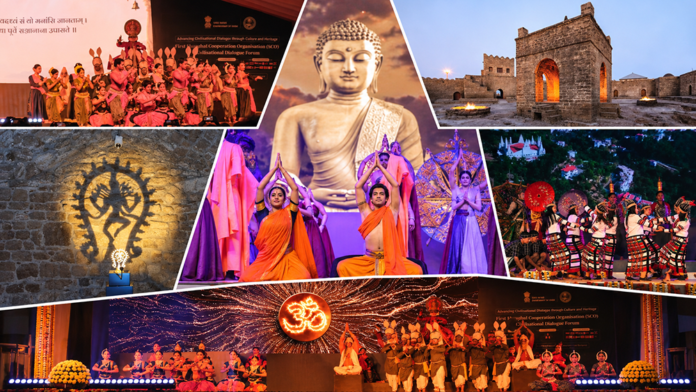
While geopolitics and geoeconomic factors are shaping India’s Eurasian outreach, one aspect that has not received much attention is its geocultural connection. This aspect needs better understanding to provide a holistic framework for India’s engagement with this part of the world, often known as the post-Soviet space. As defined in scholarly studies, geoculture helps map a country’s wider cultural outreach, while placing that country at the centre stage within a broader geographical space. Thus, geoculture augments a country’s geopolitical and geoeconomic links. Using this normative argument, it is necessary to locate India’s geocultural linkages with Eurasia and to assess the extent to which they shape India’s Eurasian engagement.
Geo-Cultural Foundation
An interesting aspect of India’s geocultural link with Eurasia is that religion and trade operated simultaneously, which gave much-needed impetus to India’s outreach. In ancient times, India’s territorial frontier extended up to the Arctic through Central Asia and the Caucasus. This was part of a common geographical and geocultural space, and Sanskrit influenced language formation. Along with this, a common pattern of religious practices in the form of worshipping nature provided the basis for the evolution of a common ethnogenesis where Indian culture was predominant. This was reflected in religious practices across this part of Eurasia.

The Sun worship was a common practice that brought India and Eurasia closer. The same practice is also known as Tengri in Kazakhstan, Mihir in Armenia, Guns in Turkmenistan, and Yash in Uzbekistan
The Sun worship was a common practice that brought India and Eurasia closer. The same practice is also known as Tengri in Kazakhstan, Mihir in Armenia, Guns in Turkmenistan, Yash in Uzbekistan, and the worship of fire in Central Asia and the Caspian Region, as well as Panchamahabhut (five elements of nature), which provide the basis for the evolution of India-Eurasia relations. Indian scholar Lokesh Chandra draws a parallel between the fire temple of Ateşgah, Baku, Azerbaijan, also known as Jwalamukhi, and the Jwalamukhi temple in Kangra, India. Thus, he draws a common parallel between fire worship in India and Central Asia.
The discovery of the Shiva (Natraj) idol at Penjikent (Tajikistan) also reflects the influence of Indian culture in Central Asia, as observed by Devendra Kaushik in his article “India and Central Asia: Renewing a Traditional Relationship”, published in South Asian Survey in 1998. Similarly, Lokesh Chandra also highlights that Shiva worship was a common practice among the Slavic population before their conversion to Christianity. Studies suggest a spiritual connection between Mount Meru, located in the Arctic part of Russia, and the Himalayas. This was also highlighted by the famous Russian painter Nicolai Roerich, who later settled in India.
Worshipping nature is a common practice in both India and Russia. The same can be inferred from the writings of Bal Gangadhar Tilak in his book Arctic Home in the Vedas. In this book, Tilak quotes extensively from two Indian religious scriptures, namely the Rig Veda and the Tripatha Brahmana, to bring out a geo-cultural synthesis between India and the Russian Arctic. He also says that the worship of Aditya (Sun God) and Lord Vishnu was a common practice in the Arctic region. Similarly, the worship of ancestors is another cultural element common to both India and the Arctic region. This testifies to India’s geographical and cultural influence in ancient times in Russia. Kalidasa’s Abhijnanashakuntalam and Vishnu Sharma’s Panchatantra also suggest the deep-rooted historico-cultural relations between India and Russia.
The discovery of the Shiva idol at Penjikent (Tajikistan) reflects the influence of Indian culture in Central Asia. Shiva worship was a common practice among the Slavic population before their conversion to Christianity
Similarly, in the linguistic sphere, certain common elements bind Sanskrit and Russian. In fact, as scholarly studies suggest, Panini’s Sanskrit grammar of Asthadhyayi influenced the Russian grammar. WR Rishi’s pioneering work, India and Russia: Linguistic and Cultural Affinity, has dealt extensively with this aspect in great detail. For instance, Mat in Russian and Matr in Sanskrit mean mother; so also Prithivi is also called Matr, which has a geographical conception, as mentioned by PC Bagchi in his work India and Central Asia. Similarly, Trista in Russian and Tristam in Sanskrit denote three hundred. At the same time, in Russian, Surya used to be denoted as Syrus. These are a few instances through which one can decipher India-Russia relations.

The importance of Sanskrit to Russia was emphasised by the famous Russian Orientalist Kaetan Kossovich of the 19th century, who first started the Sanskrit Department at St Petersburg University. He said, “Russia needs Sanskrit scholars as much as it needs mathematicians and historians.” His statement has reflected the importance of Sanskrit in the Russian literary sphere. One may add here that, towards the middle of the 19th century, major Hindu religious texts were translated into Russian, as highlighted by Levin in his above-mentioned scientific study. Kossovich, in his scientific work, further highlighted “the organic relationship of Sanskrit and Slavonic languages.”
Along with Hinduism, Buddhism also played a prominent role in shaping the bilateral relations between India and Eurasia. The Tantric cult of Buddhism has influenced religious rituals in Russia. The tradition is continuing even today. Historical accounts suggest the influence of Mahayana Buddhism in Russia. Quoting the famous Russian ethnographer PS Pallas, Russian Orientalist Baatr U Kitinov says in an interesting article, “Central Asian Nomads in the Spread of Buddhism in Russia”, published in RUDN Journal of World History, 2024, that Indians played a prominent role in the spread of Buddhism. Quoting Pallas, Kitinov writes, “Lama faith” (Buddhism) and the Kalmyks themselves originated from the Indians. Kitinov further writes, “Before reaching Russian lands, Indian Buddhism passed through many empires, nations and cultures, from the Middle to the Far East, through Central Asia, Tibet, China and Mongolia. Buddhism found itself enriched and made more flexible through adaptive civilisation patterns of the entire continent, capable of uniting nomadic and sedentary cultures and customs into one vast Buddhist civilisation.”

Studies suggest a spiritual connection between Mount Meru, located in the Arctic part of Russia, and the Himalayas. This was highlighted by the famous Russian painter Nikolai Roerich, who later settled in India
It is pertinent to highlight that the late academicians from Russia, G Bongard Levin and A Vigasin, wrote their classical research study titled The Study of Ancient Civilisation in the USSR. Though this book was written and published during Soviet times, this never prevented them from giving objective facts about the influence of Indian culture in the Eurasian region. In this book, both authors mention that Indian coins used to be very popular in Russia, and there are several instances where Indians held high positions in many kingdoms of Russia in the 8th and 9th centuries.
Similarly, the study further highlights that a trade route connected India and Russia in the 10th and 11th centuries through Central Asia and the Caspian region. Over the years, many Indians traded with Russia and enjoyed patronage from Tsarist rulers. In the same book, the authors highlight how Indians traded and settled in Astrakhan and Moscow with the support of Tsarist rulers. Most of these Indian traders brought silk, medicine, and moneylending activities. The Tsarist rulers also protected the Indian trading community in Astrakhan and even constructed a Vishnu temple. One of the reasons behind the Russian rulers’ interaction with the Indian trading community was the huge tax they collected. Michal Wanner, in his article “Indian Trading Community in Astrakhan in Context of Russian-Indian Relationship (1636–1725)”, published in West Bohemian Historical Review 2012, highlights how Indian merchants, because of their long stay in Astrakhan, married locals and were known as ‘Agryjan’. This demonstrates India’s deep-rooted relations with Russia.
From the above analysis, it can be stated that over the years India shaped the geo-cultural matrix of this part of the world. Along with trade, India’s religio-cultural traditions also attracted much attention not only from the elites but also from local people. In this regard, India’s trade also played a crucial role in shaping the relations. India’s rich culture and economic prosperity always attracted the Russian people. Even in the 18th and 19th centuries, Tsarist rulers took keen interest in forging trade connectivity with India. Tsarist rulers also envisioned rail connectivity with India. They planned to connect India by rail in the late 19th and early 20th centuries. India’s ‘image’ in Russia, as reflected in Russian literature of the 13th century, was “a fabulous land inhabited by righteous people”, as quoted in Levin’s above-mentioned book.
The importance of Sanskrit to Russia was emphasised by the famous Russian Orientalist Kaetan Kossovich of the 19th century, who first started the Sanskrit Department at St Petersburg University. He said, “Russia needs Sanskrit scholars as much as it needs mathematicians and historians”
Apart from Russia, India developed extensive trade links with Central Asia and the Caucasus region as early as ancient times. This was made possible due to uninterrupted geo-cultural links, along with patronage from emperors such as Asoka and Kanishka. As described at the beginning, being part of a common geo-cultural space, there are several commonalities one can notice. Like the worship of nature so also similarities in syntax, such as Pitr (father) and matr (mother) in Central Asian vocabulary, that reflect Sanskrit’s deep cultural influence. Similarly, as discussed above, the worship of Vedic gods and goddesses was prominent in the Central Asian and Caucasus region. This fact testifies that India- Central Asia-Caucasus- Caspian-Arctic Russia was part of a single geocultural space and bounded by a single culture whose link is Sanskrit and a more or less common ethnography, which continued and flourished till the Arabic invasion, which, to a great extent, impaired this geopolitical space.
The ethnographical adaptability of this vast geographical space can be termed as ‘Greater India ’, to paraphrase Kalidas Nag, was bounded by a common phenomenon, i.e., a settled population, advancement of agricultural practices, science and technology, and also the development of a common cultural practice like Arya, which implies a phenomenon called noble. Even Indian holy religious texts like the Mahabharata. This has been discussed by Babajan Gafurov in his scientific work Central Asia (Vol 1). Gafurov writes about how many kings from Central Asia arrived and joined the war of the Mahabharata. The shared sacred culture can be further expressed through the development of Buddhist arts and artefacts throughout Central Asia and the Caucasus-Caspian Region. For instance, the name Bukhara implies a Buddhist monastery, and so does Samarkand imply Markendaya. These names denote a geocultural synergy of India and Central Asia.
The study highlights that a trade route connected India and Russia in the 10th and 11th centuries through Central Asia and the Caspian region. Over the years, many Indians traded with Russia and enjoyed patronage from Tsarist rulers
Probadh Chandra Bagchi, in his work titled India and Central Asia, highlights how Buddhist culture spread into different parts of Central Asia. In the same book, he highlights how Asoka spread Buddhism in different parts of present-day Central Asia. Along with Asoka, India-Central Asia relations reached their peak during the Kushan period. The discovery of Buddhist art and artefacts is discussed by Bongard Levin in his work Studies in Ancient India and Central Asia. Levin explains how Buddhism expanded into different parts of Central Asia, and Termez emerged as the springboard for flourishing Buddhist culture in Central Asia. He further mentions that numerous Buddhist sites were discovered in the Surkhan Darya region of present-day Uzbekistan. Levin’s work further highlights that apart from Termez, Sogd, Bukhara, Kara Tepe, Samarkand and Khoremz emerged as the major Buddhist centres under the patronage of Kushan rulers. Levin further mentions that the Gandhara style of Art and architecture provided the basis of Indo-Central Asian cultural relations.
The ancient cities of Merv in Turkmenistan, as well as Tamgaly-Tas, located near Almaty, provide an opportunity to understand India’s deep cultural imprint. These interactions provided the basis for the flourishing of Indian civilisational links with Central Asia. Even in the 19th century, British military officer Alexander Burnes, in his book Bokhara, underlined that the worship of Hindu gods and goddesses was widely prevalent in Central Asia.
A closer look at India-Eurasia relations in the context of the geo-cultural context demonstrates three important factors, namely a common civilisational geo-cultural space, the role of religion, as well as a common market, which augmented trade. The study by Balram Srivastav, titled Trade and Commerce in Ancient India, highlights the nature of bilateral trade relations between India and Eurasia. In this book, he explores trade between India and Eurasian civilisations like the Anau civilisation of Turkmenistan, as well as in the Caspian Basin region. Similarly, gold used to be imported from southern Russia to India via Black Sea and the Caspian region, and from India they used to import pepper.
Russian rulers planned to connect India by rail in the late 19th and early 20th centuries. India’s ‘image’ in Russia, as reflected in Russian literature of the 13th century, was “a fabulous land inhabited by righteous people”
In more recent years, Stephen Friedrich Dale, in his book, Indian Merchants and Eurasian Trade, 1600-1750, gave a detailed account of India’s traders in Baku, Derbent, Astrakhan, Novogorad, Bukhara, Samarkand, Yerevan, and Derbent. Surendra Gopal made a similar argument in his academic writings. In one of his addresses to the Indian Historical Congress in 1991, titled ‘Indians in Central Asia in the 16th and 17th Centuries’, he underlines the importance of India-Central Asian trade. He underlines the importance of India-Central Asian trade by stating, “Our contacts with Central Asia go to antiquity, and there have been populations at different levels: traders, scholars, religious preachers, seekers, etc., who have been crossing the boundaries of the two areas: changes in the political boundaries and political climate.” Some of these aspects, as Gopal writes, provide a backdrop to understand the dynamics of India-Central Asia trade and cultural relations.
The same is manifested in the writings of Scott Levi. In his book Indian Merchants and Eurasian Trade, 1600-1750, he highlights the prominence of Indian traders in the Central Asian economy, particularly in banking and textile trading. He mentions a peculiar form of banking system that Indian traders promoted, the Hundi system, which was used to provide loans to the local community. The dominance of Indian traders was so entrenched in the Central Asian economy that it alarmed Tsarist rulers, who, after their takeover of Central Asia, wanted to prohibit and restrict Indian trading activities. To ensure this, General Kaufman, the Governor-General of Turkestan, issued a decree. The objective of the decree was, as Arup Banerjee argues in his book Old Routes, to give favourable treatment to Russian traders. In one of his decrees in 1878, Kaufmann, as Banerjee mentions, states: “The Hindus [Indians] are prohibited from obtaining possession of land belonging to any person, either by loan or purchase.” This move was to prevent Indian merchants from trading in Central Asia in the 19th century.
However, Russia was interested in promoting trade with India and was also interested in carrying out trade with Tibet through India. It needs to be mentioned here that for the Tsarist Russian rulers, one of the prime objectives of Russia was to expand into India to control the Arabian Sea. This, in fact, would have given the Tsarist Russian rulers a route for maritime trade and also to counter the British. In fact, to achieve this strategic goal, the Russians expanded their railway route up to Herat. This propelled the onset of the Great Game between Russia and Britain in the late 19th century.
At the 24th SCO Summit in Tianjin, Prime Minister Modi proposed the ‘Civilisational Dialogue Forum’ to promote ‘cultural dialogue’ among the SCO members because of a shared Buddhist legacy and a common cultural heritage
Indo-Soviet Relations
In the post-1947 phase, India-Russia cooperation reached its peak when both countries signed the Indo-Soviet Treaty of Peace, Friendship and Cooperation in 1971. This treaty provided the basis for Indo-Soviet cooperation and generated robust trade and bilateral relations between the two countries. One may add here that despite the Soviet Union’s policy of opposing religious education, attempts were made to promote Indology. Similarly, the International Kushan Conference took place in Dushanbe in 1968 during Soviet times. This conference was the first seminal attempt to study India’s social and cultural relations with Central Asia.
Contextualising in the Present Context
An attempt is being made in recent years to rejuvenate strong cultural and trade ties with the post-Soviet countries. The same can be seen in the context of rejuvenation of bilateral trade and cultural ties, as well as overall geopolitical relations. The proactive diplomacy that India has pursued towards this region can be seen in the context of the number of strategic cooperation agreements India has signed with some of these countries. Over the years, Buddhism has provided cultural context to strengthen bilateral relations. Along with geo-strategic and geopolitical aspects of bilateral relations, the cultural aspect needs to be emphasised. The geo-cultural aspects build a foundation to promote India’s relations with the Eurasian countries.
Over the years, India’s trade with post-Soviet Eurasian countries has grown rapidly. One important aspect of India’s trade relations with Eurasia is that it has shifted from buyer-seller relations to equitable relations with Russia. It has also been observed that trade relations with Russia will reach around $150 billion by 2030. Similarly, trade relations have also diversified into new domains such as critical technology, renewable energy, health, and semiconductors. The same is not only in the context of India-Russia relations but also with Central Asia, Armenia and Belarus. India has also emerged as a major exporter of defence equipment to Armenia.
The first SCO Civilisational Dialogue Forum took place in New Delhi on November 20, 2026, and was inaugurated by Prime Minister Modi
SCO Civilisational Dialogue Forum
Understanding the importance of culture in promoting geo-cultural relations, India took steps to promote bilateral cultural relations at an institutional level in a broader geopolitical ambit of the Shanghai Cooperation Organisation (SCO). In this regard, Prime Minister Narendra Modi, at the 24th Summit in Tianjin, proposed the ‘Civilisational Dialogue Forum’. The objective of this forum is to promote ‘cultural dialogue’ among the SCO members because of a shared Buddhist legacy and a common cultural heritage.
Incidentally, the first SCO Civilisational Dialogue Forum took place in India on November 20, 2026, in New Delhi. Inaugurating the Forum, Prime Minister Modi stressed, “Centuries-old international collaboration and people-to-people ties, from trade links between the Indus Valley Civilisation and Mesopotamia around five thousand years ago to silk and trade networks connecting India, China, Central Asia, and Eurasia, where merchants, scholars, travellers, and Buddhist monks such as Faxian, Xuanzang, Yijing, and Kucha-born Kumarajiva, alongside institutions like Nalanda and centres like Kucha and Dunhuang, enriched civilisations through exchanges of ideas, languages, and Buddhist texts.” Prime Minister Modi further emphasised, “Empires have certainly changed the maps of the world, but civilisational dialogues have changed the ideas of the world and enriched them.” Prime Minister Modi’s words certainly highlight the need to rejuvenate India’s geo-cultural relations with post-Soviet Eurasian SCO member countries.
Conclusion
A closer look at India’s geo-cultural relations with Eurasia over the years demonstrates that culture provides the necessary bedrock to India’s engagement with this geopolitical space. Though external powers are engaging with this geocultural space of Eurasia to promote their necessary geopolitical agenda, India is providing the normative basis for the fruition of civilisational cooperation with Eurasian countries based on rich geohistorical linkages rooted in a conception of “common geocultural” linkages. What is necessary here is that there is a need to “reimagine” India’s geopolitical frontiers up to the Arctic, which will be premised upon the concept of “Greater India”.

The writer is a Professor at the Centre for Russian and Central Asian Studies (CRCAS), School of International Studies (SIS) and Chairperson, Special Centre for National Security Studies (SCNSS), Jawaharlal Nehru University (JNU), New Delhi. The views expressed are personal and do not necessarily carry the views of Raksha Anirveda






