WASHINGTON: United Launch Alliance (ULA) and SpaceX are the winners of the Space Force’s hard-fought National Security Space Launch (NSSL) program worth billions, Air Force acquisition czar Will Roper announced.
ULA’s immediate award is for $337 million for two launches, and SpaceX’s is $316 million for one launch, Roper told reporters. ULA is launching Space Force missions 51 and 106; SpaceX Space Force’s mission 67 — all three are classified, he said.

However, the overarching contract for the two firms is an indefinite delivery/ indefinite quantity (ID/IQ) award covering all Space Force and National Reconnaissance Office (NRO) launches between 2022 and 2027, with ULA winning 60 per cent and SpaceX 40 per cent. The Space Force currently plans some 34 launches during that time frame.
The NSSL program is designed to replace the Atlas V and its Russian-made RD-180s engines. Congress has mandated that Department of Defense (DoD) stop buying the Russian engines by 2022.
The contest began prior to the stand up of the Space Force in 2018, when the Air Force awarded a total of $2.3 billion in funding to Blue Origin, Northrop Grumman and United Launch Alliance (ULA) to do developmental work.
Phase 2 of the acquisition, launched in May 2019, pitted four contestants — ULA, SpaceX, Northrop Grumman and Blue Origin against each other for the award.

Blue Origin had been pressing hard for the current two-provider contract to be expanded — something the Air Force consistently rejected. The Senate and House in their 2021 defence policy bills likewise prohibited the current contract phase, for which the Air Force requested $1.04 billion in 2021, from being re-opened to allow three winners.
However, the HASC and SASC also both inserted language into their versions of the 2021 National Defence Authorization Act (NDAA) to force the Air Force to provide funds in the next phase of the program, Phase 3, to ensure three firms can do early development work on the following generation of heavy-lift rockets.

Further, a recent RAND study recommended that three launch vendors be supported in the near term to stave off entry into the US commercial market of a foreign competitor — something Roper said resonated with him.
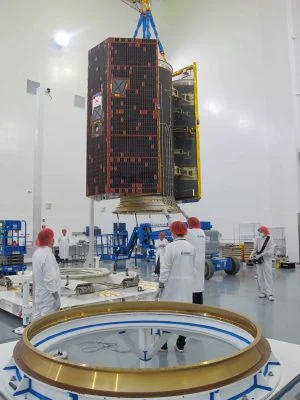
Once 24 GPS III satellites are on orbit, the encrypted M-Code for military users will be available world wide.
“Phase 3 will be a full and open competition to all companies,” Roper said, thus Blue Origin and Northrop Grumman can re-enter the contest. “Funding is our limiting factor,” he explained, pointing out that the RAND study agreed with the Air Force that over the long term the national security launch market can only support two providers.
At the same time, Roper said, there are advantages to keeping more companies alive in the commercial launch market in order to spur innovation.
“We’re looking ahead to Phase 3 five years from now and just wondering what new-leap ahead, lower cost technologies might be on the forefront to make assured access to space, not just assured, but cheaper,” he added.