


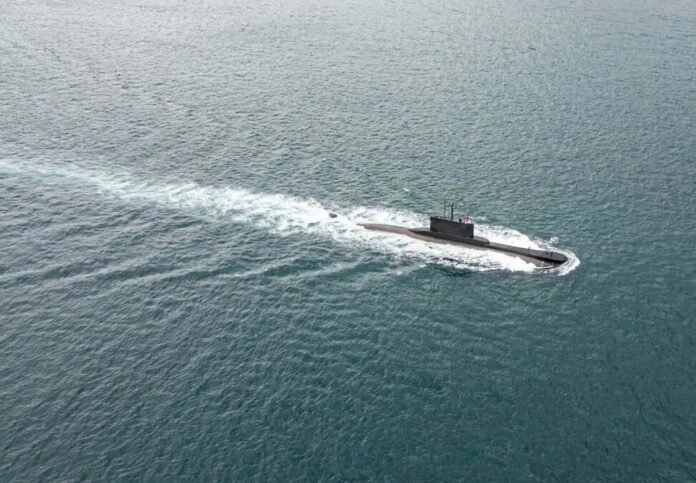
At Euronaval 2026 in Paris, Thales presented a “Hybrid Fleet” concept for anti-submarine warfare (ASW), built around coordination among ships, helicopters, uncrewed vessels and sensors. The company’s three highlighted technologies are M-Cube, a mission-management system; a new Lightweight Dipping Sonar (LDS); and the CAPTAS-4 Mission Module (C4MM). Together, they are intended to distribute sensing and operations across a fleet rather than rely on a single specialist ship.
The announcements reflect a broader naval interest in combining crewed and uncrewed systems. Distributing sensors could help navies monitor wider areas, while networked command systems could coordinate assets operating at different distances. The approach also raises practical questions: how reliably can platforms exchange information, how will operators assess conflicting sensor reports, and how will fleets protect communications from disruption? The technologies’ operational value will depend on how well they perform in trials and integrate with existing ships and systems.

A Shared Mission-Management System
M-Cube is the coordination element in Thales’ proposal. The company says it allows operators to plan, assign and supervise missions involving multiple platforms from a common environment. It was first developed for mine-warfare missions and is now being extended to ASW, intelligence, surveillance and reconnaissance, and above-water warfare, according to the company. Thales also describes the system as scalable and interoperable with NATO operational requirements.
A shared management system could help operators coordinate sensor deployment and combine information from different platforms. But a common interface does not itself guarantee a complete or accurate picture. Performance depends on sensor quality, communications links, data standards and operator training. In an ASW setting, where detections can be uncertain and conditions change, crews must be able to assess information rather than treat a software display as definitive.
Sonar on Lighter and Uncrewed Platforms
The Lightweight Dipping Sonar is designed to bring acoustic detection to lightweight and autonomous platforms. Thales says its compact, modular system can be deployed on unmanned vessels and other platforms, extending surveillance and potentially reducing the need to expose personnel or high-value ships to some risks. The company’s announcement does not provide detailed performance specifications or independent test results, so claims about detection capability and endurance remain to be demonstrated publicly.
The concept fits a wider effort to use uncrewed maritime systems for surveillance and other naval tasks. Such craft can potentially operate for extended periods or in areas where deploying a crewed vessel is less attractive. However, they still need dependable communications, navigation and control, and their sensor data must be integrated into a wider operational picture. They add options to a fleet; they do not remove the need for trained personnel and crewed platforms.

A Modular CAPTAS-4 Capability
The third component, C4MM, packages the company’s CAPTAS-4 variable-depth sonar in a modular, deployable format. Thales says the mission module could be moved between compatible vessels, allowing navies to add advanced sonar to a broader range of ships without dedicating every ASW mission to a specialist frigate. That flexibility could help operators adapt vessels to changing tasks, although the practical value will depend on installation requirements, ship compatibility, maintenance and crew training.
CAPTAS is an established Thales sonar family. The company describes it as a variable-depth system intended to identify submarines in challenging acoustic environments, including littoral waters. That background gives the module a foundation in an existing product line, but the newly presented mission-module configuration should be assessed separately from the performance of CAPTAS systems already in service.

Promise Depends on Integration
Thales’ announcements point toward a more distributed model of ASW: sensors placed across different platforms, with operators coordinating them through a shared mission system. If integrated successfully, such an approach could expand coverage and give navies more ways to assign assets. It may also offer flexibility where fleets face competing demands for ships and crews.
The proposal is not a guarantee of better submarine detection or lower costs. Navies will need to evaluate reliability, interoperability, cyber resilience and performance in realistic conditions. Euronaval’s focus on autonomous systems and adaptable capabilities underscores the industry’s interest in these approaches, but operational results – not product demonstrations – will determine whether hybrid fleets deliver a lasting advantage.







