


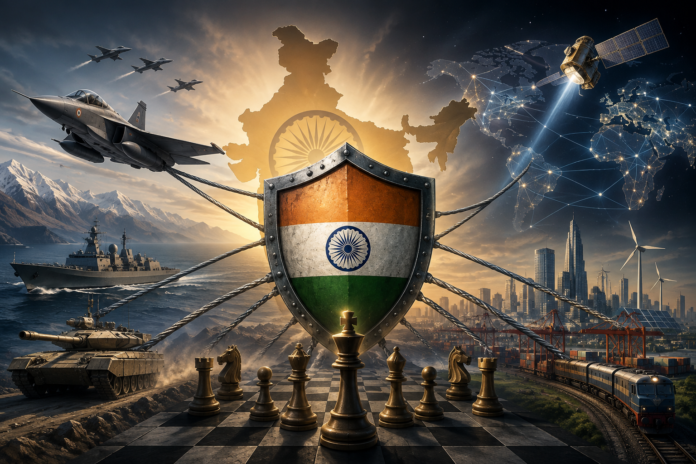
The world order is increasingly turning turbulent, driven by conflicts, wars and geopolitical contests across all dimensions. This “turbulence” is a symptom rather than the root cause. The underlying cause is a shift in power dynamics, characterised by the clash of geopolitical tectonic plates as an emerging multipolar world challenges the hegemony intent on sustaining its dominance. This results in a widening gap between real power and an order whose rules were written for an earlier age.
Unlike previous transitions, this one is distinctive because, historically, such imbalances were resolved through hegemonic wars. However, among nuclear-armed great powers, such a war is impossible, as it would lead to mutual destruction.

Consequently, the pressure is redirected into various domains short of central war, including economic statecraft, technology denial, financial weaponisation, disruption of connectivity and proxy conflicts at the periphery.
This power-transition struggle for succession is fought everywhere except where it is impossible, at the summit, with weapons. It is the hegemon, not in decline but reasserting its dominance and preponderance, that wields these tools, resulting in a bipolar contest between Washington and Beijing within an otherwise multipolarising landscape.
The underlying mechanism reveals a key fact that defines its scope: the conclusion is not merely the end of a seventy-year Pax Americana but the culmination of a five-century era of Western dominance, which is depleting itself internally through processes such as deindustrialisation, financialisation and oligarchic capture, as much as from external challengers.
This decline is quantifiable. The dollar’s share of global reserves has fallen from approximately 73 per cent in 2001 to around 56 per cent today, while BRICS has moved from rhetoric to implementation, including local-currency settlements, a pilot gold-backed unit, the New Development Bank, and India’s chairmanship in 2026.

With nuclear war off the table, great-power rivalry now unfolds through tariffs, sanctions, currency control and proxy conflicts – a bipolar US-China struggle wrapped inside a multi-polarising world
These developments do not overthrow the dollar; rather, they signify the erosion of its monopoly, which is what rendered the dollar a strategic tool through its weaponisation.
The term “destabilisation,” often used to describe Western actions, misrepresents the direction of influence, particularly regarding the issue most critical to India: energy.

In two significant regions, the United States has acted aggressively. In West Asia, the February 2026 aggressive war on Iran, launched jointly with Israel, decapitated Iran’s leadership and closed the Strait of Hormuz for the last several months.
In the Western hemisphere, a January operation resulted in the kidnapping of Venezuela’s president, a blatant violation of the dignity of the head of state and the state’s sovereignty, followed by the lifting of oil sanctions and the opening of the industry to privatisation and control by American oil majors.
These actions are not chaotic but are strategic efforts to reassert control over pivotal global energy areas, namely the Gulf chokepoints and Western hemisphere crude, as tools of coercion.
A hegemon that controls these critical points does not require chaos; it requires the potential for chaos. This alters India’s problem: the objective is no longer merely to diversify away from disruption but to protect against a supplier who might eventually weaponise the supply under their control.
The interconnected systems established by globalisation, such as the “SWIFT” payment systems, semiconductor supply chains, cloud computing, undersea cables, insurance and satellite positioning, have progressively become strategic chokepoints.
This phenomenon, ‘weaponised interdependence’, marks a transition that cannot be countered by military means. For emerging powers, this situation presents a paradox: structurally, they possess unprecedented opportunities, yet they must navigate an increasingly coercive environment. These nations are ascending, albeit into a realm of heightened risk.
Furthermore, these emerging powers do not coalesce into a unified bloc. The Global South does not function as a single entity. China, as a systemic challenger, has the capacity to establish a parallel order and control its own chokepoints.
By contrast, middle powers such as India, Indonesia, Brazil and the Gulf states hold a distinct, albeit lesser, advantage: they remain unaligned with either dominant pole.
India exemplifies this approach by refusing to settle its Russian oil transactions only in yuan (India uses a multi-currency strategy of using Rupee in a ‘Vostro’ account, UAE’s Dirham and minimising the use of Yuan) despite the yuan’s dominance in Russia–China trade, and by viewing a Sino-centric monetary order as equally risky as the dollar system it seeks to hedge against. For a middle power, autonomy entails rejecting the infrastructure of the hegemons.
Recent US moves in Iran and Venezuela reveal a strategy of controlling global energy chokepoints, not creating chaos – reshaping India’s imperative from diversification to genuine supply protection
This leads to a critical realisation that India has been hesitant to articulate. Strategic autonomy is not merely a stance; it is contingent on capability. Non-alignment and equidistance were postures, economical yet fragile.
The past two years have highlighted this distinction. The Chabahar port, representing a decade of Indian investment to access Central Asia and counter Gwadar, was debilitated by a partner’s sanctions and airstrikes.
The cost of the GE F414 engine nearly tripled once the Tejas Mk2 and AMCA airframes were committed to it. Tariffs on Indian goods escalated to fifty per cent to coerce a shift in energy policy.
Additionally, the Ayni airbase in Tajikistan, India’s sole overseas military facility, was relinquished under Russian and Chinese pressure. In each instance, India could hedge, absorb and protest, yet it lacked the capacity to shape, deter or protect. Autonomy that cannot be enforced remains a preference rather than a policy.
The solution lies neither in a nostalgic return to non-alignment nor in a sudden shift towards a single alliance, but in an active multi-alignment strategy, underpinned by capability.
From Chabahar port to the F414 engine deal, India’s recent setbacks show that non-alignment without capability is just vulnerability dressed up as policy
This approach aligns with India’s most enduring strategic philosophy, as articulated by Kautilya. The concept of rājamaṇḍala does not advocate equidistance; instead, it entails a calibrated, asymmetric hedging strategy in which the state continuously strengthens its Kośa (treasury) and Daṇḍa (coercive power), ensuring that alignments serve as instruments rather than dependencies.
However, the Arthashastra stipulates a stringent condition: the mandala safeguards only a state that has fortified its own foundations. A state aspiring to balance without capability is not a balancer; it is merely vulnerable, possessing opinions without power – in effect, it is a menu on the table.
These foundational strengths are supported by four pillars. Firstly, sovereign energy logistics must be established, encompassing not only diversified sources but also Indian-flagged tankers, indigenous insurance, adequate reserves for a genuine chokepoint closure and sanction-resistant payment systems, as highlighted by vulnerabilities exposed during the Iran conflict.
Secondly, there must be connectivity redundancy to avoid reliance on single points of failure, as demonstrated by the failures of Chabahar and Ayni due to their singular nature.
Thirdly, financial hedging should be employed, utilising rupee settlement and alternative payment systems to avoid replacing dollar dependence with yuan dependence.
Lastly, the most profound pillar is the technological foundation that underpins all these elements.
Reviving the rājamaṇḍala concept, the piece calls for calibrated multi-alignment built on four pillars: energy logistics, connectivity redundancy, financial hedging and technological sovereignty
Technology sovereignty is the primary determinant in a world where technological chokepoints are weaponised. The F414 engine exemplifies this issue: an 80% technology transfer does not equate to sovereignty but rather to dependence with improved optics.
Given that the airframes are designed around the engine, the supplier could significantly increase the price at the point of maximum commitment. Sovereignty is not gauged by intellectual property transferred on paper but by domesticated processes, such as metallurgy, fabrication and test infrastructure, which India continues to rent from abroad.
The thirty-five-years delay of the Kaveri engine serves as a cautionary tale: India’s aeroengine project (Kaveri or the new one) needs to be a standalone national project because it entails achieving control over critical technologies. An engine project, made as a sub-project in a larger aircraft programme, never materialises.
The semiconductor sector illustrates both ambition and its limitations. India’s Semiconductor Mission has transitioned from policy to tangible outcomes, with over twenty billion dollars approved, packaging plants operational at Sanand and the Tata fabrication facility at Dholera nearing completion, targeting first silicon production this year.
Although overdue, this represents base-layer capability, commencing at the 28-nanometre node used in cars and appliances, rather than the advanced logic required for cutting-edge computing and weaponry.
This is the start that should have been made three decades ago, but it is never too late, and there is a long way to go. India is establishing foundational capabilities but has yet to reach the commanding heights.
India’s semiconductor and AI ambitions are real, but reliance on foreign chips and cloud infrastructure could mean winning aviation independence while losing the far bigger battle over cognitive technology
The most evident and rapidly emerging challenge lies in computing and artificial intelligence. The India AI Mission has assembled a subsidised pool of more than thirty-four thousand GPUs and financed a fleet of sovereign models, marking the most ambitious initiative of its kind in the Global South.
However, nearly all operations rely on American silicon; the flagship indigenous supercomputer is itself a partnership with Nvidia.
A critical lesson emerged in June 2026, when Washington, citing export controls, compelled a leading American AI company to disable worldwide access to one of its most advanced models. Dependence on a foreign compute stack amounts to reliance on a switch controlled by a foreign government.
If India applies the same seriousness to computing as it is belatedly applying to jet engines, it stands a chance; otherwise, by the 2030s, it may achieve autonomy in aviation while conceding it in cognitive technologies.
The transition presents both risks and opportunities due to its genuine openness. The conclusion of a five-century monopoly is giving rise to a more diverse order, wherein India’s tradition of influence through trade and reciprocity is significant.
However, history favours not the civilisation that is correct, but the one that constructs. While India’s significance is unquestionable, its influence must be actively developed. This development requires investment in fabrication facilities, test cells, engine cores and the gradual accumulation of sovereign capabilities.
Although the opportunity is tangible, it is diminishing more rapidly than anticipated by the planning cycle, and it will not accommodate delays in execution.
——-
The writer, AVSM VM PhD (V) is a former Deputy Chief of Integrated Defence Staff at HQ IDS, and is currently Founder-President of The Peninsula Foundation.

The writer, AVSM VM PhD (V) is a former Deputy Chief of Integrated Defence Staff at HQ IDS, and is currently Founder-President of The Peninsula Foundation. The views expressed are of the writer and do not necessarily reflect the views of Raksha Anirveda





