


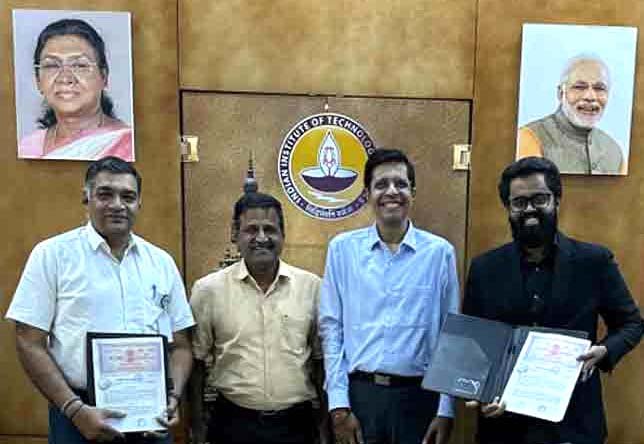
IIT-M Pravartak Technologies Foundation, the technology innovation hub hosted by the Indian Institute of Technology-Madras, has signed a memorandum of understanding with Medhastra Techsystems Private Limited to pursue defence technologies for India’s armed forces. The collaboration will focus on sovereign artificial intelligence, cognitive electronic warfare, multi-sensor data fusion, undersea sensing and autonomous platforms, according to the organisations.
The agreement is intended to bring research and engineering closer to defence applications. IIT-M Pravartak contributes access to academic research, laboratories and students, while Hyderabad-based Medhastra brings its focus on AI-powered systems for military use. The partners say the arrangement will support joint research, faculty collaboration, laboratory access and student engagement. They have not publicly detailed specific products, development timelines, funding commitments or deployment plans.

The memorandum was signed in the presence of IIT Madras director V Kamakoti, IIT-M Pravartak chief executive MJ Shankar Raman and Air Vice Marshal R Guruhari (Retd), Medhastra’s chief adviser for defence. Shankar Raman said the partnership aims to accelerate the journey from Indian research laboratories to field deployment and support strategic self-reliance. Medhastra founder and chief executive Abinav Varma Kalidindi described joining the IIT-Madras ecosystem as an opportunity to advance defence AI work.
The focus areas reflect how defence organisations are exploring AI beyond standalone software. “Sovereign AI” generally refers to capabilities developed and controlled within a country, including the underlying data, models and infrastructure. In defence, that can matter because systems may process sensitive information or support operational decisions. The partnership’s stated aim is to develop technologies domestically; the announcement does not specify which data, models or systems will be used.
Multi-sensor data fusion combines information from different sources-such as radar, cameras or other sensors-to create a more complete operational picture. Undersea sensing can support the detection and monitoring of activity below the sea surface, while autonomous platforms may operate with limited direct control. These are broad research areas, rather than confirmation that the partners have already built or tested a particular operational system.
The reference to cognitive electronic warfare signals another complex area. Electronic warfare involves using or countering electromagnetic signals, including those used for communications, navigation and sensing. The adjective “cognitive” commonly points to systems that can adapt to changing conditions using data-driven methods. The companies have not announced technical specifications or explained how their proposed work would be integrated into existing military networks.

For Medhastra, the agreement offers closer links to an academic and research network. The company describes its work as developing AI-enabled defence systems and integrating information from multiple sensors to support situational awareness and autonomous capabilities. The collaboration may provide routes to expertise and facilities, but participation in an innovation ecosystem is not itself evidence of a military contract or a system’s acceptance by the armed forces.
IIT-M Pravartak operates within India’s broader public investment in cyber-physical systems research. The Department of Science and Technology’s National Mission on Interdisciplinary Cyber-Physical Systems supports technology innovation hubs focused on areas including AI, robotics, data analytics and autonomous systems. In August 2026, the government said 25 hubs had been established under the mission and reported more than 1,100 technologies and 1,300 technology products developed across them.

The agreement also fits the government’s Aatmanirbhar Bharat objective of strengthening domestic capabilities and reducing dependence on foreign systems. But translating a research collaboration into deployable defence technology typically requires development, testing, validation and procurement decisions. Neither organisation has disclosed milestones or a schedule for those steps.
For now, the MoU establishes a framework for cooperation, rather than announcing a finished capability. Its significance will depend on whether the partners can turn research into reliable systems that meet operational needs and demonstrate that performance through testing and eventual adoption.






