


Japan has called on India to fast-track its internal processes for the UNICORN naval communications system, seeking early implementation of what both countries describe as their first bilateral defence equipment transfer project.
Reportedly, the issue was discussed during a meeting in New Delhi on August 20 between Indian Defence Minister Rajnath Singh and Japanese Defence Minister Shinjiro Koizumi. In a joint statement, the ministers described the shipborne UNICORN integrated communications antenna system as a symbol of deepening cooperation in defence equipment and technology transfers. They committed themselves to working towards its early realisation.

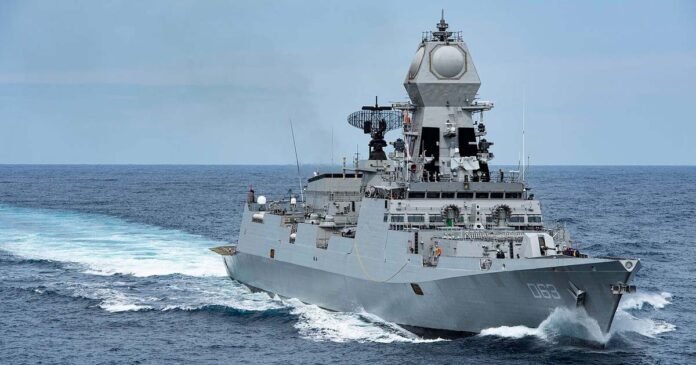
UNICORN, or Unified Complex Radio Antenna, is designed to combine several communication systems and antennas into a single integrated mast on a warship. By reducing the number of exposed antennas, the system can lower a vessel’s radar cross-section and improve its stealth and survivability in contested maritime environments. It is therefore, more than a communications upgrade: the project has implications for naval design, electronic warfare and combat effectiveness.
The two governments signed a Memorandum of Implementation for co-developing the system in November 2024. Under the proposed arrangement, Japan is expected to provide design and engineering support, while India would undertake integration, adaptation and manufacturing for Indian Navy platforms. Bharat Electronics Limited has been identified in previous reports as a potential Indian production partner.
The project gained political momentum during the 16th India-Japan Annual Summit in July, when the two sides announced it as their first joint defence co-development initiative. The plan is to manufacture the UNICORN mast in India for future Indian naval vessels, aligning the project with New Delhi’s “Make in India” defence-industrial policy.
For Tokyo, the agreement offers an opportunity to expand defence equipment cooperation with a major Indo-Pacific partner following Japan’s review of its rules governing transfers of defence equipment and technology. For New Delhi, it could provide access to advanced Japanese naval technology while strengthening domestic capacity to build and maintain sophisticated warship systems.

The UNICORN discussions formed part of a broader effort to deepen maritime security cooperation. Singh and Koizumi signed a Memorandum of Arrangement covering information-sharing for maritime domain awareness, search-and-rescue operations, humanitarian assistance and disaster relief. The two countries also agreed to expand reciprocal ship visits, naval exercises and logistical cooperation between the Indian Navy and Japan’s Maritime Self-Defence Force.
The ministers further discussed cooperation in mine-countermeasure operations and progress towards arrangements for mutual ship-repair facilities. They also backed stronger research and development ties between India’s Defence Research and Development Organisation and Japan’s Acquisition, Technology and Logistics Agency.

A bilateral Defence Industry Forum is expected to help identify additional projects, while a new senior-level Working Group will coordinate cooperation across operational, intelligence, equipment, technology and industrial fields. The group is intended to prevent separate initiatives from moving slowly and to accelerate implementation of decisions taken by the ministers.
Beyond UNICORN, India and Japan are examining possibilities for joint naval ship design and construction. Japan would contribute technological expertise, while India would offer its manufacturing capacity and growing shipbuilding infrastructure.
The push to complete the UNICORN process reflects the strategic importance both governments attach to practical defence cooperation. While the project remains subject to domestic approvals and implementation arrangements, its progress could establish a model for larger India-Japan technology partnerships in naval production and Indo-Pacific security.






