


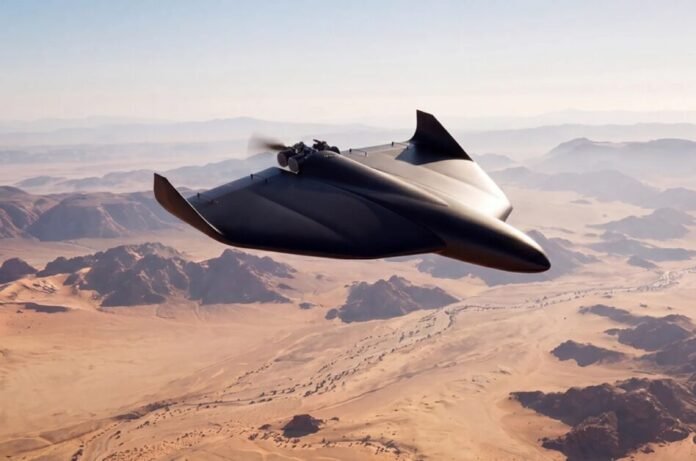
Harmattan AI says IRIFI is designed to fly as far as 2,000 kilometres and strike targets authorised by human commanders. The announcement marks the French company’s move into deep-strike systems and places Morocco at the centre of its development plans.
At the Marrakech Air Show, Morocco’s National Defence Administration and Harmattan AI’s Moroccan subsidiary signed a letter of intent covering the acquisition, development and production of IRIFI. The signing took place on October 7, in the presence of senior Moroccan defence officials and company representatives. The document sets out a development partnership, but does not specify funding, planned quantities or a schedule for delivery and operational service.

The agreement builds on a strategic partnership announced in June between Harmattan AI and Morocco’s Royal Armed Forces. That broader initiative set out plans for local manufacturing of autonomous defence systems, a research and development centre focused on artificial intelligence, and cooperation with Moroccan universities and research institutions. The IRIFI project gives the partnership a specific long-range strike programme to pursue.
Harmattan describes IRIFI as a mobile, canister-launched system intended for missions deep beyond the front line. The company says it can navigate without relying on satellite positioning and use visual guidance in its terminal approach. It claims the design is intended to operate when satellite navigation is disrupted and communications are contested. The payload has not been disclosed, and independent performance testing or operational demonstrations have not been reported in the announcements.
The system is designed to complete an authorised mission autonomously after launch. Harmattan says commanders set mission parameters and approve targets beforehand; IRIFI then executes the mission without human control during flight. The company also describes a concept in which one commander could direct multiple-strikes, supported by software that processes satellite imagery. The public material does not explain the system’s target-verification safeguards in detail or how it would handle unexpected changes during a mission.
Harmattan presents IRIFI as an attempt to occupy a space between lower-cost, mass-produced one-way attack drones and highly capable, expensive cruise missiles. Chief executive Mouad M’Ghari has contrasted the cost and production limits of systems such as Tomahawk and Storm Shadow with the low cost and larger production scale associated with Shahed-type drones. The comparison is the company’s framing; no IRIFI unit cost, production rate or independently verified performance figures have been released.

Morocco’s role signals an ambition to expand its domestic defence industry beyond purchasing finished equipment. The June partnership committed Harmattan to supporting manufacturing, research and skills development in the country. Moroccan reporting says IRIFI’s critical technologies are intended to be developed and produced locally, primarily by Moroccan personnel, though the exact division of work and extent of technology transfer remain unclear.
The programme is still at an early stage. A separate report citing M’Ghari said the company expected production by the end of 2027, but the letter of intent itself gives no production timetable. That distinction leaves open how quickly the system can progress from concept and development to testing, manufacturing and deployment.

For Harmattan AI, IRIFI extends its portfolio from autonomous defence systems into long-range strike. For Morocco, it offers a prospective route to local industrial and technical capabilities in a sensitive field. Whether the project delivers those ambitions will depend on development progress, production arrangements and the system’s demonstrated performance-details that remain to be established.






