


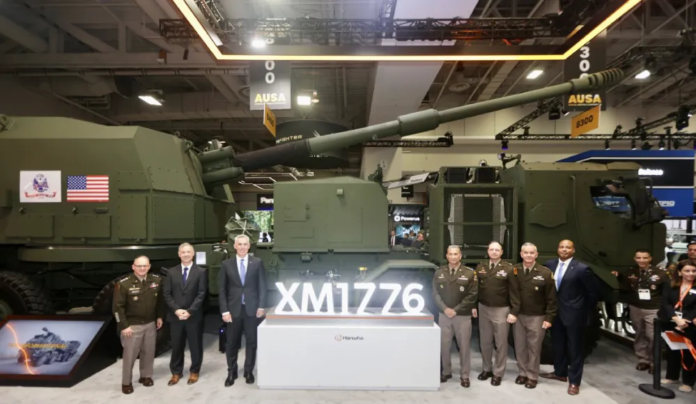
The new howitzer system, developed by Hanwha Defense USA, was revealed at the Association of the United States Army’s (AUSA) annual meeting in Washington on October 12. The Army has received its first prototype and will test the weapon with soldiers before deciding whether to field it. The XM1776 is the American version of Hanwha’s K9 Mobile Howitzer, adapted for the Army’s Mobile Tactical Cannon programme.
The XM1776 combines a 155mm cannon with a wheeled truck chassis, allowing it to travel under its own power rather than being towed into position. Its mobility is intended to help artillery units relocate quickly after firing-a tactic often called “shoot and scoot”. On battlefields where drones and counter-battery systems can detect firing positions, reducing the time a gun remains stationary may improve its chances of avoiding retaliation.

The Army says the prototype programme will assess the system’s performance, reliability and supportability in realistic conditions. Its August agreement with Hanwha covers an initial six systems, with options for additional units; the Army’s announcement valued the agreement at up to $262,903,274 and described a four-year prototyping and experimentation period. Hanwha later said the Army had ordered nine prototypes, with an option for nine more. The different figures reflect subsequent updates to the order.
Reported specifications indicate the XM1776 can fire as many as nine rounds per minute, compared with about four for the M777 towed howitzer. Its range is reported at up to 37 miles, depending on ammunition, while the M777’s range varies with the round used. These comparisons should be treated as system and ammunition-dependent: effective range is not a single fixed figure, and operational testing will help establish how the prototype performs under Army conditions.
A crew of three operates the XM1776, and an automated loading system is designed to let soldiers handle firing and resupply from inside the vehicle’s cab. Cameras provide views of activity around the gun, while a manual firing option remains available if automation fails. The design could reduce crew exposure during operations, although the degree of protection and the system’s performance under battlefield conditions will require assessment during testing.
The Army has said the XM1776 is not intended to replace every M777. If approved for fielding, the mobile cannon would replace the towed system in selected formations. Army plans outlined in reporting identify Stryker Brigade Combat Teams as an early focus, followed by mobile and infantry brigade formations. The service has also sought a tracked variant under a separate effort, suggesting it is considering more than one configuration for mobile artillery.

The programme reflects a broader push to modernise long-range fires with systems that can move and adapt more quickly. The Army selected Hanwha after market research and demonstrations involving multiple suppliers, opting for a mature design rather than a clean-sheet weapon. The existing K9 family has been used by South Korea and exported to other countries, giving the US programme, a platform with operational history-but the American configuration still must meet Army requirements.
Production capacity is another part of the plan. Hanwha is establishing an integration and test facility in Opelika, Alabama, and says it is engaging potential US suppliers to develop a domestic industrial base for the system. The Army’s contract is for prototyping, however, not a commitment to full-scale production. Testing, soldier feedback and decisions on future fielding will determine whether the programme advances beyond its current phase.

For now, the XM1776 remains a prototype, not an operational replacement for the M777. The Army expects experimentation to shape potential modifications and future decisions. Its central test will be whether greater mobility, firing speed and range can be delivered reliably, while remaining supportable and effective for soldiers in the field.






