


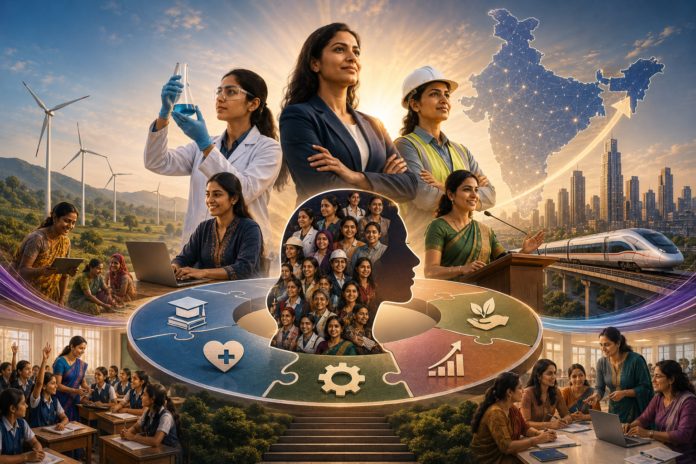
“Equality written into a constitution is a promise; equality lived in a nation’s institutions is power.”
As India marks another Independence Day, its rise is customarily measured against economic growth, technological capability, military modernisation and diplomatic reach. Yet the twenty-first century is quietly rewriting the grammar of power. GDP and defence budgets remain necessary conditions of strength, but they are no longer sufficient ones. A nation’s true capacity is increasingly judged by how fully it mobilises its human capital, and no measure of that capacity is more revealing than the place women occupy within it.

It is in this context that India’s shift from “women’s development” to “women-led development” acquires constitutional and strategic significance. The change is not cosmetic: it repositions women from recipients of welfare to architects of growth, innovation and governance, treating them as bearers of agency under Articles 14, 15 and 19, rather than objects of paternalist protection. As India aspires to become what may credibly be called a real global power, the decisive question is not whether gender inclusion is desirable, but whether great-power status is achievable at all while half the population remains under-deployed.
Economy: Women as Co-Authors of India’s Growth Story
No economy has sustained long-run prosperity while leaving half its workforce on the margins, and India’s numbers illustrate both the earlier deficit and the pace of recent correction. Government labour-force data shows the female labour force participation rate (FLFPR) rising from 23.3 percent in 2017-18 to 41.7 percent in 2023-24, nearly doubling in six years, with female unemployment falling from 5.6 to 3.2 per cent (PLFS, MoSPI). India recorded the sharpest rise in women’s labour-force participation among the BRICS economies over this period. Rural participation surged from 24.6 to 41.5 percent, driven substantially by Self – Help Groups, Mudra loans and schemes such as Drone Didi, while EPFO data records nearly 27 lakh net new female subscribers added in 2024–25 alone, evidence of a gradual shift from informal subsistence to formal, documented employment.
India’s female labour-force participation rate has surged from 23.3 to 41.7 percent in six years—but independent analysis cautions that much of this rise is concentrated in rural, self-employed and unpaid work, with rural women’s share in agriculture actually rising from 71 to 77 percent
Intellectual honesty, however, demands a caveat. Independent analysis, notably by the Centre for Economic Data and Analysis (CEDA), cautions that much of this rise is concentrated in rural, self-employed and unpaid work, with rural women’s share in agriculture actually rising from roughly 71 to 77 percent. It suggests a partial retreat into, rather than diversification beyond, the primary sector; some of the surge is plausibly distress-driven. Participation has genuinely broadened, but its quality, formality and wage-return remain the unfinished half of the story.
For a nation aspiring to Viksit Bharat by 2047, closing the gap with the global female labour-participation average — the McKinsey Global Institute puts the potential GDP gain in the hundreds of billions of dollars — is an economic imperative, not merely a social one.

For a nation aspiring to Viksit Bharat by 2047, closing the quality, formality and wage-return gap vis-à-vis female labour-force with the global average is not merely a social good but an economic imperative worth hundreds of billions of dollars
Technology: Gender Inclusion as Digital Sovereignty
India’s second claim to global power rests on its digital public infrastructure, fintech architecture and expanding footprint in artificial intelligence. But technological power is defined not only by what a nation builds, but by who builds and governs it. Women constitute barely a third of STEM graduates globally and an even smaller share of the STEM workforce, in the well-documented “leaky pipeline.”
As a legal scholar, one must also register the regulatory dimension: the very technologies reshaping India’s standing — AI, biometric identity systems, algorithmic decision-making — carry new risks of harassment, non-consensual image abuse and data exploitation that disproportionately affect women. The Digital Personal Data Protection Act, 2023, is an initial legislative response, but enforcement architecture, grievance timelines, and the independence of the Data Protection Board, remain works in progress. A credible technology power must pair innovation with jurisprudence; inclusive design and enforceable redress are as much a part of “digital sovereignty” as chip fabrication or satellite launches.

Diplomacy and Institutions: Gender as Soft Power
India’s diplomatic ascent — its G20 Presidency, its advocacy for the Global South, its engagement with BRICS — has been accompanied by a deliberate normative choice. By placing “Women-Led Development” at the centre of its G20 agenda and the New Delhi Leaders’ Declaration, India advanced a claim about what equitable development should look like for the rest of the world — soft power exercised through persuasion rather than coercion. This matters in international law because instruments from CEDAW (ratified by India in 1993) to the SDGs increasingly treat gender equality as a benchmark of a state’s developmental credibility and normative legitimacy.
From the Supreme Court’s landmark rulings in Babita Puniyaand Nitisha to the National Defence Academy admitting its first co-educated women cadets, India’s institutions are steadily converting constitutional equality into enforceable entitlement
This narrative gains credibility from institutional change at home. Women officers across India’s armed services have grown from roughly 3,000 in 2014 to over 11,000 today, with several now holding Lieutenant General rank and commanding operational units. This is traceable to specific jurisprudence: in The Secretary, Ministry of Defence v. Babita Puniya (2020), the Supreme Court held that excluding women from Permanent Commission and command postings violated Articles 14, 15 and 16, rejecting claims of “physiological limitations” as resting on sex stereotypes.
Lt Col Nitisha v. Union of India (2021) went further, holding that facially neutral evaluation criteria could still amount to indirect discrimination, moving equality doctrine from formal parity to structural effect. The National Defence Academy admitted its first fully co-educated batches of women cadets in 2025 as an outcome.
Yet India ranked 131st out of 148 countries in the WEF’s Global Gender Gap Report 2025, a reminder that the export of a normative model abroad still outpaces its realisation at home.
This should not be read as an indictment of the framework — India’s absolute score improved even as its rank slipped — but it complicates any triumphalist telling. A state that markets gender equality as a diplomatic export invites exactly this scrutiny of its domestic record; the credibility of soft power rests on coherence between what a nation says abroad and does at home.
Constitutional Foundations: The Jurisprudence Beneath the Policy
None of this is separable from India’s constitutional design, nor did the underlying jurisprudence begin with the phrase “women-led development.” In Vishaka v. State of Rajasthan (1997), the Supreme Court, in the absence of domestic legislation, drew on CEDAW to fashion binding guidelines against workplace sexual harassment, later codified in the 2013 Act.
India’s Global Gender Gap rank of 131 out of 148 countries—in the bottom fifteen per cent of surveyed economies—reminds us that exporting a normative model abroad still outpaces its realisation at home
In Anuj Garg v. Hotel Association of India (2007), the Court struck down a law barring women from certain employment, holding that “protective discrimination” can itself entrench stereotypes. In Joseph Shine v. Union of India (2018), while decriminalising adultery, the Court recognised women as autonomous constitutional subjects rather than as a husband’s proprietary interest. Read together with Articles 14 and 15, this case law shows the judiciary steadily converting the Constitution’s equality guarantee into enforceable entitlement — from the workplace to the armed forces to the family itself. Women-led development, then, is less a new policy innovation than a belated fulfilment of a seventy-five-year-old constitutional commitment.
Reimagining Power in the Indian Century
The question before India is not how much power it accumulates on its path to real global power, but what kind of power it chooses to become. If the twentieth century measured strength through territory and industrial output, the twenty-first measures it through resilience and the breadth of participation in national life.
A near-doubling of female workforce participation, a nearly fourfold rise in women officers, a G20 Presidency built around women-led development, and a constitutional jurisprudence converting formal equality into structural entitlement are not disconnected data points, nor, given a gender-gap rank in the bottom fifteen per cent of surveyed economies, are they a finished project. Together they mark the outline of a different kind of power: one measured not only in what a nation builds, but in who builds it, and in whether courts and the legislature keep faith with that commitment once the celebration has passed. That is the wager India makes as it enters its next decade of transition: that the surest path to becoming a real global power runs not around half its population, but through it.

The writer is a legal academic with a PhD in Law, working at the intersection of gender justice, public policy, and national security. She is presently serving as Assistant Professor (Gr II) of Law at Amity University, Noida. She can be contacted at sunandini.arun@gmail.com. The views expressed are personal and do not necessarily carry the views of Raksha Anirveda





