


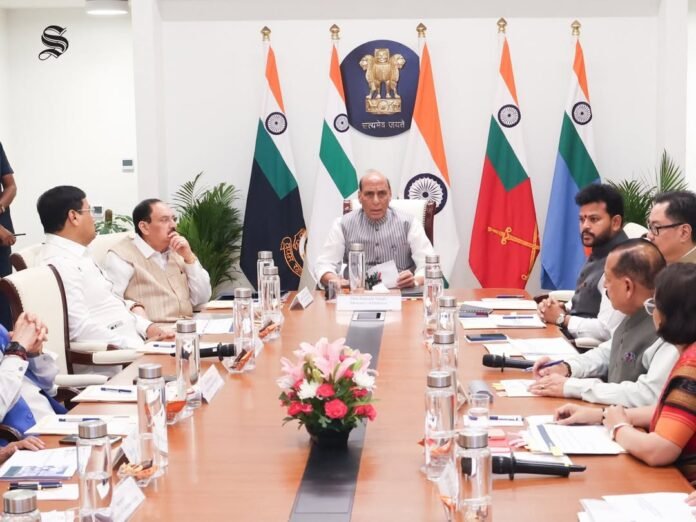
Shirdi (Maharashtra). India’s annual defence production hit a record ₹1.78 lakh crore in the 2025-26 fiscal year, highlighting a profound transformation from a weapons importer into an aggressive, sovereign exporter.
The long-term trajectory of India’s military industrial complex is undergoing a historic realignment. For decades, the nation relied heavily on external tech pipelines to equip its armed forces, consistently ranking among the world’s largest importers of conventional weaponry.

However, speaking at the inauguration of an advanced ammunition and aerospace manufacturing complex in Shirdi, Maharashtra, Defence Minister Rajnath Singh declared that a structural break from this legacy has officially arrived.
Backed by an unprecedented surge in domestic capital and aggressive policy frameworks under the Aatmanirbhar Bharat initiative, the country’s defence manufacturing infrastructure is actively pivoting outward.
With annual production hitting historic benchmarks and exports reaching a record ₹38,424 crore across more than 80 allied nations, Singh asserted that no global power can stop India’s transformation into a premier arms exporter within the next quarter-century.
Dismantling the “Nuts and Bolts” Paradigm
A central pillar of this defence strategy is the elevation of private sector entities from minor component fabricators to prime, tier-one systems innovators. Singh strongly emphasised that private industry has permanently outgrown its restrictive legacy boundaries.

“Earlier, the role of the private sector in defence production was negligible,” Rajnath Singh stated, reflecting on colonial-era policy footprints that historically weakened indigenous technical capacities. “The private sector is no longer merely a supplier of ‘nuts and bolts’ to the armed forces, but has evolved into an innovator and producer of advanced weapon systems.”
To cement this collaborative momentum, the Ministry of Defence (MoD) has established a target to raise private sector participation to 50 per cent of total national defence production, shifting rapidly from its previous baseline levels.

The industrial evolution blueprint maps out a major transition path across three distinct phases.
First, the Legacy Footprint reflects a historical period where private players were largely confined to providing basic raw materials and low-tier component supplies. Second, the Modern Private Baseline marks a significant shift in current output, with the private share capturing 24% of total domestic defence production – amounting to an impressive ₹42,000 crore in FY26. Finally, the Targeted Growth Horizon outlines the next phase of this strategy, where a statutory target has been set to absorb 50% of overall production through advanced integration and prime systems manufacturing.
Data-Driven Autonomy: Breaking Production Records
The industrial transformation is anchored by concrete production volumes. According to recent data released by the Department of Defence Production, India’s annual output surged by 15.6 per cent year-on-year to hit ₹1.78 lakh crore for FY26. This trajectory represents an extraordinary 110 per cent explosion since FY21, effectively tripling production values from a decade prior.
The roadmap of the Aatmanirbhar production expansion demonstrates a consistent upward trajectory across sequential fiscal thresholds. The growth timeline begins in FY14 with a baseline output of ₹43,746 crore. This volume nearly doubles by FY21, climbing to ₹84,643 crore, before experiencing a massive surge to reach a record ₹1,78,000 crore by FY26.
Crucially, while Defence Public Sector Undertakings (DPSUs) continue to generate approximately 76 per cent of total output, private firms registered an all-time high contribution of 24 per cent, injecting ₹42,000 crore into the national defence industrial ecosystem.
The financial and operational growth strategy for the defence manufacturing sector maps key strategic metric vectors from current performance baselines to ambitious long-term vision targets.
First, Total Domestic Production reached a baseline of ₹1.78 Lakh Crore in FY 2025-26, with a long-term target to scale the output to ₹3.00 Lakh Crore by 2029. Second, Global Export Volume stood at a performance baseline of ₹38,424 Crore, aiming for an expansion to ₹50,000 Crore by 2029.
Third, the Private Sector Share captured a 24% baseline – equivalent to roughly ₹42,000 Crore – and is systematically targeted to meet a 50% participation threshold over the 2029-2033 horizon. Finally, the sector’s International Footprint currently spans a baseline of over 80 importing nations, paving the way for its long-term evolution into a dominant global export hub.
This growth has fundamentally altered the export environment. In 2014, India’s total defence exports stood at a modest ₹900 crore. By executing sequential policy updates – including the Defence Acquisition Procedure (DAP) 2020, the Defence Procurement Manual 2025, and stringently enforcing Positive Indigenisation Lists – the state has created a highly protective incubator for domestic tech labs.
Technological Superiority in Automated Warfare
The aggressive push for complete self-reliance is heavily informed by ongoing global conflicts. Pointing directly to lessons emerging from the Russia-Ukraine war and localised geopolitical instability across West Asia, Singh warned that numbers alone can no longer guarantee territorial integrity.
“The biggest difference in future wars will not depend on the number of soldiers a country possesses, but on how advanced and capable it is in munitions and automation,” Singh remarked. He noted that private industry’s innate willingness to assume financial risk, innovate rapidly, and maintain high operational efficiency makes it uniquely suited to drive next-generation breakthroughs.
By modernising older state networks – including the strategic corporatisation of the legacy Ordnance Factory Boards into agile, globally competitive entities – and setting an ultimate output goal of ₹3 lakh crore by 2029, India is positioning itself as a reliable defence partner to the Global South. The ultimate outcome of this strategy extends beyond pure commercial gain; as Singh concluded, a genuinely self-reliant nation is a fundamentally secure, capable, and unassailable power.






