


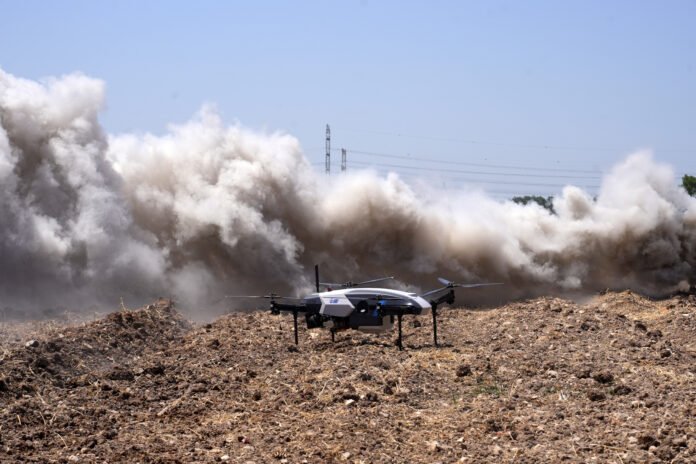
Tel Aviv: As extreme weather events and the effects of global warming continue to drive an increase in the frequency and intensity of wildfires, the Israeli Ministry of National Security, the Israel Innovation Authority, Israel Aerospace Industries (IAI), the Technion, and the Israel Fire and Rescue Authority have launched a joint project to develop an advanced solution for detecting and locating fires in real time within minutes of ignition. The system completed its first flight test, marking the beginning of a series of additional trials designed to evaluate its capabilities across a range of operational scenarios and changing field conditions, to enable emergency organisations to respond more quickly and effectively to fires, particularly across vast and remote areas.
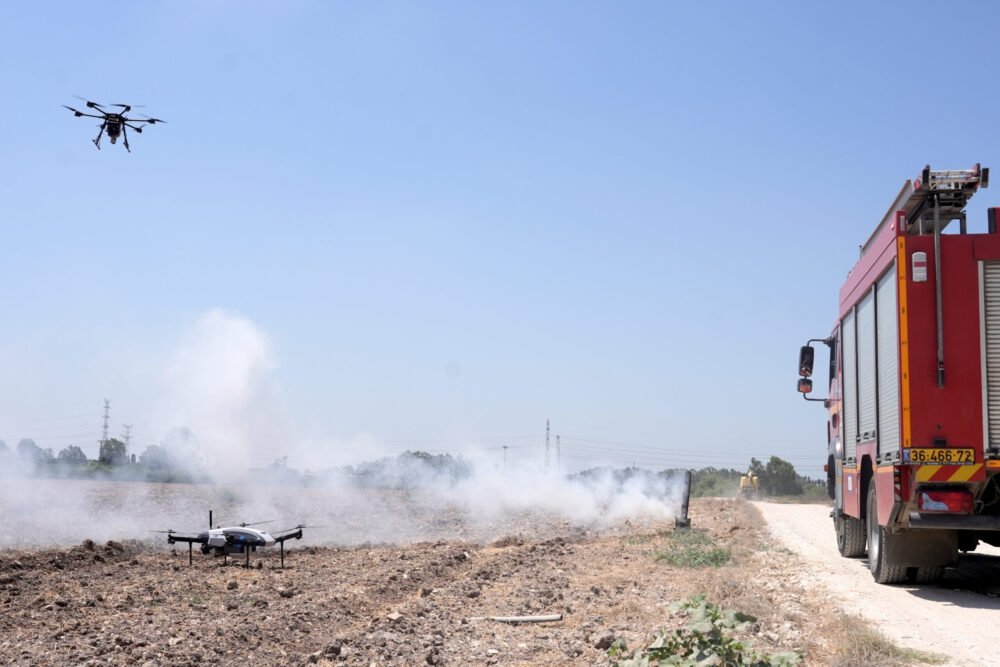
As part of the project, a dedicated system was developed and integrated onto IAI’s APUS 25 platform, an advanced tactical VTOL (Vertical Takeoff and Landing) drone capable of operating from virtually any location without the need for a dedicated runway, flying at high altitudes, and remaining airborne for extended periods.

The system combines day and night-vision cameras with infrared capabilities that enable the detection of fire hotspots even in darkness and allow it to penetrate dense smoke. It uses spectral image-processing algorithms and artificial intelligence to analyse information in real time, detect anomalies, identify fire outbreaks, and extract the precise location of a fire from high altitudes, while immediately transmitting alerts to the Israel Fire and Rescue Authority’s command and control centre.
The system represents a breakthrough thanks to its ability to cover hundreds of square kilometres with a single drone, detect fires within just a few minutes of ignition, and determine the fire’s location with meter-level accuracy from its earliest stages – before it develops into a large-scale wildfire that could become uncontrollable.
The solution is based on the APUS 25 drone, developed for long-endurance missions and capable of remaining airborne continuously for extended periods, even under challenging terrain and weather conditions. The platform is optimised for long-range persistent surveillance missions while carrying a dedicated payload. Powered by an internal combustion engine rather than electric motors or batteries, the APUS 25 achieves significantly extended flight endurance.
The drone will be operated by a firefighter, who will define the search area by marking a polygon on a digital map. Following takeoff, the drone will operate autonomously, position itself at the optimal observation point, and continuously scan the designated area for four to five hours, providing emergency responders with a real-time operational picture to support decision-making, incident management, and the efficient deployment of firefighting resources.

Yaron Schone, Head of R&D Technology Department, Israel Ministry of National Security, stated, “This project represents another step forward in advancing innovative technological capabilities for Israel’s security and emergency organisations. The combination of drones, artificial intelligence, and advanced data-processing capabilities has the potential to enable earlier fire detection, improve operational situational awareness, and shorten response times in the field. The collaboration between all participating organisations reflects the importance we place on connecting operational needs with Israeli innovation to develop solutions that help protect lives, property, and Israel’s natural resources.”
Moshe Levy, EVP and GM of the Military Aircraft Group, IAI, commented, “For many years, IAI has been developing advanced technological solutions for complex challenges across both defence and civilian domains. This unique project demonstrates our ability to leverage our expertise, operational experience, and capabilities in aviation, artificial intelligence, and autonomous systems to address an issue of both national and global importance. Collaborations of this kind enable us to transform advanced technology into operational capabilities that deliver real value in the field.”

Kerem Nevo, VP of the Growth Division, Israel Innovation Authority, remarked, “This project is part of a collaboration between the Israel Innovation Authority and the Ministry of National Security, enabling advanced technologies to be evaluated in a relevant operational environment and creating meaningful value for the public. It is an excellent example of how the integration of drones, artificial intelligence, and operational field capabilities contributes to the development of innovative solutions for urgent operational challenges.”
Prof Asaf Schuster, Henry and Marilyn Taub Faculty of Computer Science at the Technion, said, “The Fire Detection system demonstrates how scientific excellence can be translated into a practical solution that helps save lives and reduce damage. The integration of the drone platform and its hardware with our expertise in algorithms and AI will enable fire and rescue authorities to make decisions based on real-time information received from the drone and respond to fires more rapidly, more efficiently, and at an earlier stage. It is a great privilege to be part of such an important national project.”
Lieutenant General Eyal Caspi, Commissioner of the Israel Fire and Rescue Authority, stated, “Climate change and the increasing frequency of extreme weather events require us to develop the future capabilities of the Israel Fire and Rescue Authority today. We are investing in advanced technologies that will enable earlier detection, enhanced command and control, and faster responses to large-scale wildfire events. This historic collaboration with the Israel Innovation Authority, IAI, and the Technion is intended to advance the development of next-generation operational capabilities that will significantly strengthen our command, control, and operational monitoring capabilities while helping contain fires in their earliest stages. This is the first strategic step toward building a smarter, more advanced Fire and Rescue Authority that will strengthen the protection of lives, communities, and Israel’s natural resources in the years ahead.”






