


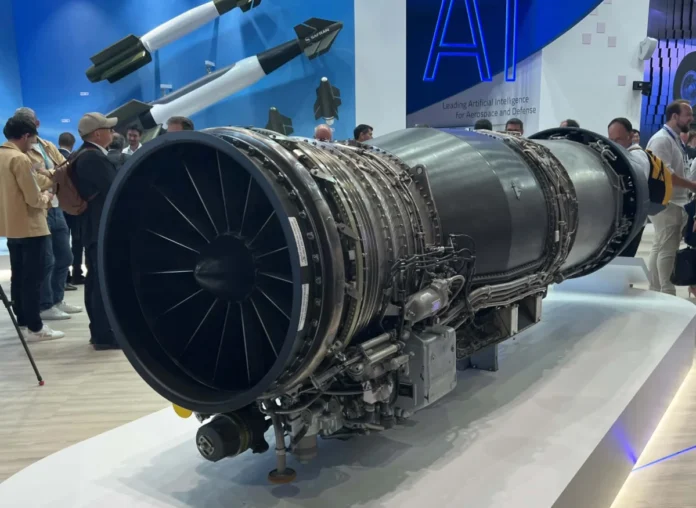
French aerospace contractor Safran has announced that funding for the joint Franco-German Future Combat Air System (FCAS) fighter jet engine will cease in September 2026. The decision follows the broader collapse of the €100 billion defence initiative, which was derailed by irreconcilable differences between industrial primes Dassault Aviation and Airbus Defence.
End of Joint Propulsion Efforts
Speaking during Safran’s half-year financial results conference call, Chief Executive Officer Olivier Andriès made it clear that the company cannot sustain dual engine developments.

“We won’t have the engineering resources to produce two different engines,” Andriès stated, “We only have resources to develop one combat aircraft engine, and we will obviously prioritise the French roadmap.”
The propulsion initiative had been managed through EUMET, a joint venture involving Safran Aircraft Engines, Germany’s MTU Aero Engines and Spain’s ITP Aero. With the main Next Generation Fighter (NGF) programme cancelled, the future of the industrial partnership remains uncertain as governments re-evaluate their defence strategies.
Pivot to the Rafale F5 and M88 T-REX
Rather than continuing to support a fragmented multinational effort, Safran is shifting its military research and development capacity to France’s sovereign air combat roadmap. Primary among these efforts is the development of the M88 T-REX engine, an upgraded propulsion system designed to power the upcoming Dassault Rafale F5 standard.
The Rafale F5 standard represents a significant generational leap for the French Air and Space Force and the French Navy. Intended to serve alongside autonomous “loyal wingman” combat drones, the aircraft requires enhanced power, advanced thermal management and upgraded avionics integration. By redirecting engineering talent toward the M88 T-REX, Safran aims to ensure that France maintains an independent, cutting-edge military aviation capability through the coming decades.

Implications for European Defence Industrial Base
Safran’s strategic pivot highlights growing friction between joint European defence initiatives and individual national sovereignty imperatives. FCAS was originally designed as a flag-ship project to unite European air power under a single sixth-generation platform. However, stark disagreements regarding intellectual property rights, industrial leadership and differing operational requirements ultimately doomed the fighter element of the programme.
While components of the broader FCAS ecosystem – such as the interconnected “Combat Cloud” data networks and remote drone platforms – may continue as separate initiatives, the engine programme’s end leaves partner nations searching for alternatives. Germany and Spain must now determine whether to fund an independent European propulsion solution or pursue alternative alliances, such as aligning with rival next-generation fighter efforts.

For France, the consolidation of resources behind the domestic M88 T-REX project guarantees that local industrial supply chains remain secure. However, industry observers warn that the failure of joint projects risks fragmenting the European defence market further, driving up acquisition costs for individual nations while handing a strategic advantage to international competitors.






