


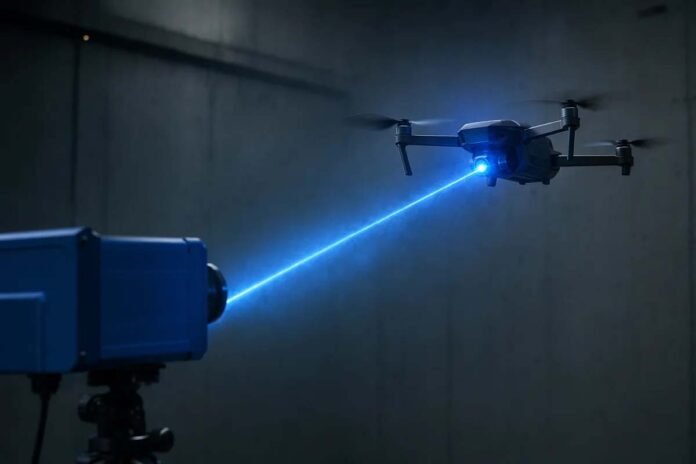
ROME. As the threat of hostile unmanned aerial vehicles (UAVs) escalates globally, a breakthrough in directed-energy technology promises to reshape front-line air defence. Colorado-based developer NUBURU Inc, in collaboration with Italian tactical systems firm Tekne SpA, has announced the successful completion of initial testing for a novel laser dazzler designed to completely blind the electro-optical sensors of incoming drones.
The defence trials, conducted at Tekne’s specialised testing facilities in Italy, focused on evaluating how effectively the high-intensity laser could disrupt a drone’s vision. Unlike high-energy military lasers built to physically melt or destroy target frames, a “laser dazzler” is a non-kinetic weapon. It emits a precisely calibrated, intense beam of light aimed directly at a drone’s optical or infrared camera lenses. This creates a state of total sensor saturation – essentially a localised “flash blindness” – rendering the aircraft unable to capture visual data, track targets or navigate accurately.

Invisible Close-Range Domination
During controlled indoor tactical simulations, simulating a drone searching for a human target, the results were definitive. When the dazzler engaged the aircraft’s optics, the system achieved total visual denial. In an extraordinary demonstration of tactical concealment, a neutralisation operator was able to successfully approach within 20 metres (66 feet) of an actively tracking hostile drone without ever being detected by its onboard camera.
The test campaign evaluated the system’s performance across multiple commercial and tactical UAV configurations using both steady continuous-wave beams and rapid pulsed-laser operations. The dazzling effect remained flawlessly consistent across all platforms. While physical restrictions kept the indoor testing range to 100 metres, technical teams confirmed that the laser-beam propagation physics support a modelled operational engagement range starting at one kilometer and stretching significantly beyond.
A Shift Toward Non-Kinetic Defence
The rising prominence of cheap, weaponised consumer drones in modern conflicts has left traditional military units vulnerable. Standard kinetic defences – such as surface-to-air missiles or physical anti-aircraft rounds – are often too expensive and limited by ammunition capacity to counter massive swarms.
“The objective has been to design a compact, modular system capable of delivering effective optical countermeasures against drone threats while maintaining portability and operational flexibility” stated the joint engineering group.

Furthermore, shooting down drones with physical projectiles poses immense collateral damage risks in urban zones or near critical civilian infrastructure. Laser dazzlers solve this dilemma by disabling the enemy’s sensing layer silently and harmlessly. If a drone is blinded, its remote operator cannot drop payloads or relay coordinates, thus, effectively neutralising the threat.
The Next-Gen Tri-Spectrum Evolution
Following these successful trials, NUBURU and Tekne have established a unified engineering team to transition the proof-of-concept hardware into field-ready military hardware. The product roadmap outlines an ambitious next-generation platform architecture that integrates three separate light sources into a single device: green, blue and infrared (IR) lasers.

The inclusion of the blue spectrum is vital, blue laser light is absorbed much more efficiently by standard optical materials, maximising sensor disruption even at exceptionally low power outputs. Crucially, the system is designed to be highly portable. Future iterations are being engineered to attach directly to standard infantry rifle mounts, instantly transforming individual soldiers into highly capable anti-drone fighters.
The technology is slated to be integrated directly into Tekne’s mobile tactical vehicles and future multi-domain mission packages under the NUBURU Defence’s Italian Plan. As global demand for counter-UAS technologies surges toward an estimated $13 billion market by 2033, this light-based shield could soon become standard issue for safeguarding military airspace worldwide.






