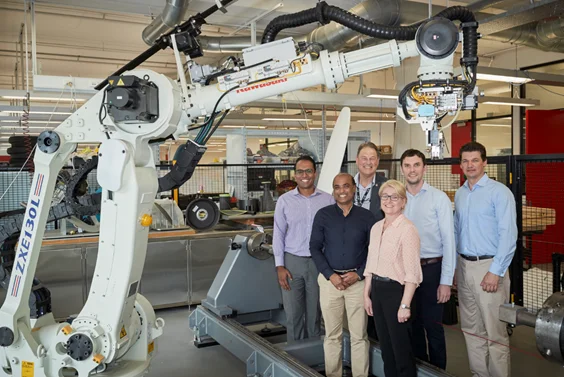
Naval Group Pacific, in partnership with the ARC Training Centre for Automated Manufacture of Advanced Composites (AMAC) at UNSW Sydney, has successfully demonstrated how a carbon composite embedded with fibre optics could be used for structural applications in marine vessels.

The proof-of-concept test was designed to determine how a composite embedded with fibre optics could be used in the masts of marine vessels that may house vital equipment such as radars and periscopes.
The use of composites can decrease the weight of the mast, which in turn can reduce the vessel’s overall weight due to a lighter counterbalance being required. By applying fibre optics that allow for structural health monitoring (SHM), it is possible to save vital maintenance time and resources over the lifetime of any vessel to which it is applied.
Over the course of 5 days, AMAC and Naval Group successfully demonstrated how the composite embedded with fibre optic sensors can be used to assess the performance under mechanical loads. Airspeed Pty Ltd, an Australian designer and manufacturer of composite materials for aerospace, maritime and energy-related projects also participated in the test.
AMAC has been actively developing the application of fibre optic sensors as SHM solutions for composite structures with proven results. Naval Group and the AMAC at UNSW will continue exploring the collaboration possibilities to support Naval Group’s expanding field of composites related R&D.

The test builds on Naval Group’s long history of applying composite materials for not only parts, but entire structures, similar to the mine-hunters developed in the 1980s.
AMAC Centre Director Professor Gangadhara Prusty, said “The positive, and rapid delivery of the composite test is an evidence of the innovation capabilities of our two organisations. Professor Prusty said that AMAC’s vision is to benefit our strategic industry partners by delivering world-class composite R&D capabilities, typically achieving significant improvement in R&D cost and time overheads.

François Romanet, Naval Group Pacific CEO said, “Composites are a key capability for modern shipbuilding and it has been mutually beneficial to work with UNSW. We are already looking into furthering our cooperation and including industrial partners in our research.”
Serge Kamkin, a Naval Architect with Airspeed, said he was excited about the possibilities demonstrated by the test and explained: “Composites have broad application potential across the entire marine industry, and seeing this new application opens a whole new world of possibilities.”
Naval Group Pacific and UNSW are founding members of the Australian Maritime Development Centre (AMDC), a world-class maritime research collaboration between government, academia and industry.