


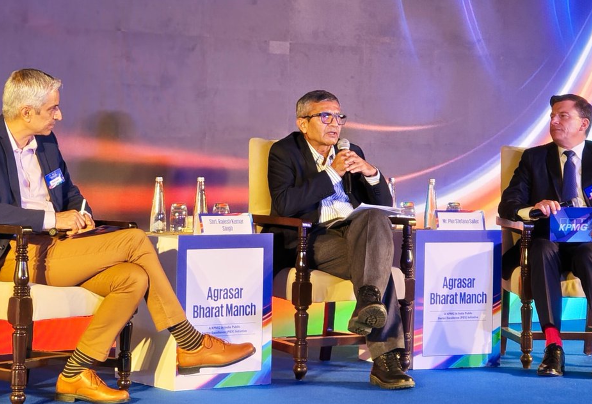
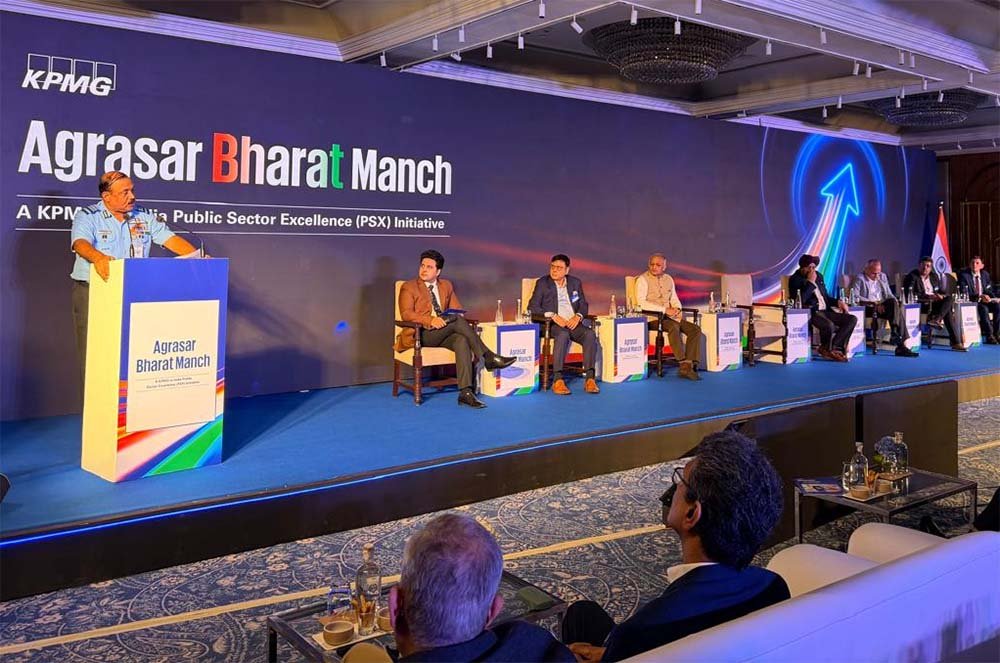
At a fireside chat at Agrasar Bharat Manch, organised by KPMG India on October 23, Defence Secretary Rajesh Kumar Singh described a defence landscape being reshaped by geopolitical uncertainty, emerging technologies and supply-chain risks. The government’s ambition, he said, is to shift from “Made in India” to “Owned by India”: ensuring Indian entities hold a system’s design, intellectual property and source code, and the ability to upgrade it.
The distinction matters, Singh argued, because local assembly alone does not guarantee control over a capability. Nor, he acknowledged, is it realistic to manufacture every component domestically. India’s approach, he said, is to deepen local capability while maintaining “trusted interdependence” with private-sector firms and friendly countries.

The remarks come as India’s defence industry expands. Singh cited domestic defence sales of ₹1.78 lakh crore and record exports of ₹38,424 crore, reaching more than 80 countries. Government figures show defence production reached ₹1.78 lakh crore in financial year 2025-26, up 15.6% from the previous year. The private sector accounted for about 24% of production, or around ₹42,000 crore.
Defence Secretary Rajesh Kumar Singh stressed moving beyond local assembly (“Made in India”) toward complete Indian ownership of design, source code and intellectual property to guarantee strategic control and capability upgrades
The export growth, however, does not mean India has become self-sufficient. The Stockholm International Peace Research Institute reported that India was the world’s second-largest recipient of major arms in 2021-25, accounting for 8.2% of global imports. Imports declined 4% from the previous five-year period, but SIPRI said India’s continued reliance on foreign suppliers reflects both security pressures and delays in domestic production.
Singh said India was broadening an industrial base once centred largely on government-owned companies. He cited nearly 840 large and medium-sized firms with industrial licences and about 17,000 small and medium enterprises, including startups. For the government, widening participation is not only an industrial policy goal: it is also a way to build more resilient supply chains and increase production capacity.
That capacity will be tested by demand for equipment that can be produced and replenished quickly. Drawing on the Russia-Ukraine war, the Middle East and India’s own recent confrontation with its western neighbour, Singh pointed to the growing use of unmanned systems, long-range strikes and counter-drone capabilities. He said emergency procurement powers had been used to address gaps in unmanned systems, counter-UAS equipment, mobile artillery and mobile radars.

The Ministry of Defence is developing an indigenous AI layer for decision-making and targeting, citing risks that foreign-supplied AI could contain backdoors, kill switches or be withheld during crises
Networked air defence is another priority. Singh cited the Integrated Air Command and Control System, which connects radars, aircraft and air-defence systems, and said India plans to strengthen its shield and upgrade older equipment. Retrofitted, networked guns could provide a lower-cost response to drones than missiles priced at ₹5-10 crore each, he said. The broader challenge is to match threats with defences that are both operationally effective and financially sustainable.

For missiles, scale is central to deterrence, Singh said. Higher production volumes can bring down unit costs, while a wider supplier base can help meet demand during a crisis. He said DRDO had opened conventional missile technologies to industry through requests for information, with nearly 17 large private-sector firms, as well as public-sector companies, taking or pursuing technology transfers for systems of different ranges.
Singh also outlined plans for an indigenous AI layer for the armed forces, covering decision support, target acquisition, data fusion and the sensor-to-shooter loop. The Ministry of Defence is working with the IndiaAI Mission and procuring computing capacity, he said, with private partners expected to contribute. He argued that critical military AI must be developed domestically because foreign suppliers could withhold technology or leave India exposed to backdoors or kill switches, while adding that collaboration with trusted partners remained possible.
To help startups bridge the gap between prototypes and full-scale production, the new Defence Acquisition Procedure plans to grant proven prototype developers five years of order visibility without alternative vendor seeking
Moving new technologies from prototype to production remains a hurdle, especially for startups. Singh said the iDEX programme had produced contracts worth about ₹2,000 crore, but recognised that funding gaps can prevent companies from scaling. Under the new Defence Acquisition Procedure, he said, startups with proven prototypes may receive five years of order visibility, during which the government does not seek an alternative vendor. The measure is designed to give companies room to manufacture at scale without immediately surrendering equity to larger players or investors.
The five-year window reflects a difficult balance: defence firms need predictable demand to invest in production, but military technology can change rapidly. Singh said the limit was intended to provide stability without creating a permanent monopoly. The policy’s effectiveness will depend on whether prototype success translates into repeatable orders, production capacity and equipment that meets the armed services’ requirements.
He also addressed the proposed integration of the Army, Navy and Air Force into theatre commands. A blueprint has been prepared and is awaiting approval at the highest levels, he said. The plan is intended to support coordinated operations across land, sea, air, space and cyber-domains that increasingly depend on shared information and communications infrastructure.
India’s domestic defence production surged to ₹1.78 lakh crore with exports reaching ₹38,424 crore across 80+ nations, backed by over 17,000 SMEs and private-sector partnerships in missile technology and production
On international cooperation, Singh described a strategy of diversifying partnerships while building domestic control. He said France and Israel each account for about 15% of India’s defence imports, while Russia remains an important historical supplier. He also pointed to a new India–European Union security and defence partnership as a basis for cooperation, including joint ventures and participation in European programmes. Foreign firms operating in India, he said, would be expected to meet localisation requirements.
The tension between self-reliance and foreign sourcing remains clear. SIPRI’s data shows India’s arms imports are still substantial, even as domestic production and exports rise. Singh’s “Owned by India” formulation offers one measure of progress: not complete isolation from global suppliers, but greater Indian control over design, upgrades and the industrial capacity needed to sustain equipment.
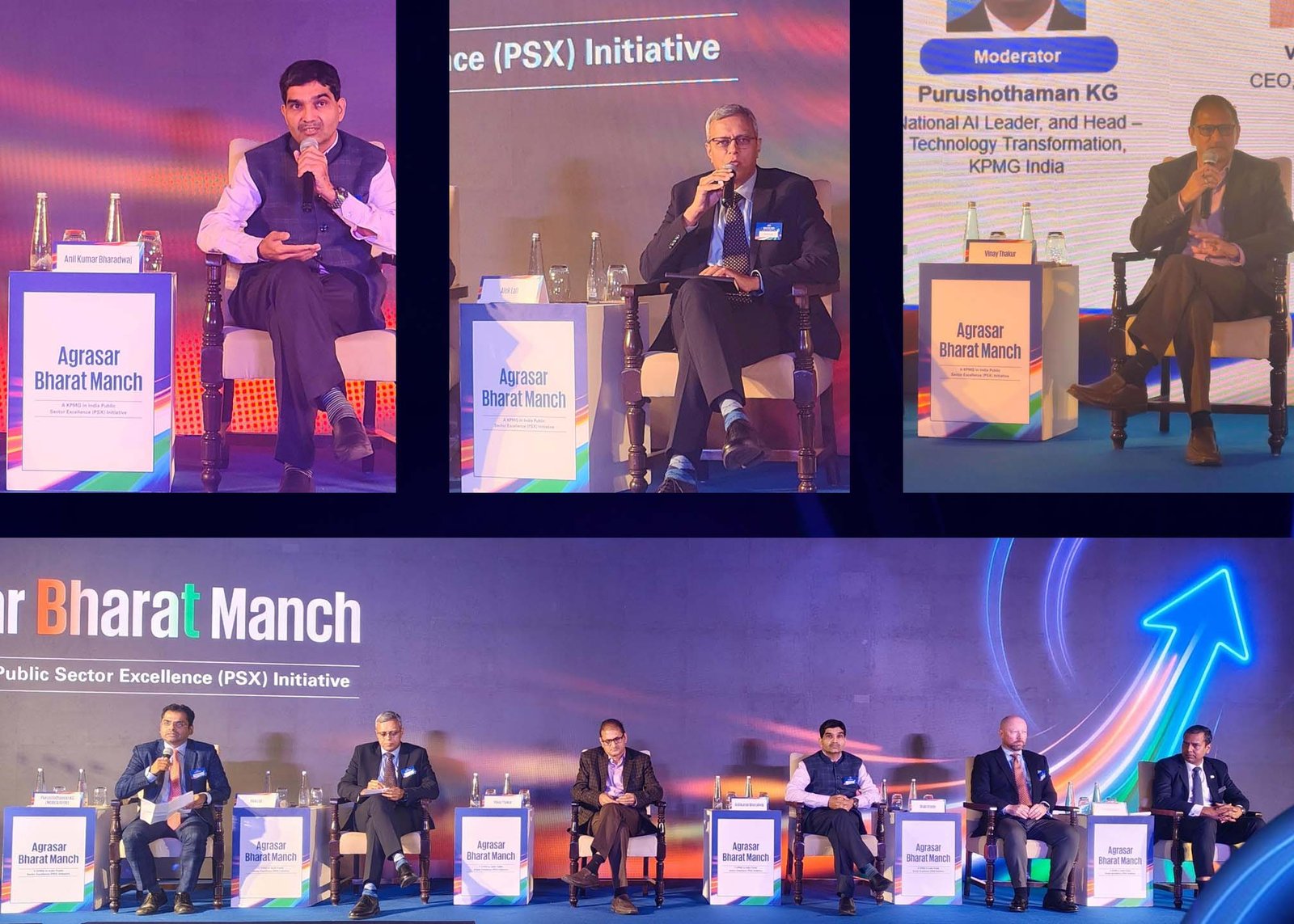
On the sidelines, Gaurav Mehndiratta, KPMG India’s partner and national head of aerospace, defence and space, told Raksha Anirveda that future military effectiveness would depend on the convergence of data, sensors, networks, autonomous systems, space and human judgement. The forum’s discussion pointed to the same conclusion: defence modernisation is not simply about acquiring advanced platforms. It also requires secure supply chains, dependable procurement, scalable industry and the ability to integrate technology into military operations.

-The writer is a New Delhi-based senior commentator on international and strategic affairs, environmental issues, an interfaith practitioner, and a media consultant. The views expressed are personal and do not necessarily carry the views of Raksha Anirveda





