


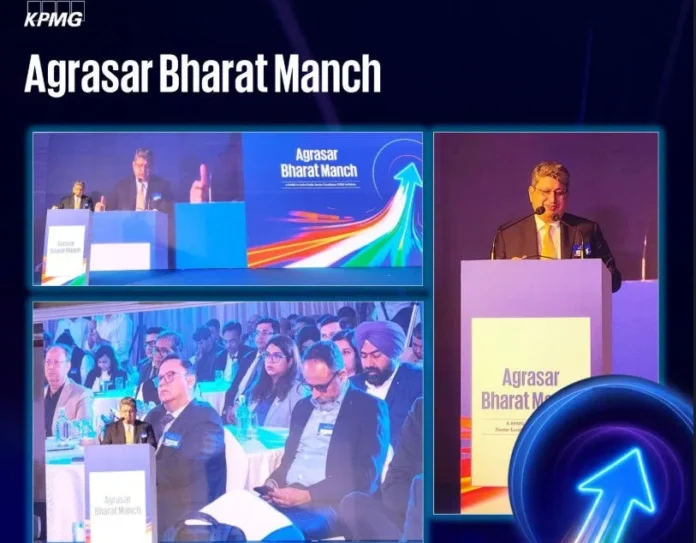
KPMG India’s flagship Public Sector Excellence initiative, Agrasar Bharat Manch, was held on October 23, 2026 in New Delhi. The forum brought together senior leaders from government, industry and the wider development ecosystem to discuss the priorities shaping India’s next decade of progress. The discussions focused on the defence sector, with particular emphasis on how artificial intelligence and machine learning are transforming modern warfare and shaping the future of battlefield capabilities.
On the occasion, Yezdi Nagporewalla, Chief Executive Officer, KPMG India said, “India’s ambition to become a developed nation is clear. The opportunity before us now is to accelerate that journey while ensuring that the progress we create is meaningful, sustainable and inclusive. Agrasar Bharat represents this spirit of purposeful progress, moving ahead with confidence and a shared sense of direction. Viksit Bharat 2047 may define our destination, but it is the choices and momentum we build today that will determine how we get there.”

AI is revolutionising warfare by integrating sensors, networks and weapons to enable “decision superiority” – allowing armed forces to process intelligence and act faster than their adversaries
The forum’s session, “Battlefield of the Future – How AI/ML is Transforming Warfare”, examined how artificial intelligence, autonomous systems and rapidly advancing technologies are changing military operations. The discussion ranged from battlefield decision-making and electronic warfare to modernising existing equipment, developing domestic technologies and ensuring that emerging capabilities can be sustained and deployed at scale.
KPMG’s report, Battlefield of the Future: How AI/ML is Transforming Warfare, says AI’s military significance lies in connecting sensors, communications networks, commanders and weapons. That integration can help armed forces interpret information, coordinate decisions and respond more quickly.
The report identifies “decision superiority” – the ability to turn information into action faster than an adversary – as a defining source of future military advantage. It calls for India to build a sovereign, trusted and operationally integrated defence AI ecosystem, supported by secure data, interoperable systems, assured computing infrastructure, adaptive procurement and accountable human command.
While AI and autonomous systems drastically improve the speed and quality of operational planning, military experts emphasise that human judgement, strategic command and resilient networks remain essential to safeguard against deception and system disruptions
Air Marshal Prem Kumar Krishnaswamy, delivering the special address, said future conflicts would not be decided simply by the number of troops or the sophistication of individual platforms. He pointed to intelligence, surveillance and reconnaissance; operational planning and decision support; autonomous systems; and predictive maintenance and logistics as areas where AI could strengthen military capability.

But the potential gains, he cautioned, depend on careful integration. Incomplete information, deception or manipulation can produce misleading assessments, making human oversight and military judgement essential. The advantage, he argued, would go not simply to forces that adopt AI, but to those that incorporate it securely and effectively into operational doctrine. India’s technology talent offers an opportunity, he added, but the central challenge is combining human intelligence with machine capability.
Lt Gen PJS Pannu (Retd) also framed AI as a means to improve the speed and quality of decisions, not as a substitute for commanders. He argued that increasingly connected platforms could support more distributed operations, while warning that centralised command systems may be vulnerable to physical and digital disruption. Decisions, he said, must remain grounded in national interests and strategic objectives.

Gen Pannu extended the discussion to space and cyber preparedness, noting the dependence of autonomous platforms and command systems on satellites, data centres and communications networks. Those connections create vulnerabilities that defence planning must address.
Modern conflicts demonstrate the financial risk of using multi-million-dollar air defence missiles against low-cost drones, highlighting an urgent need for scalable, lower-cost interceptors and rapid software innovation
The need for resilient networks is reinforced by lessons from the war in Ukraine, he said: a 2025 analysis by the Center for Strategic and International Studies describes how GPS jamming and communications disruption have affected autonomous systems and command and control, prompting the use of alternatives such as inertial navigation, satellite communications, relay stations and mesh networks.
Lt Gen Rahul R Singh (Retd), former Deputy Chief of Army Staff (CD&S), focused on the vulnerability of conventional platforms to precision strikes and relatively inexpensive drones. Drawing on the Armenia-Azerbaijan conflict, he called for upgrading existing assets, improving battlefield networking and integrating crewed and uncrewed systems. He said defence planning must also address the economic imbalance that arises when costly air-defence weapons are used against low-cost threats.
That cost question is increasingly central to air defence. A 2026 analysis of Ukraine’s experience describes how mass drone attacks can exhaust sensors and interceptors, and force defenders into costly exchanges. It points to layered responses-including mobile teams and lower-cost interceptor drones-rather than reliance on expensive missiles alone.
Building a sovereign defence AI ecosystem requires more than adopting new tools; it demands an institutional shift towards secure data, interoperable systems, robust computing infrastructure and adaptive procurement models
At the forum, Singh stressed that India needs integrated sensors and broader multi-domain awareness to select an appropriate response. Modernisation, he said, must cover both disruptive technologies and upgrades to legacy equipment. Given India’s borders and difficult high-altitude conditions, he cautioned against treating technology as a simple replacement for personnel; the priority should be to equip service members with stronger technological capabilities while rationalising structures where possible.
Rear Admiral Surendra Ahuja (Retd), vice-president at Shield AI, urged a shift from acquiring unmanned equipment to developing genuine autonomous capabilities. He described a future in which one operator can oversee multiple systems, coordinating tasks such as surveillance and target identification. He also highlighted resilience against electronic warfare, including secure communications, robust navigation and alternatives to satellite-based positioning.
The discussion’s caution on autonomy is echoed in a 2025 CSIS analysis of Ukraine, which notes that electronic warfare has disrupted GPS navigation and communications, and driven adaptations such as inertial navigation and alternative networks.
For Adm Ahuja, the implication is that autonomy must be paired with systems able to function in contested environments, not simply added to platforms designed for permissive conditions.
Although initiatives like iDEX and DRDO funding spur initial defence innovation, the critical challenge remains helping tech startups transition from initial prototypes to full-scale military procurement
Stefan Hefter, KPMG’s EMA head of defence, focused on the economics and speed of innovation. He warned that using expensive missiles against cheap drones is difficult to sustain, and argued for air-defence approaches that can be produced and replenished at scale. He also pointed to Ukraine’s faster software-development cycle, where battlefield needs can lead to updates within days or weeks, and said rapid production capacity is as important as maintaining stockpiles.
India’s domestic innovation ecosystem was another major theme. Gaurav Mehndiratta, KPMG India’s aerospace and defence industry leader, said long-term capability roadmaps can help startups, investors and manufacturers align development with future military needs. He cited iDEX, the ADITI scheme and DRDO’s Technology Development Fund as mechanisms intended to support smaller firms and emerging technologies, while warning that the absence of follow-on orders can leave startups stranded between prototype development and full-scale procurement.

The procurement challenge is significant because military technologies must meet demanding requirements for reliability, security and interoperability. A 2026 report on India’s defence innovation programmes describes a pathway from challenge-based development and prototype funding towards procurement, while identifying the transition from a successful prototype to an order as a persistent test for the system.
Beyond new acquisitions, predictive maintenance and health-monitoring AI offer immediate strategic value by maximising the reliability, performance and lifespan of existing military equipment
Nagendra Prasad Kumble, founder and CEO of Radome Tech, emphasised that readiness also depends on getting more from equipment already in service. He described his company’s work on AI-powered predictive maintenance and aircraft health monitoring, and said fragmented data and the difficulty of operating in secure environments can impede deployment. Building a model is only one step; the data and systems needed to use it reliably in operations are equally important.
Moderated by Ashish Pareek of ETNow, the session brought together military, industry and technology perspectives on a common challenge: turning innovation into durable capability. The central message was that AI is not a standalone purchase or a shortcut to military advantage. It requires trusted data, resilient infrastructure, doctrine and training that keep pace with technology, effective collaboration between the armed forces, government and industry, and human judgement at the point of decision.
KPMG’s report Battlefield of the Future: How AI is Transforming Warfare stresses that India’s defence AI agenda must be treated as an institutional and industrial transformation, not merely a technology programme. Its measure of progress, the report says, should ultimately be mission outcomes: faster and better decisions, stronger readiness and greater resilience across the spectrum of conflict.

-The writer is a New Delhi-based senior commentator on international and strategic affairs, environmental issues, an interfaith practitioner, and a media consultant. The views expressed are personal and do not necessarily carry the views of Raksha Anirveda





