


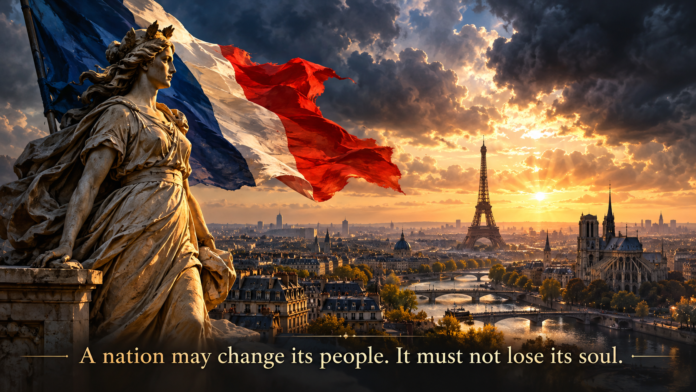
France gave the modern world a language of liberty, equality and fraternity. Its revolution challenged inherited privilege, its republic placed citizenship above ancestry, and its secular institutions sought to create a common public space for people of different beliefs. Yet, can a nation preserve its monuments while becoming uncertain about the principles that hold it together? France now faces a question extending beyond immigration or religion: can a historic civilisation accommodate profound demographic and cultural change without losing the shared identity on which its political order rests?
The country’s present unease cannot be reduced to a single cause. Fragmented politics, fiscal pressures, anxiety about public services, distrust of elites and disputes over security have reinforced one another. Recent unrest in France has exposed grievances over living costs and education alongside episodes of violence and property destruction; peaceful protest, criminality and organised political agitation must not be conflated. Nor should France’s difficulties be mistaken for state collapse. Its institutions continue to function, elections remain consequential, and public debate is vigorous, sometimes painfully so.

The strategic concern lies in how these pressures interact. When governments struggle to maintain stability, citizens become more receptive to explanations that identify a single culprit or promise simple restoration. Immigration and religious identity then become proxies for wider anxieties about work, status, safety and national direction. France’s challenge is therefore both material and symbolic: it must govern effectively while persuading citizens that the republic remains a shared enterprise, not merely a set of procedures inherited from another age.
France’s position in Europe also raises the stakes. As a nuclear power and a permanent member of the UN Security Council, its cohesion affects European defence and diplomacy.
When Civilisations Change Their Character
History offers warnings, but not ready-made predictions. The Arab conquests of the seventh century profoundly transformed North Africa and parts of the Middle East. Islam spread through a combination of political rule, migration, conversion, cultural exchange and changing institutions over many generations. The pace and character of change varied by place. In some periods, non-Muslim communities retained important roles and religious life remained diverse; in others, coercion, discriminatory arrangements or political pressure formed part of the experience. No single account explains every region.
The Balkans followed different trajectories under Ottoman rule, where conversion, social mobility, local politics, taxation, conflict and community structures shaped religious change unevenly. The fall of Byzantine Constantinople in 1453 was principally the defeat of an empire after long military and political decline, not a modern demographic partition. Spain’s centuries-long Reconquista involved warfare, dynastic competition and changing sovereignty. These histories caution against treating the religious transformation in a territory as a simple, uniform process.

The relevant lesson is not that France must repeat these histories. Modern France is a consolidated nation-state with citizenship, constitutional law, mass education, democratic politics and a powerful administrative system. Its Muslim citizens are not a foreign army, and religious identity does not automatically determine political allegiance. Yet history does demonstrate that institutions and collective loyalties are not self-sustaining. When state authority weakens, elites lose legitimacy and communities increasingly organise around rival political identities; cultural differences can acquire sharper territorial meaning. History is most useful when it clarifies mechanisms, not when it supplies inevitabilities.
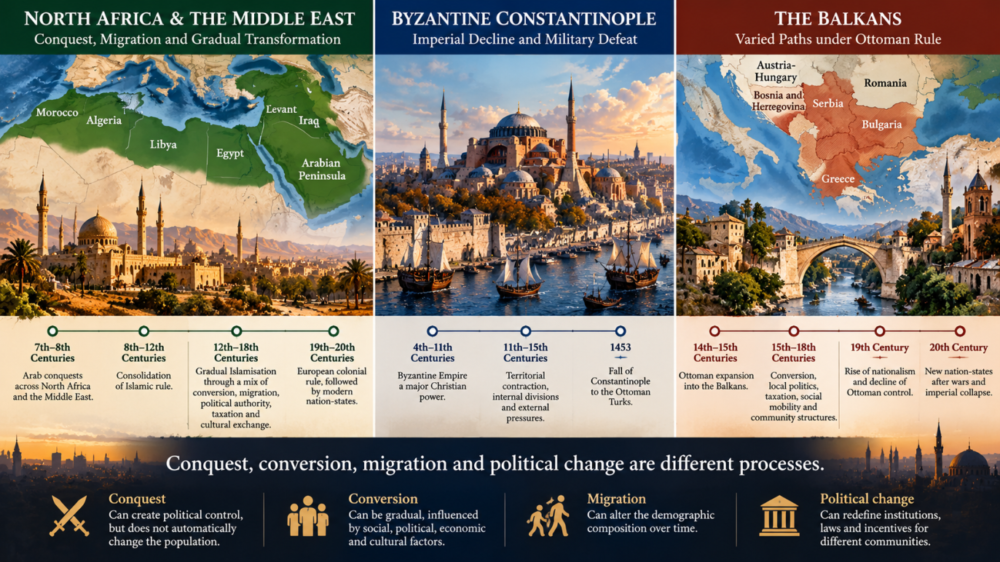

Historical comparison must respect the agency of people who lived through these transitions. Religious change unfolded alongside shifts in language, administration and economic life; modern citizenship cannot simply be projected backwards onto medieval empires.
Demography, Faith and the Integration Question
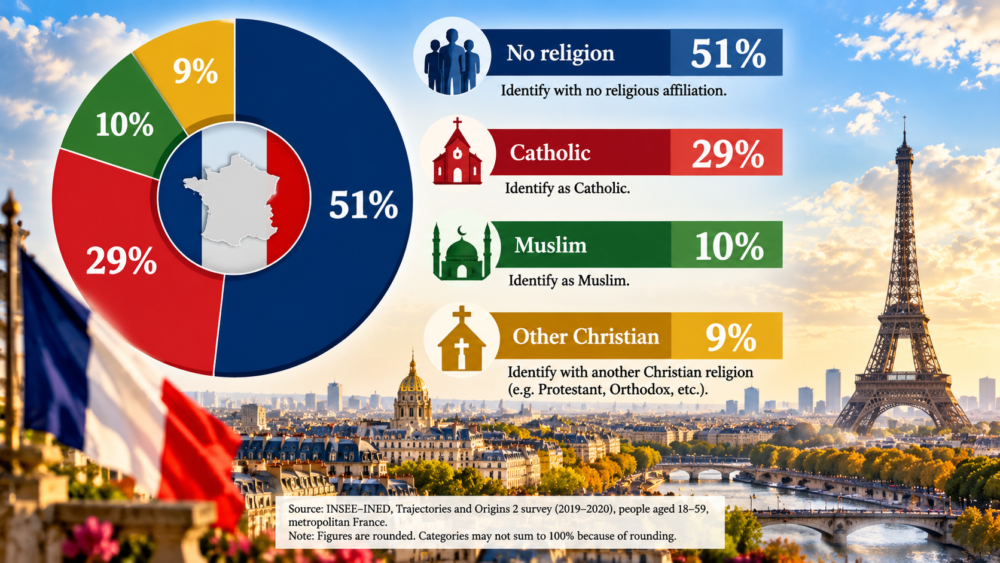
France’s demographic debate needs evidence, rather than viral projections. The INSEE–INED Trajectories and Origins survey, conducted in 2019–2020 among people aged 18 to 59 in metropolitan France, found that 51% reported no religion, 29% identified as Catholic and 10% as Muslim. These figures describe a defined age group and survey period, not the entire population in 2026. They nevertheless reveal two simultaneous realities: France has undergone extensive secularisation, while Islam has become its second-largest reported religious affiliation.
Religious transmission is stronger in some families and communities than in others, but it is not uniform or immutable. Some descendants of immigrants retain religious commitments; others become less observant or identify with no religion. Origin, education, class, family circumstances, neighbourhood and personal choice all matter. It is therefore unsound to extrapolate a future Muslim majority from current local concentrations or from fertility assumptions alone. France does not routinely record religion in its census, and long-range estimates depend on uncertain assumptions about migration, births, intermarriage, conversion and secularisation.
The unrest in France has exposed grievances over living costs and education. Peaceful protest, criminality and organised political agitation must not be conflated, nor should France’s difficulties be mistaken for state collapse. Its institutions continue to function, elections remain consequential, and public debate is vigorous, sometimes painfully so
Demography still matters. Residential segregation, unequal access to employment, educational disadvantage and discrimination can weaken everyday contact among citizens. Where public services fail or social mobility appears blocked, identity may become a source of solidarity but also a boundary against outsiders. The same conditions can strengthen resentment among people who believe the state has abandoned their neighbourhoods or ignored their concerns. These grievances deserve serious attention without treating any religious group as a single political bloc.
Three distinctions are essential. Muslim identity is not synonymous with Islamism; religious conservatism is not automatically extremism; and neither religious affiliation nor ancestry proves support for separatism. The question is whether people of different backgrounds accept the same civic rules and can participate fully in common institutions. Demographic change alters the setting in which politics operates, but choices by citizens, communities and governments shape what follows.
Religious affiliation alone says little about political beliefs or civic commitment. A Muslim may strongly support secular government; a non-religious citizen may hold exclusionary views. Better policy measures conduct and outcomes, not presumed loyalty.
One Republic, Competing Ideas of Authority
France’s model of laïcité seeks to keep public authority secular while protecting freedom of conscience. In practice, the boundary between religious expression and the requirements of public institutions is contested, particularly in schools, debates over dress, gender equality, speech and the visibility of religion. Such disputes can become symbolic battles in which each side sees the other as threatening its deepest principles. The state must protect religious freedom without allowing intimidation or coercive authority to displace civil law.
The INSEE–INED Trajectories and Origins survey, conducted in 2019–2020 among people aged 18 to 59 in metropolitan France, found that 51% reported no religion, 29% identified as Catholic, and 10% as Muslim. So, while France has undergone extensive secularisation, Islam has become its second-largest reported religious affiliation
Islamist movements that seek to organise political life around a particular interpretation of Islam should be examined through their stated objectives, conduct and actual influence. They should not be confused with ordinary Muslim worshippers, just as Christian identity cannot be equated with every form of Christian nationalism. A democratic state should confront advocacy of violence, coercion and unlawful parallel authority with lawful, proportionate measures, while protecting peaceful belief and political expression. Broad suspicion directed at an entire community is not only unjust; it can alienate citizens whose cooperation is indispensable to public security.
France’s Constitution defines the country as an indivisible, secular, democratic and social republic, guarantees equality before the law without distinction of religion, and respects all beliefs. This framework is a significant barrier to a religiously defined territorial state, though no constitutional text can eliminate every political crisis. A separatist project would require far more than neighbourhood concentration: it would need sustained territorial mobilisation, organised political support and a severe challenge to the authority of the French state.
The bigger risk is a fragmented public sphere. If citizens increasingly attend separate institutions, consume mutually hostile narratives and regard national law as legitimate only when it favours their group, territorial unity may remain intact while civic trust erodes. The task is not to enforce identical private beliefs; it is to preserve a common constitutional framework in which no religious or ideological authority stands above the law, and every citizen enjoys equal protection under it.
Claims of separatism should be investigated through evidence about organisations, aims, resources and actions, not inferred from clothing, worship or neighbourhood demographics. Transparent enforcement and judicial oversight protect security and public confidence.
Religious affiliation alone says little about political beliefs or civic commitment. A Muslim may strongly support secular government; a non-religious citizen may hold exclusionary views. Better policy measures conduct and outcomes, not presumed loyalty
France 2050: Renewal, Fragmentation or Crisis?
Looking towards 2050, France should be assessed through scenarios rather than prophecy.
- Renewal: Better schools, effective language instruction, fair access to work, housing policies that reduce concentrated disadvantage, and consistent law enforcement could strengthen shared citizenship. A confident republic would neither apologise for its secular foundations nor treat every cultural difference as a threat. It would expect commitment to common rules while offering equal opportunity to those who make France their home.
- Prolonged Fragmentation: When political polarisation deepens, communities become more segregated, and competing accounts of history and identity harden. Most citizens may continue to reject separatism, yet everyday trust declines and each crisis is interpreted through communal suspicion. This outcome would damage France’s social resilience even without a change in its borders. It could also empower extremists on different sides, each using the other’s excesses to justify its own.
- Constitutional Crisis: Economic shock, serious security failures and political paralysis reinforce existing divisions. In such conditions, movements demanding exceptional autonomy or religiously defined separation could gain visibility. But this is a conditional possibility, not an evidenced forecast. There is no sound basis for asserting that France is on an inevitable path towards partition between Muslims and non-Muslims. The institutional, political and geographical obstacles are substantial, and Muslim citizens hold diverse views about religion, identity and the state.
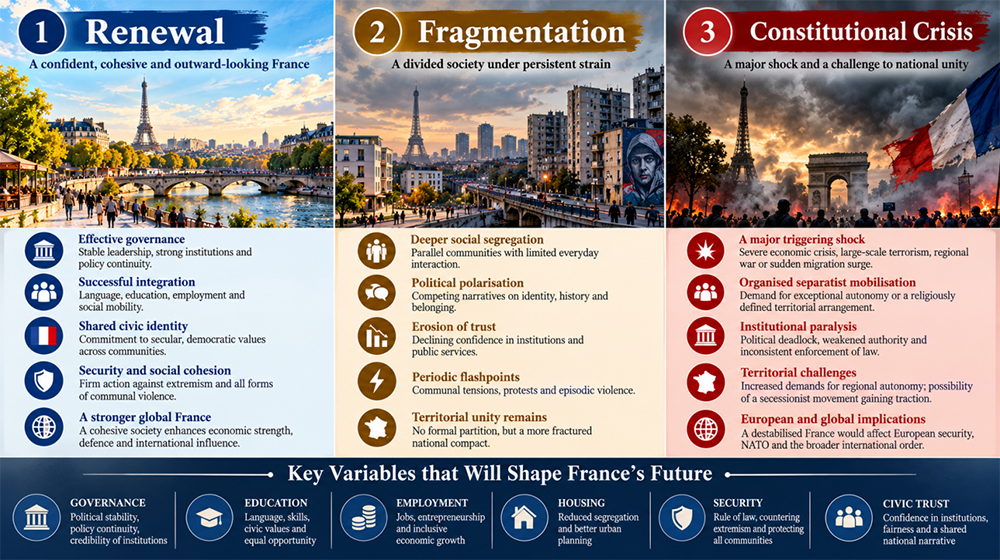
Policymakers should monitor evidence, not imagined maps: support for separatist organisations, attempts to intimidate residents or officials, rejection of civil law, local patterns of segregation, trust in institutions and the capacity of public services. Such indicators should be interpreted carefully and consistently across ideologies. Violence from an Islamist group, a far-right network or another extremist movement threatens constitutional order by the same basic principle. The future will turn on whether France can address genuine risks early, without inflaming the divisions it seeks to contain.
External shocks — a recession, terrorist attack, regional war or sudden migration surge — could intensify tensions; competent leadership could contain them. Scenario planning should identify choices that strengthen resilience now, not portray a dramatic future as inevitable.
The bigger risk is a fragmented public sphere. If citizens increasingly attend separate institutions, consume mutually hostile narratives and regard national law as legitimate only when it favours their group, territorial unity may remain intact while civic trust erodes
The Republic Must Rediscover Itself
France needs neither complacency nor panic. Complacency would dismiss concerns about segregation, extremist influence and the erosion of public trust as mere prejudice. Panic would turn millions of diverse citizens into a presumed collective threat and mistake demographic change for a predetermined political outcome. Both approaches would weaken the republic. A credible strategy must combine security, integration, social fairness and confidence in the constitutional order.
- Consistent application of Law: Violence, intimidation, antisemitism, anti-Muslim hatred, attacks on Christians and coercion in the name of any ideology require serious investigation and proportionate prosecution.
- Tangible Integration: Language proficiency, educational attainment, employment, housing access and participation in civic life should be treated as national priorities, not slogans.
- Secular Institutions: Institutions must remain impartial, protecting freedom of conscience while ensuring that public decisions are made under civil law.
- Political Leadership: Political leaders must resist the temptation to exploit fear for short-term advantage.
The question for France is whether liberty, equality and fraternity can still function as lived commitments rather than ceremonial words. The answer will matter far beyond its borders. France will not be saved by nostalgia or fear of the future, but by the courage to make its republican promise real for every citizen
France should also tell a more confident story about citizenship. National belonging cannot depend solely on ancestry or inherited faith in a society shaped by generations of movement and exchange. Nor can it survive if shared obligations are endlessly negotiable. A republic earns allegiance by offering fairness and opportunity, but it also has the right to expect respect for its laws and democratic institutions. Integration is a two-way process, though the state must set and enforce the common framework.
France’s future will not be decided by demographic arithmetic alone; it will be shaped by the quality of its institutions, the integrity of its political leadership and the willingness of citizens to recognise one another as participants in the same national project. A civilisation is preserved when its core principles remain compelling through change, not by freezing its population in time.
The question for France is whether liberty, equality and fraternity can still function as lived commitments rather than ceremonial words. The answer will matter far beyond its borders. France will not be saved by nostalgia or fear of the future, but by the courage to make its republican promise real for every citizen.

Lt Gen Rajeev Chaudhry (Retd) writes on contemporary national and international issues, strategic implications of infrastructure development towards national power, geo-moral dimension of international relations, and leadership nuances in a changing social construct. The views expressed are of the author and do not necessarily reflect the views of Raksha Anirveda





