


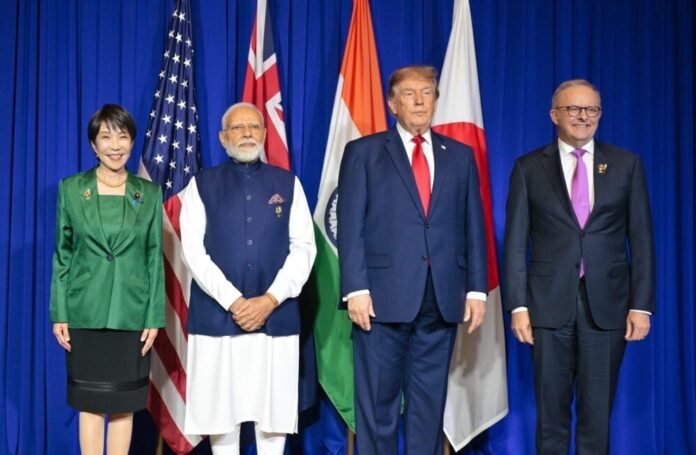
The most important fact about the Quad Leaders’ Summit in Manila on November 17 is that it took place. The four leaders had not shared a room for two years. The last meeting was held in Wilmington in September 2024. India, the expected host, saw a November 2025 date slip, then watched a gathering planned for New Delhi in early 2026 fall through. Analysts began to wonder whether the grouping was settling into a ministerial habit with no leader attached to it.
Then Donald Trump, Narendra Modi, Anthony Albanese and Sanae Takaichi sat down together at the Solaire resort, on the margins of the ASEAN summits. It was Trump’s first Quad leaders’ meeting of his current term and Takaichi’s first as Japan’s prime minister. The meeting also fell in the tenth year since Shinzo Abe set out the idea of a Free and Open Indo-Pacific, a point the joint press release makes with some pride.

It is a curious record. Trump is the American president most associated with reviving the Quad in 2017, yet this was the first time he had met its leaders under that banner. Doubts about his commitment were never really about the idea. They were about attention, and attention is what Manila supplied. Whether it lasts is another matter.
Donald Trump, Narendra Modi, Anthony Albanese and Sanae Takaichi sat down together at the Solaire resort, on the margins of the ASEAN summits. It was Trump’s first Quad leaders’ meeting of his current term and Takaichi’s first as Japan’s prime minister
On paper, the outcomes are modest. In practice, several of them are useful. The press release lists six deliverables. A Quad Business Leaders’ Forum is planned for early 2027. A Super Intelligence Accelerator, first announced by foreign ministers in Atlanta, will coordinate and fund trusted access to AI across the region. A footnote explains that Australia, India and Japan say ‘artificial intelligence ’, whereas American documents now say ‘Super Intelligence’. It is a small detail, and also a reminder that four governments are still translating for one another. Press reports put the pledged assistance at more than $85 million.
The remaining items are more concrete. An Indo-Pacific Maritime Surveillance Collaboration will share information and, in 2027, put P-8 and P-3C patrol aircraft in a Quad exercise for the first time. The cable partnership widens from data to electricity, and new undersea projects in the Indian Ocean were welcomed. Cybersecurity cooperation needs to be strengthened, and so does counterterrorism cooperation.
The security language is careful. The leaders oppose destabilising or unilateral actions that seek to change the status quo, including by force or coercion, and they voice grave concern about economic coercion, including arbitrary export restrictions. No country is named. Every reader knows which capital is meant, and the omission is deliberate. A statement that names no one is harder to answer and easier for ASEAN members to sign up to, which matters because the release also reaffirms ASEAN centrality. That probably suits New Delhi as well.

For India, the most valuable lines are the least dramatic. The condemnation of terrorism in all its forms, with cross-border terrorism named in the text, puts on record a concern India has raised for years, now with Washington, Tokyo, and Canberra attached to it
For India, the most valuable lines are the least dramatic. The condemnation of terrorism in all its forms, with cross-border terrorism named in the text, puts on record a concern India has raised for years, now with Washington, Tokyo and Canberra attached to it. The maritime collaboration, as Foreign Secretary Vikram Misri described it, builds on existing work in maritime domain awareness and aims at everyday problems such as illegal fishing and trafficking. Its first exercise is to be held on the sidelines of Exercise Sea Dragon in Guam in March 2027. India flies the P-8I, so Indian aircraft have a real place in that picture.
The Indian Ocean cable projects deserve the same attention. Dependable connectivity in waters that India shares with its smaller neighbours is a strategic asset. No communiqué can create it, but a funded project can. Misri also said Modi told the meeting that India was keen to host the business forum in the first quarter of 2027. If Delhi runs it well, the forum could bring Indian industry and Indian Ocean partners into a conversation that so far has belonged mostly to governments.

Three weaknesses are worth stating plainly. The first is money: $85 million will matter only if it draws private capital and if ‘trusted’ AI means something specific to a ministry in Colombo or Suva deciding whose systems to buy. The second is trade. The release does not mention trade among the four members at all. A grouping that speaks of resilient supply chains and economic coercion will eventually be asked how its members treat each other on tariffs and market access. Manila did not answer that question and was not expected to.
Prime Minister Modi told the meeting that India was keen to host the business forum in the first quarter of 2027. If Delhi runs it well, the forum could bring Indian industry and Indian Ocean partners into a conversation that so far has belonged mostly to governments
The third is critical minerals. Press reports said agreements were announced on the margins, with Trump warning against dependence on a single foreign supplier. Those details are not among the deliverables in the joint release, so they should be read as reported, not confirmed. Minerals are where the Quad’s economic language meets real leverage, and a vague treatment will not last.
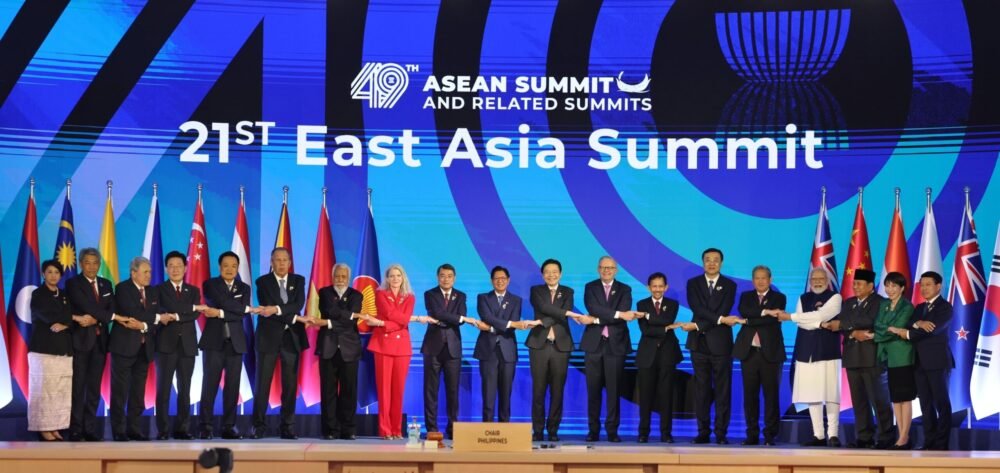
The calendar adds a complication. The four leaders were due in Shenzhen next for the APEC leaders’ meeting on November 18 and 19, where a meeting between Trump and Xi Jinping is expected. Whatever the Quad said in Manila will be read against what is said, and left unsaid, in Shenzhen. Any group led by its strongest member carries the risk that its sharper phrases soften when that member is bargaining elsewhere. India does not need to assume the worst. It should plan for the possibility and make sure the practical work holds up whatever the rhetoric does.
That points to three things India can push for without waiting for anyone’s permission. The first is ownership. Every deliverable needs a named lead, a date, and a reporting line: who flies, who pays, who publishes the results. The Quad has announced more than it has completed before, and partners in the region remember the gap.
Many regional states fear being asked to choose a side, and a Quad that keeps delivering things they can use will keep their goodwill. A Quad that is seen mainly as a signal to Beijing will not
The second is a clear Indian Ocean thread. The Manila text speaks of the Indo-Pacific in general terms, which is natural at a summit hosted beside ASEAN. India’s own weight lies in the western half of that arc. Surveillance, cables, ports and disaster response there should be treated as core business and not as extensions of a Pacific agenda.
The third is discipline in how the Quad describes itself. Misri called its work public goods for the people of the Indo-Pacific, and Modi, by his account, spoke at each of the Manila summits of the need for peace, stability and predictability. That is the right register. Many regional states fear being asked to choose a side, and a Quad that keeps delivering things they can use will keep their goodwill. A Quad that is seen mainly as a signal to Beijing will not.
Manila repaired a gap and restored a rhythm. It did not settle what the Quad is for in an era when its largest member negotiates with everyone, including the power the others worry about most. That answer will come from projects, not statements. The first real measure arrives in March, when patrol aircraft from four countries gather off Guam.
The writer, a PVSM, AVSM, VSM has had an illustrious career spanning nearly four decades. A distinguished Armoured Corps officer, he has served in various prestigious staff and command appointments including Commander Independent Armoured Brigade, ADG PP, GOC Armoured Division and GOC Strike 1. The officer retired as DG Mechanised Forces in December 2017 during which he was the architect to initiate process for reintroduction of Light Tank and Chairman on the study on C5ISR for Indian Army. Subsequently he was Consultant MoD/OFB from 2018 to 2020. He is also a reputed defence analyst, a motivational speaker and prolific writer on matters of military, defence technology and national security. The views expressed are personal and do not necessarily carry the views of Raksha Anirveda






