


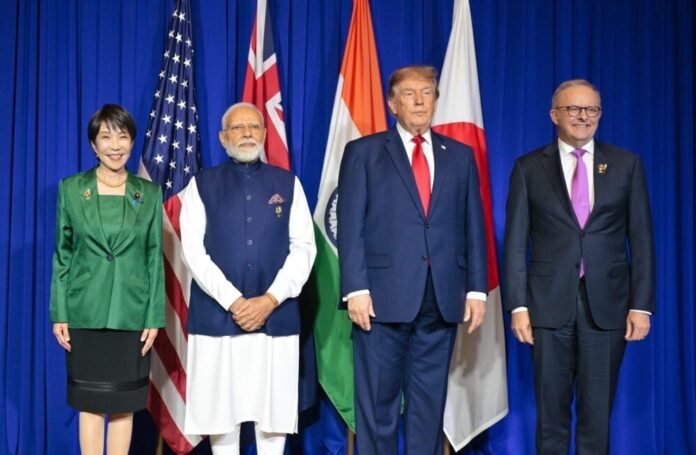
On November 17, 2026, PM Narendra Modi, President Donald Trump, PM Anthony Albanese and PM Sanae Takaichi met in Manila for the Quad’s first leaders’ summit since 2024. Its significance lies less in a dramatic new doctrine than in the effort to turn a loose diplomatic grouping into a more usable network.
The leaders opposed unilateral attempts to change the regional status quo by force or coercion, voiced concern about economic coercion and arbitrary export restrictions, and promised cooperation on maritime security, technology, supply chains and counterterrorism. They also reaffirmed support for ASEAN centrality, an important signal that the Quad presents itself as a partner to the region, not its replacement.

Deterrence by Awareness and Resilience
The most concrete security initiative is the Indo-Pacific Maritime Surveillance Collaboration. It is intended to improve information sharing and maritime domain awareness, while patrol aircraft from the four countries are scheduled to take part in a Quad-context maritime exercise in 2027.
The new Indo-Pacific Maritime Surveillance Collaboration will boost intelligence sharing and deploy P-8 and P-3C patrol aircraft for a coordinated Quad exercise in 2027
The joint statement identifies P-8 and P-3C aircraft, making the planned activity more operational than a general pledge to cooperate. Shared surveillance can help partners build a clearer picture of activity at sea, identify suspicious movements and coordinate responses. It does not, by itself, create a joint command or commit any member to intervene in a conflict.
That distinction matters. The Quad is not a NATO-style alliance: the Manila statement contains no collective-defence guarantee, and the summit announced no automatic military response to an attack. Its deterrent effect is instead cumulative.
Better information, regular coordination and visible cooperation can make coercion harder to conceal and potentially more costly to attempt. Analysts have also stressed the political value of the leaders meeting together: the summit signals that the four governments still regard Indo-Pacific stability as a shared priority, even when their other foreign-policy interests differ.

The agenda reaches beyond military activity. The leaders announced enhanced cybersecurity cooperation and welcomed progress on a programme to support trusted artificial-intelligence access, deployment and technical assistance across the region.
Leaders pledged deeper cooperation on cybersecurity, trusted AI deployment and protecting vulnerable undersea communications and electricity cables from disruption
They also cited resilient communications infrastructure, including undersea cables, and welcomed Australia’s expanded focus on electricity cables. These steps matter to security because ports, networks, energy systems and communications links can be vulnerable to disruption or political pressure. The summit’s wider logic is to strengthen the systems that enable countries to remain connected and make independent decisions.

China is the Unstated Strategic Test
The joint statement does not name China as the target of the initiatives. Its language instead condemns coercion, destabilising conduct and attempts to change the status quo, while expressing concern about export restrictions. That diplomatic restraint allows the four countries to present the Quad as a regional public-goods partnership.
But the focus on maritime awareness, resilient supply chains and economic coercion plainly addresses concerns about China’s growing influence and its ability to apply pressure through trade, technology or strategic dependencies. The summit’s posture is therefore firm but indirect: deter by improving partners’ capacity and reducing vulnerabilities, rather than by announcing a bloc explicitly aimed at Beijing.
Critical minerals are central to this approach. The leaders’ emphasis on securing supply chains builds on a Quad framework launched in May 2026, which focuses on investment, project development, regulatory coordination, recycling and recovery. Such cooperation could reduce reliance on any single supplier for materials used in batteries, semiconductors and defence technologies.
Building on a May 2026 framework, the summit prioritised critical mineral recovery and processing to reduce reliance on single suppliers without explicitly naming China
But diversification is a long-term industrial undertaking, not an instant substitute for established supply chains. The practical test will be whether the partners finance projects, build processing capacity and create commercially viable alternatives, not simply issue statements about resilience.
The summit also announced the first Quad Business Leaders’ Forum, scheduled for early 2027. By bringing business leaders, officials and policy experts together, the forum is meant to encourage commercial partnerships and deals.
This economic track could help turn strategic alignment into investment, but it also underscores the Quad’s reliance on private companies and national governments to deliver. The group can convene and coordinate; it cannot guarantee that firms will invest or that all four members will maintain the same priorities.
What India Can Gain
For India’s defence sector, the clearest immediate benefit is operational rather than a new weapons package. Better maritime information-sharing and the planned aircraft exercise can support India’s ability to monitor regional waters, coordinate with partners and develop familiarity with their procedures.
The inaugural Quad Business Leaders’ Forum, set for early 2027, aims to translate strategic alignment into concrete commercial investments and industrial partnerships
The summit statement does not announce a specific arms sale, defence contract or technology-transfer agreement. The longer-term industrial opportunity is more substantial, but still conditional. Supply-chain cooperation could help Indian firms attract investment and participate in critical-mineral processing, recycling, secure communications, cybersecurity, artificial intelligence and other dual-use technologies.
These fields matter to defence because modern forces rely on reliable access to materials, data and advanced systems. India may also benefit from a stronger regional role as a provider of maritime awareness and capacity-building. Earlier Quad cooperation has included maritime information-sharing through India’s Information Fusion Centre in Gurugram, illustrating how the country can serve as a hub rather than merely a recipient of assistance.
That opportunity fits India’s strategic-autonomy preference: cooperation can improve capabilities without requiring a formal alliance or exclusive alignment. Yet, autonomy is not cost-free.
India will need to balance closer practical cooperation with the need to preserve its freedom of action, and to ensure that access to technology or capital produces domestic expertise, manufacturing and jobs rather than dependence on imported systems. The benefits will depend on the terms of projects and on India’s ability to build local capacity.
New Delhi stands to enhance its regional maritime monitoring and attract investment into dual-use tech and mineral processing while preserving its strategic autonomy
The summit’s commercial and industrial track could also yield gains beyond defence procurement. If the Business Leaders’ Forum leads to investment, Indian companies could find new partners and markets, while the country’s role in the Indo-Pacific’s infrastructure and technology networks grows. But such gains are prospective. A forum is not a factory, and a supply-chain pledge is not a delivered capability.
The Manila meeting therefore offers India a platform, not a windfall. Its most credible gains are better maritime coordination, a stronger voice in regional security and a chance to attract investment into strategic industries.
The Quad’s deterrence will depend on whether surveillance plans become routine cooperation, whether supply-chain projects become operational and whether members sustain their commitments. For India, the payoff will be measured not by the summit’s rhetoric, but by what it can build, secure and influence afterward.

-The writer is a New Delhi-based senior commentator on international and strategic affairs, environmental issues, an interfaith practitioner, and a media consultant. The views expressed are personal and do not necessarily carry the views of Raksha Anirveda






