


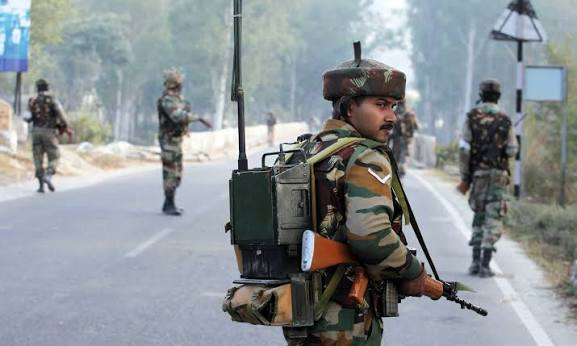
Two 20-year-old engineering students at BITS Pilani’s Hyderabad campus have developed Krath Control, a compact tactical communications system that has been assessed by two Indian Army units. The device is designed to let soldiers exchange voice and data, share locations and view a common operational map without depending on mobile towers, SIM cards or satellite connectivity. Its promise is practical: maintaining a shared picture when conventional communications are out of reach.
The founders, Samarth Alok Srivastava and Shresth Prakash Singh, are developing the system through Krathveil Private Limited, a student-led defence technology startup. Weighing less than 180 grams, Krath Control pairs with an Android phone running ATAK, or Android Team Awareness Kit, a mapping and situational-awareness application. The system uses an encrypted radio mesh to connect nearby devices. The company’s pitch is that soldiers could share more than voice updates: positions, messages, map markers and alerts can help teams coordinate using a common picture.

Mesh networks work by allowing participating devices or nodes, to relay information onward. If a link fails, a network can seek another route through available nodes rather than relying on a single central connection. That design can help in places where fixed infrastructure is absent or disrupted, though it does not guarantee uninterrupted service: radio range and performance depend on conditions, equipment and how nodes are positioned. Wider reporting on Krath Control says its founders estimate a potential range exceeding 100 kilometres in suitable circumstances, including a line between two hilltops. That is a claimed possibility, not a demonstrated operational range.
The Army’s assessment has identified work still to be done. The first version reportedly operated at 156 milliwatts; the Army asked the team to raise output to one watt and upgrade the antennas. These requirements underscore the difference between a working prototype and a system ready for demanding field use: range, reliability and usability must be demonstrated under realistic conditions.
Price is another part of the proposition. The startup is targeting about ₹40,000 per device, compared with roughly ₹2 lakh for similar imported equipment, according to the reports. Those figures are reported estimates, not confirmed procurement prices or a final sales offer. If the target is achieved, cost could make the device attractive for wider evaluation, but affordability alone would not establish that it meets the Army’s technical, security or integration requirements.
The founders say conventional voice radios do not provide the location-sharing and mapping functions they are seeking, while some imported systems are costly and difficult to integrate. Krath Control’s reported pairing with ATAK points to an attempt to connect radio communications with digital mapping. The US government’s TAK product suite describes ATAK as part of a broader set of geospatial and collaboration tools; compatibility with an application, however, does not by itself demonstrate interoperability with military networks or other equipment.

Krathveil was incorporated in May and has received recognition from India’s Department for Promotion of Industry and Internal Trade. The company is seeking incubation support. Its next milestone is not simply a stronger radio: it is evidence that the revised system can deliver secure, dependable communication and useful situational awareness in the field.
For now, Krath Control remains a developing technology, not a deployed Army capability. The Army units’ assessment signals interest, while the requested power and antenna improvements show that substantial testing remains. If the team can meet those needs and validate performance, the lightweight device could become an indigenous option for small units operating beyond conventional network coverage.








