


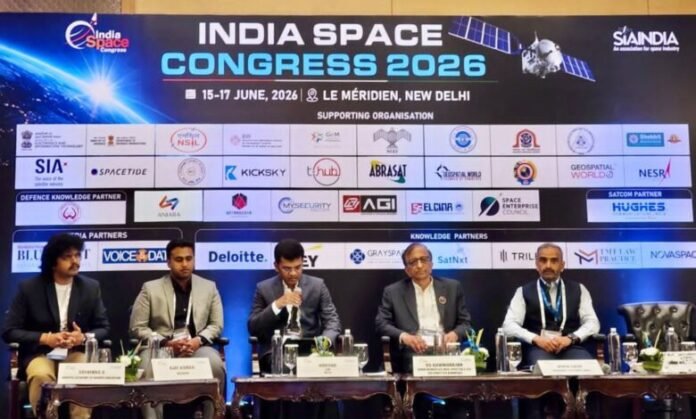
New Delhi. The India Space Congress 2026 kicked off in New Delhi on June 15, bringing together global leaders to expand international space cooperation, target a $44 billion domestic space economy, and advance sustainable interstellar frontiers.
As India’s cosmic footprint undergoes unprecedented expansion, representatives from prominent nations – including Canada, Italy, Thailand, and the Philippines – converged at the India Space Congress 2026 to establish strategic commercial partnerships. Seeking to leverage India’s cost-effective launch capabilities and robust foundational infrastructure, these foreign space agencies aim to move past standard government-to-government (G2G) framework agreements. The primary objective is to forge active business-to-business (B2B) operational pathways, co-developing small satellite architectures and localised downstream data software.

The event, meticulously organised by the Space Industry Association-India (SIA-India) from June 15 to 17, 2026, gathered over 600 key participants and 200 subject matter experts spanning 25 countries. Centered around the overarching theme, “Reimagining Space. Reinventing Collaboration. Realising the Next Era of Space,” the convention effectively served as an international catalyst to align regional capability needs with India’s liberalised defence-space and commercial manufacturing sectors.
Driving the $44 Billion Mandate via Private Innovation
A core focal point of the high-level policy roundtables was India’s ambitious road map to rapidly scale its domestic market footprint from its current baseline into a $44 billion powerhouse by 2033. Industry leaders unanimously emphasised that achieving this milestone requires predictable regulatory mechanisms, long-term venture capital flow, and strong commercial demand signals.
“Building a globally competitive ecosystem is no longer just about advancing technology and rocket science,” noted Dr Subba Rao Pavuluri, President of SIA-India. “It is about designing foundational economic infrastructure capable of capturing sustainable, long-term commercial value.”
Fuelled by groundbreaking structural reforms, India’s private space landscape now boasts more than 300 active startups. These private operators are pivoting from minor component fabrication to designing comprehensive, localised mega-constellations.

Technologists at the summit noted that Indian entrepreneurs possess the unique capability to assemble and launch extensive satellite communications constellations – functionally matching frameworks like Starlink – to effectively serve high-bandwidth data requirements across emerging global markets.
ISRO’s SMOPS 2026: Setting the Standard for Operational Safety
Simultaneously, the vital focus on operational longevity and orbital sustainability was addressed through the lens of the Spacecraft Mission Operations (SMOPS) 2026 framework spearheaded by the Indian Space Research Organisation (ISRO). As low Earth orbit (LEO) becomes increasingly crowded with commercial constellations, mission safety has shifted from a secondary compliance parameter to an absolute operational necessity.

The strategic framework of space operations revolves around three main operational priorities, each mapped to a specific core focus and long-term objective.
First, Space Situational Awareness (SSA) centres on executing real-time radar tracking with the targeted strategic goal of preventing catastrophic orbital impacts. Second, Debris Mitigation relies heavily on implementing strict end-of-life de-orbiting plans to successfully maintain clean and active orbital planes. Finally, Traffic Automation utilises autonomous collision avoidance systems to effectively minimise manual mission intervention and streamline operations in increasingly crowded orbits.
SMOPS 2026 highlights Indian space sector breakthroughs in high-fidelity tracking, automated close-approach analysis, and collaborative global data-sharing frameworks. By embedding rigorous space sustainability standards directly into commercial design blueprints, India positions itself not only as an efficient launch base but as a responsible global custodian of shared celestial resources.
Emerging Frontiers: AI, Quantum, and the Circular Space Economy
Beyond conventional launch vehicles and satellite transponders, the congress mapped out experimental growth vectors shaping tomorrow’s space paradigm. Parallel technical sessions explored the convergence of Artificial Intelligence (AI) and advanced geospatial intelligence, showcasing how automated machine learning models process terabytes of Earth-observation data in real time to monitor climate shifts, evaluate agricultural health, and predict resource constraints globally.
Furthermore, actionable blueprints were presented for quantum encrypted communication links, deep-space manufacturing, and novel microgravity research. By prioritising circular economy principles, such as utilising eco-friendly green satellite propellants and creating in-orbit servicing frameworks, the global space leadership cohort at ISC 2026 reaffirmed their commitment to ensuring that humanity’s push toward a trillion-dollar cosmic marketplace remains clean, secure, and deeply collaborative.






