


Eighty-one years ago, two Japanese cities got turned to ash, and the survivors, the hibakusha, spent the rest of their lives insisting that the world keep remembering what a bomb does to human beings, plainly and without any pretty spin. Their warnings worked, for a time. Nuclear weapons were tolerated but never celebrated, restrained less by treaties than by the living memory of what they cost. Now those witnesses are dying, and a numbed world is rediscovering the strategic charm of the bomb.
Pakistan is living a version of the same tragedy, not with a weapon, but with itself.

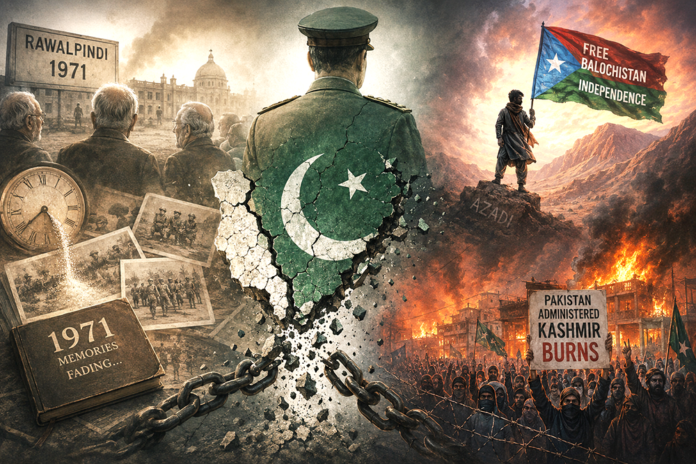
Every state carries a founding wound that teaches it fear. For Pakistan, that wound is 1971, the year East Pakistan pulled itself loose, some 93,000 soldiers gave up in Dhaka, and a country conceived as one Islamic refuge discovered it could end up splitting in half within a fortnight. That trauma functioned, for a generation, as Pakistan’s moral immune system. The men who felt it, who watched a wing of their own country vanish, governed with a certain humility about coercion’s limits. It is why Zulfikar Ali Bhutto went to Simla in 1972 rather than gamble on another round. The witnesses to dismemberment imposed a restraint no constitution could.
That generation has now left the room. The officers who staff General Headquarters today have no lived memory of Dhaka; to them 1971 is a chapter, not a scar. And as the witness fades, so does the fear, and with the fear, the restraint.
Call it the recovery paradox. Just as Hiroshima’s rebuilding into a neon-lit metropolis has quietly taught a new generation that the bomb is survivable, Pakistan’s serial survival has taught its own establishment that partition is survivable
Watch how the establishment now treats its own peripheries. Balochistan and Pakistan-administered Kashmir are no longer handled as existential questions of consent, the kind that once cost the country its eastern half. They are handled as instruments of statecraft, viz. bargaining chips against India, buffers against Iran, corridors to be secured for Chinese capital. It is the logic of a state that has stopped fearing its own map.
This complacency has a source, and it is the most dangerous illusion in Islamabad’s strategic imagination: the belief that Pakistan always survives. It survived 1971. It survived the Baloch insurgencies of the 1970s and 2000s, a decade of jihadist blowback, serial IMF bailouts, assassinations and floods. Each time, the state bounced back. And so its managers have concluded that fragmentation is a survivable, manageable event, a shock the federation can always absorb.

Call it the recovery paradox. Just as Hiroshima’s rebuilding into a neon-lit metropolis has quietly taught a new generation that the bomb is survivable, Pakistan’s serial survival has taught its own establishment that partition is survivable. In both cases, the proof of resilience has become the enemy of restraint. A state that no longer fears coming apart stops doing the hard political work – devolution, power-sharing, genuine federalism – that keeps it together.
A territory Islamabad presents to the world as the willing heart of its Kashmir cause is being governed by curfew and live fire, its elections staggered under boycott. This is what the withdrawal of consent looks like before it hardens into a demand for exit
Meanwhile, the fracture is advancing, and it is advancing in plain sight.

In Balochistan, the exiled activist Mir Yar Baloch has twice now, in May 2025 and again this July, declared an independent ‘Republic of Balochistan’ and appealed to the United Nations and New Delhi both for recognition. Yet it is not a state, and not one government has actually recognised it. Islamabad still keeps control over the province, and governs it directly. But the declaration is not the point. The point is that decades of documented enforced disappearances, resource extraction and lethal military operations have produced a grievance so total that separation can be proclaimed on a public timeline and go viral, while the Balochistan Liberation Army escalates against convoys, pipelines and Chinese workers. Twenty-first-century secession does not hide beneath a mountain. It announces itself in a communiqué.
In Pakistan-administered Kashmir, the story is quieter, but still more revealing. The people there are honestly not even asking anymore, as if leaving is off the table. Since June, the Joint Awami Action Committee’s protests over electricity tariffs, the price of wheat, and over what they call a rigged distribution of assembly seats have been met not with any back-and-forth, but with paramilitary deployments. There were internet blackouts, a ban on movement under an anti-terrorism law and, in general, a closure. Amnesty International counts at least 40 dead, most of them protesters. A territory Islamabad presents to the world as the willing heart of its Kashmir cause is being governed by curfew and live fire, its elections staggered under boycott. This is what the withdrawal of consent looks like before it hardens into a demand for exit.
The world, for its part, has gone numb, for the same reason it has gone numb to the Hiroshima bomb. Balochistan and PoJK still stand; they have not been vapourised into the sea. So their declarations read as noise, their dead as statistics, their unrest as the ordinary friction of a difficult country
And what is the establishment doing while its interior erodes? Projecting outward. In September, it signed a mutual-defence pact with Saudi Arabia, and its defence minister volunteered that Islamabad’s nuclear capabilities ‘will be made available’ to Riyadh, extending an umbrella abroad even as the ground gives way at home. It is the posture of a state performing invulnerability precisely because it has stopped feeling the tremors beneath it.
The world, for its part, has gone numb, for the same reason it has gone numb to the bomb. Balochistan and PoJK still stand; they have not been vapourised into the sea. So their declarations read as noise, their dead as statistics, their unrest as the ordinary friction of a difficult country. Foreign capitals engage Islamabad’s generals and underwrite its bailouts, treating each rupture as a manageable dossier item, until it isn’t.
Here is the twist the recovery paradox conceals. Hiroshima recovered because the victors chose to rebuild it. No Marshall Plan will save a fragmenting state. When the consent that binds a federation drains away, province by province, protest by protest, disappearance by disappearance, no external power arrives to reassemble it. The state that assumed it could always bounce back discovers, too late, that the assumption was the trap.
None of this is cause for triumph, least of all across the border, where a nuclear-armed neighbour coming apart is a nightmare, not a spectacle. It is a warning. Restraint dies when the witness dies. Pakistan’s witnesses to 1971 are nearly gone, and its fear with them, and a state that has forgotten how it can break has already begun to.

The writer is an expert on geopolitics, national security, and counter-terrorism; and he regularly contributes his subject thought-leadership and academic commentary with several publications in newspapers, journals, and periodicals. He works with investigative agencies, regulatory bodies, financial institutions and enterprises, providing strategic and regulatory advisory. The views expressed are personal and do not necessarily carry the views of Raksha Anirveda





