


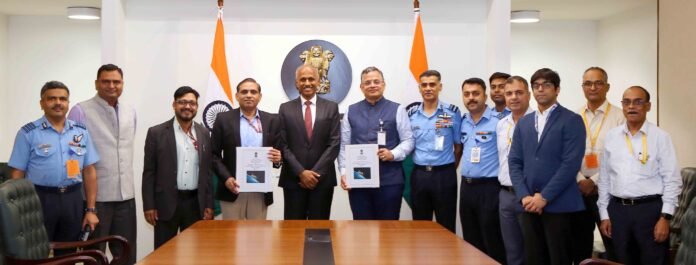
The Ministry of Defence signed the agreements in New Delhi on October 15, covering a dedicated communications satellite capability for the Indian Air Force and Varunastra heavyweight torpedoes for the Indian Navy. The combined value is approximately ₹4,106 crore, the ministry said. Additional Secretary and Director General (Acquisition) A Anbarasu was present at the signing.
The larger contract, worth ₹2,563 crore, was awarded to New Space India Limited (NSIL), Bengaluru, for GSAT-7C. The satellite is described by the ministry as indigenously designed, developed and manufactured. It is intended to improve secure, resilient and seamless communications among Air Force assets, strengthening the service’s operational communications. The announcement concerns a contract; it does not say the satellite has been launched or entered service.

The second agreement, worth ₹1,543 crore, was signed with Bharat Dynamics Limited (BDL), Hyderabad, for Varunastra. Developed by the Naval Science and Technological Laboratory (NSTL), a Defence Research and Development Organisation laboratory, the indigenous weapon is a ship-launched anti-submarine torpedo. The ministry says its manoeuvring capability allows it to engage enemy submarines at long ranges, adding an important procurement step for the Navy’s anti-submarine warfare capacity.
The two contracts address different parts of military operations. Satellite communications support the transmission of information and coordination among aircraft and other assets; a torpedo is a weapon used to attack submarines. Together, the deals span space-based communications and underwater warfare, while directing orders to Indian public-sector companies. The government framed them as support for domestic defence manufacturing and the Aatmanirbhar Bharat and Make in India initiatives.
GSAT-7C would add to the Air Force’s dedicated satellite communications capability. The Air Force already operates GSAT-7A, launched in December 2018, according to reporting on the new contract. The Navy has its own satellite communications programme: India launched GSAT-7R, also known as CMS-03, in November 2025. These separate service assets reflect the military’s reliance on secure communications, while raising the wider operational question of how each service’s systems connect in joint operations.
Varunastra, meanwhile, is not a newly announced design. The defence minister formally handed the ship-launched heavyweight torpedo over to the Navy in 2016. At that time, DRDO said the Navy had decided to produce 73 torpedoes, and identified NSTL as developer and BDL as production partner. The October 2026 contract represents a further procurement agreement; the ministry’s announcement does not specify how many torpedoes it covers or a delivery schedule.

The deal also follows a policy step: in March 2025, the Defence Acquisition Council cleared a proposal for Varunastra combat torpedoes among a set of capital acquisition proposals. That approval signalled the requirement and allowed the acquisition process to proceed; it was not itself a production contract. The latest signing now names BDL as the supplier for the new order.
The contracts add to India’s effort to place more defence production with domestic industry, but signing is only one stage between approval and operational use. The satellite must still be delivered and integrated into communications networks; the torpedoes must be manufactured and accepted by the Navy. Neither the announcement nor the available release gives detailed timelines, delivery quantities, or technical specifications such as satellite launch date and torpedo production rate.

For now, the agreements establish the financial and industrial framework: NSIL is contracted for GSAT-7C at ₹2,563 crore, while BDL will supply Varunastra under a ₹1,543-crore contract. Their eventual contribution will depend on execution, integration and induction into service-steps that will determine when the promised communications and anti-submarine capabilities become available to India’s armed forces.






