


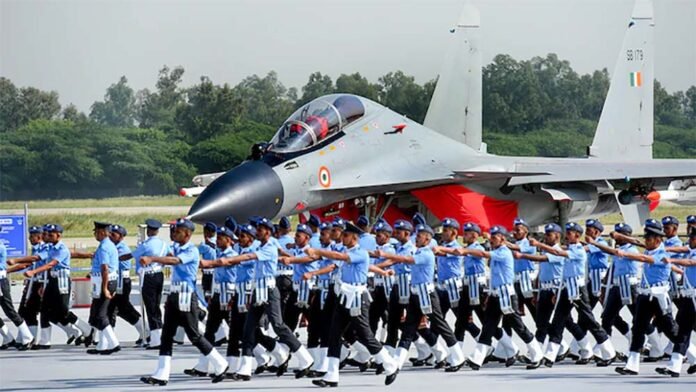
The IAF anniversary, observed each year on October 8, recalls the establishment of the Indian Air Force in 1932. This year’s theme, “Indian Air Force – Infallible, Impervious and Precise,” places emphasis on reliability, resilience and accuracy-qualities increasingly tested by threats that can arrive from multiple directions and at different speeds.
President Droupadi Murmu and Prime Minister Narendra Modi joined other leaders in extending greetings to air warriors, veterans and their families. President Murmu praised the force’s professionalism, discipline and preparedness, and said Operation Sindoor had demonstrated its courage and precision. PM Modi saluted personnel for their commitment to protecting the country’s skies.

Defence Minister Rajnath Singh also paid tribute to the air warriors, describing the Indian Air Force as a symbol of “courage, valour, discipline and professionalism.” In his Air Force Day message, Singh said the service had guarded the nation’s skies with unwavering commitment and responded whenever the country faced a crisis. He added that its personnel’s dedication had strengthened India’s security while contributing to national unity and a shared spirit of resolve.
Air Chief Marshal Amar Preet Singh, addressing the 94th anniversary celebrations at Hindon, said recent conflicts had shown that air power was central to protecting national interests. He said the IAF’s strength depended not only on advanced aircraft and weapons, but on operational preparedness and the ability to act quickly and confidently. Recalling Operation Sindoor, Singh said the force had demonstrated its speed, destructive power and air-defence capabilities. “We train as we fight,” he said, describing realistic training and joint operations with the Army and Navy as vital to readiness.
The day’s commemorations also offered a public display of the force’s operational reach. The main parade and fly-past were scheduled at Hindon Air Force Station, while a major aerial display was planned at Jodhpur. The celebrations coincide with Exercise Tarang Shakti 2026, which brings the IAF together with foreign air forces for flying operations and professional engagement.
But beyond the ceremonial fly-pasts, the anniversary arrives as air forces worldwide adapt to a more complex mix of threats. Uncrewed aircraft can provide surveillance, carry weapons or overwhelm defences in numbers; electronic warfare can disrupt communications and sensors; and precision weapons compress the time available to identify and respond to an attack. India’s push to modernise air defence and expand unmanned capabilities reflects those changing demands.

Bodhisattwa Sanghapriya, CEO and founder of IG Defence, said Air Force Day was a moment to honour air warriors and consider the technologies that will shape the next phase of air defence.
“At IG Defence, we are building indigenous capabilities across unmanned systems, surveillance, electronic warfare, counter-UAS and long-range strike technologies to meet the evolving demands of modern warfare,” he said.

“The future of air power will be defined by speed, precision, autonomy and indigenous capability-where technology moves faster, decisions come quicker, and deterrence begins before the threat arrives.” Sanghapriya said building these capabilities in India was not only a technology goal, but also a matter of operational readiness, strategic autonomy and building a more self-reliant defence ecosystem.
The themes he identified mirror a broader shift in military planning: capabilities must work together, not simply exist as separate platforms. A drone’s usefulness, for example, depends on the sensors that detect targets, communications that relay information, decision systems that process it and defence networks that can respond.
India’s recent Dronathon at Pokhran brought domestic companies, start-ups and other innovators together to test unmanned and counter-drone systems in field conditions. The IAF also released an Unmanned Aircraft Systems roadmap outlining priorities that extend beyond aircraft to engines, sensors, payloads, communications, autonomy and electronic warfare.
The push comes amid plans to strengthen both defensive and offensive air capabilities. In April, India approved a military modernisation package that included additional air-defence systems and remotely piloted strike aircraft. The government said the planned systems would support air defence, coordinate operations and intelligence, surveillance and reconnaissance. Such programmes point to the growing importance of unmanned operations, but they also underline the challenge of integrating new systems into a coherent network.
Countering drones is a particularly pressing part of that challenge. Small, low-cost aircraft can be used for surveillance or attacks, while defending against them with conventional missiles can be costly. An air-defence architecture therefore needs ways to detect and track drones, distinguish threats, and choose an appropriate response. Indian policy analysis has highlighted layered defences, electronic jamming, radar integration and indigenous counter-UAS technologies as parts of that effort.
For Sanghapriya, developing those capabilities at home connects technology with the ability to act independently and sustain operations. Indigenous systems can contribute to strategic autonomy, but the transition from promising prototypes to dependable, large-scale production remains essential. The IAF’s drone roadmap and industry trials signal a stronger channel for collaboration; the operational test will be whether equipment, software and communications can perform reliably together under demanding conditions.
The anniversary’s message, then, reaches beyond remembrance and spectacle. The IAF’s history-from a small air arm established in 1932 to a force responsible for air defence, strike, surveillance, strategic airlift and humanitarian assistance-illustrates how its role has expanded. Its next chapter will depend not only on aircraft, but on the ability to connect people, sensors, autonomous systems and weapons into a responsive force.
As India salutes its air warriors, the debate over future air power increasingly centres on how quickly a force can perceive a threat, make a decision and act. Sanghapriya’s call for speed, precision and indigenous capability captures that strategic direction: readiness will be built not by a single technology, but by a connected ecosystem able to adapt as warfare changes.






