


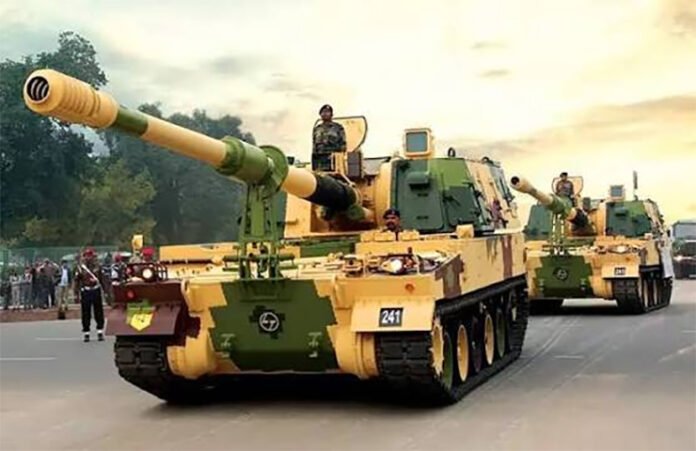
NEW DELHI. The Indian Army is advancing plans to procure an additional 300 K9 Vajra self-propelled howitzers, marking its largest-ever artillery acquisition in decades to drastically boost mobile firepower along tense border frontiers.
In a massive step toward long-range artillery standardisation, the Indian Army has laid the groundwork for a mega-defence deal estimated at roughly ₹23,000 crore. The proposed acquisition of 300 additional units will scale up the Army’s total fleet of K9 Vajra tracked self-propelled howitzers to 500 guns.

The force initially inducted 100 of these heavy artillery systems under a 2017 contract and subsequently pursued an additional 100 systems. This newest, largest-ever expansion aims to equip approximately 25 artillery regiments, significantly exceeding numbers originally planned under the military’s Field Artillery Rationalisation Plan.
Lethal Firepower & Technological Features
The K9 Vajra is a formidable 155 mm/52-calibre tracked self-propelled artillery gun system designed for devastating precision strikes. Built on a heavily armoured tracked platform, the system thrives in harsh terrains – ranging from barren deserts to high-altitude mountain regions – boasting a maximum operational speed of 67 km/h and an active combat range of 480 km.
The core strength of the Vajra lies in its advanced fire-control and automated loading systems:
- Long-Range Destruction: It delivers precision hits at a distance of over 40 km using standard ammunition, which stretches up to 54 km using extended-range, rocket-assisted projectiles.
- Rapid Burst Fire: The platform can unleash a crushing three-round burst in just 15 seconds.
- Simultaneous Impact: It fully supports Multiple Round Simultaneous Impact (MRSI) capabilities, allowing a single gun to fire successive shells at varying trajectories so they all strike the same target at the exact same moment.
Crucially, the system features a specialised “shoot-and-scoot” capability. It can halt, fire an array of rounds within 30 seconds, and completely relocate in under a minute, heavily neutralising the threat of retaliatory enemy counter-battery fire.

From Desert Sands to the High-Altitude of Ladakh
The K9 Vajra was initially acquired to bolster rapid strike formations across plains and desert terrain, particularly along the western borders. However, its strategic operational profile shifted dramatically following the 2020 military standoff with China along the Line of Actual Control (LAC).
Prompted by emergency security requirements, the Indian Army deployed the howitzers to the gruelling alpine climate of eastern Ladakh. Following successful trials, the platform received critical cold-weather modifications, including specialised winterisation kits to ensure the engine, electronics, and hydraulic fluids function flawlessly in sub-zero Himalayan temperatures. The platform’s resilience in Ladakh proved that the heavy tracked system is versatile enough to dominate both the western and northern theaters.

Mainstreaming ‘Make in India’
The multi-billion-crore project stands as a major victory for India’s Aatmanirbhar Bharat defence initiative. Originally developed by South Korea’s Hanwha Aerospace, the K9 Vajra is licensed and assembled locally by Larsen & Toubro (L&T) at its specialised armoured systems complex in Hazira, Gujarat.
The production programme incorporates substantial domestic manufacturing, encompassing 14 major sub-systems developed entirely within India – including the main fire-control system, communications networks, the gunner’s primary sight, and onboard Nuclear, Biological, and Chemical (NBC) crew protection systems.
By value, local components already comprise over 50% of the platform, and the upcoming massive order of 300 units is expected to push indigenous content even further while sustaining India’s defence industrial base.






