


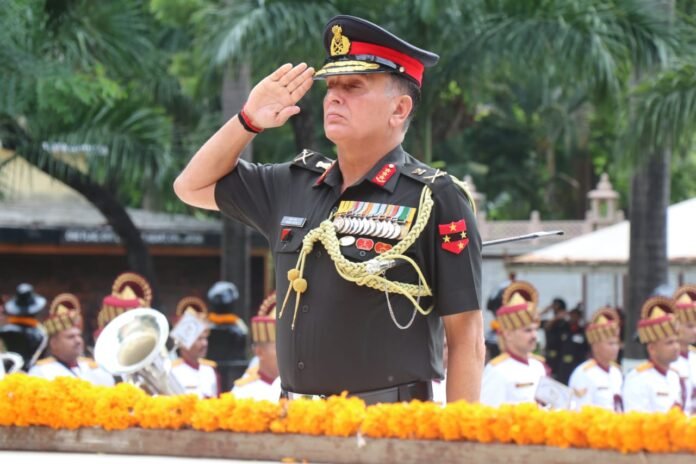
In the annals of Indian military leadership, few transitions carry the weight of symbolic and substantive continuity as the assumption of command by General Dhiraj Seth as the 31st Chief of the Army Staff on June 30, 2026. An alumnus of the National Defence Academy and a distinguished Armoured Corps officer – the first from that arm in nearly three decades to lead the force – General Seth inherited a landscape defined by persistent two-front challenges, hybrid threats, technological disruption and the imperatives of multi-domain operations. His immediate articulation of the vision encapsulated in “JAI Leads to VIJAY” represents both a rhetorical bridge to the political leadership’s priorities and a structured operational roadmap.
VIJAY, evoking the Sanskrit term for victory and resonant with the successful outcomes of Operation Vijay (Goa, 1961; Kargil, 1999), expands Prime Minister Narendra Modi’s JAI framework – Jointness, Aatmanirbharta (self-reliance) and Innovation – into a five-pillar construct tailored for the Indian Army: Vigilance (readiness), Innovation and Transformation, Jointness and Integration, Capability Development and Yodha (soldier) first.

In this backdrop, let’s explore whether VIJAY constitutes primarily catchphrase branding – memorable, politically aligned and morale-boosting – or a substantive deliverance benchmark capable of addressing structural deficiencies and positioning the Army for victory in future conflicts.
Strategic Context: A Force in Transition
India’s security environment in 2026 remains characterised by contested borders with China along the Line of Actual Control (LAC) and persistent threats from Pakistan, compounded by grey-zone tactics, cyber vulnerabilities, and the proliferation of unmanned systems. The Army, traditionally manpower-intensive, must evolve amid budgetary pressures, where revenue expenditure (personnel and maintenance) competes with capital outlays for modernisation.
General Seth’s background commanding operational formations on the Western Front equips him with insights into mechanised warfare, logistics in challenging terrain and the need for rapid technological absorption. His vision explicitly credits JAI as the foundation, positioning VIJAY as an evolution rather than rupture. Southern Command’s prior “JAI se Vijay” initiatives, including seminars and exercises emphasising military-civil fusion, provided fertile ground for this articulation.
Unpacking the Pillars: From Rhetoric to Operational Reality
Vigilance and Readiness form the foundational imperative. In high-altitude Himalayan deployments and desert sectors, constant alertness against infiltration and surprise remains paramount. Lessons from the 1999 Kargil War – where intelligence and coordination gaps were exposed despite ultimate success – underscore the need for AI-driven surveillance, real-time analytics and proactive border management. Today, this pillar demands integration of multi-domain awareness, encompassing cyber, electromagnetic spectrum and information domains.

As the 31st Chief of the Army Staff, General Dhiraj Seth’s “JAI Leads to VIJAY” vision translates Prime Minister Modi’s top-level directives into a concrete five-pillar roadmap for the Indian Army. This analysis examines whether VIJAY (Vigilance, Innovation, Jointness, Capability Development, and Yodha First) is a politically aligned rallying cry – or a substantive benchmark equipped to overhaul Indian military readiness against two-front hybrid threats
Innovation and Transformation align with global shifts toward network-centric and software-defined warfare. The Army’s Compendium of Technological Challenges targets unmanned systems, AI, quantum technologies and directed energy weapons. General Seth’s armoured expertise positions him to champion next-generation main battle tanks, networked artillery, swarm drones and doctrinal evolution toward agile, theatre-centric operations. Transformation here implies not merely platform upgrades but cultural and procedural shifts to accelerate procurement and technology induction.
Jointness and Integration addresses historical service silos. Progress toward Integrated Theatre Commands (ITCs) has been incremental, with joint exercises and Integrated Battle Groups demonstrating potential. However, bureaucratic, cultural and resource allocation hurdles persist. The Air Force’s concerns over asset allocation and command hierarchies highlight implementation challenges. Full operationalisation of ITCs would represent a generational reform, enabling seamless air-land-sea-cyber synergy essential for multi-domain dominance.

Aatmanirbharta and Capability Development reflects both strategic autonomy and economic necessity. Defence production has surged, with domestic output reaching records and exports climbing dramatically (from modest figures in 2014 to over ₹38,000 crore by FY 2025-26). Platforms like Tejas (indigenous content rising to over 70%), Pinaka, Akash and BrahMos exemplify progress, supported by Defence Acquisition Procedure reforms and positive indigenisation lists. Challenges remain in scaling production, ensuring quality, deepening private sector involvement and securing critical technologies and supply chains.
Yodha First reaffirms the human-centric core. Despite technological emphasis, the soldier -facing prolonged deployments, harsh conditions and information warfare – remains decisive. This pillar encompasses welfare measures, training modernisation, mental health support, habitat improvements and refinements to schemes like Agnipath to balance short-term recruitment with retention of expertise. Prioritising the soldier is not sentimental but a force multiplier in asymmetric and conventional scenarios alike.
Critical Assessment: Branding, Benchmark or Both?
Sceptics may dismiss VIJAY as adept branding. Indian military tradition abounds with evocative slogans – “Jai Hind,” operation codenames – that rally troops and shape public narrative. In a democracy, such communication fosters alignment with political direction and sustains morale. Acronyms are inherently memorable and media-friendly.
Yet, the framework’s coherence and inheritance from JAI suggest deeper substance. It organises disparate initiatives under a unified banner, offering commanders measurable priorities. By linking political vision (“JAI”) to service-level execution (“VIJAY”), it promotes unity of effort. Success stories – Kargil’s demonstration of resilience, indigenisation milestones and growing defence exports – provide momentum.
Built on the foundations of Jointness, Aatmanirbharta and Innovation (JAI), the Indian Army’s new VIJAY framework aims to modernise the force amid shifting geopolitical realities. Explore the structural realities, implementation hurdles, and strategic imperatives that will determine whether this vision successfully bridges political intent with operational victory
At the same time, persistent hurdles temper optimism: slow acquisitions, inter-service turf issues, industrial base limitations and the revenue-capital expenditure imbalance. Theatre commands require sustained political impetus. Aatmanirbharta demands patience as ecosystems mature.
General Seth’s tenure, extending roughly to 2028, will be evaluated on deliverables: accelerated procurement, operational ITCs, fielding of indigenous platforms at scale, Agnipath refinements and enhanced soldier welfare metrics.
Road to Vijay: Actionable Imperatives
For VIJAY to transcend slogan status, several tests loom:
- Doctrinal and Technological Acceleration: Leverage 2026 focus areas in AI and data-centricity; expand industry-academia-military collaboration via the Army Design Bureau.
- Structural Reforms: Prioritise ITC implementation, addressing command hierarchies and infrastructure.
- Logistics and Infrastructure: Bolster border infrastructure for sustained high-altitude and desert operations.
- Manpower Optimisation: Refine recruitment models to retain specialised skills while controlling personnel costs.
- Whole-of-Nation Approach: Deepen civil-military fusion for innovation and self-reliance.
In a region where adversaries pursue asymmetric advantages and numerical superiority, India’s qualitative edge – through innovation, integration and indigenous capabilities – assumes existential importance.
From high-altitude border standoffs to rapid technological disruption, the Indian Army faces a defining transition under its new COAS, General Dhiraj Seth. Dive deep into the five pillars of VIJAY to see how indigenous tech, theatre command integration and a “Soldier First” ethos aim to position India for future multi-domain warfare
Endgame: A Covenant for Victory
General Seth’s VIJAY vision, rooted in the Indian Army’s ethos of sacrifice and professionalism, positions the force at a pivotal juncture. From the 1961 liberation of Goa to the 1999 reclamation in Kargil, “Vijay” symbolises national resolve forged through adversity. The acronym provides the map; rigorous implementation, accountability and adaptability constitute the conquest.
As the Army marches under “JAI Leads to VIJAY,” the nation expects outcomes that match ambition. In defence, victory indeed favours those who are prepared. Execution will determine whether this framework etches itself as a deliverance benchmark in India’s strategic history.

The writer is a defence journalist specialising in military affairs, security policy and defence technology. He reports extensively on operation strategies, defence manufacturing initiatives and geopolitical developments across the Indo-Pacific region. The views expressed are personal and do not necessarily carry the views of Raksha Anirveda





